Al-Dawsari Tells Congress: Countering the Houthis Requires Empowering Yemen’s Government
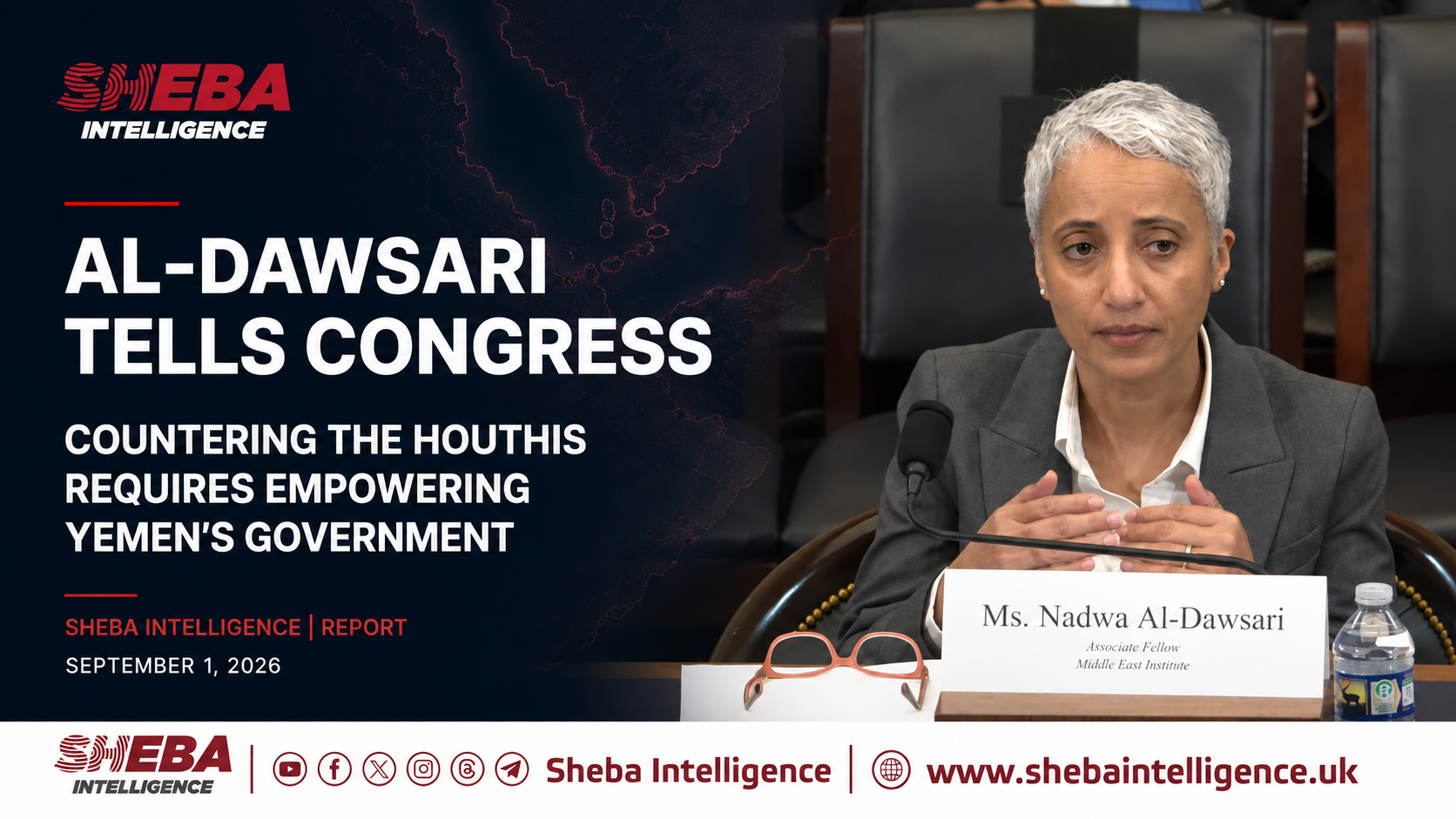
Yemeni-American researcher Nadwa Al-Dawsari has warned US lawmakers that the Houthis have evolved from a localized insurgency into an increasingly autonomous regional military actor, arguing that airstrikes, sanctions and diplomacy alone cannot contain the threat.
Al-Dawsari delivered the assessment on September 1 during a hearing of the US House Foreign Affairs Subcommittee on the Middle East and North Africa titled Countering Houthi Terrorism: Protecting U.S. Interests and Security in the Red Sea.
She attributed the Houthis’ rise to two principal factors: Iran’s sustained investment in their military capabilities and the repeated failure of the United States and the international community to recognize the scale of the group’s ideological, territorial and regional ambitions.
According to her testimony, senior Islamic Revolutionary Guard Corps-Quds Force commander Abdolreza Shahlai was operating in northern Yemen before the Houthis seized Sana’a in 2014, helping oversee recruitment, training, weapons transfers and military operations.
Over the following decade, Iran supplied the group with weapons, technology, training and technical expertise. The Houthis now possess ballistic and cruise missiles, anti-ship missiles, surface-to-air systems, advanced drones, unmanned surface vessels and naval mines. Most of these capabilities, Al-Dawsari noted, did not exist in Yemen before the war.
She said the Houthis have conducted more than 1,800 missile and drone attacks since 2015. Their missiles can reportedly reach targets around 2,000 kilometers away, while some drones have an estimated range of approximately 2,600 kilometers—placing much of the Arabian Peninsula, Israel, US regional forces and shipping in the Red Sea and Bab al-Mandab within reach.
De-escalation Without Leverage
Al-Dawsari argued that international policies designed to reduce the humanitarian consequences of the conflict frequently treated those concerns separately from the political and military dynamics sustaining Houthi power.
Washington, she said, had considerable influence over the Yemeni government and its regional partners, particularly Saudi Arabia and the United Arab Emirates, but little leverage over the Houthis. As a result, international pressure was more effective in restraining the government’s coalition than in obtaining reciprocal concessions from the group.
She cited the 2018 Stockholm Agreement as the clearest example. The deal halted the government-backed offensive toward Hodeidah but failed to secure the intended Houthi withdrawal from the city and its ports.
The result, according to Al-Dawsari, was that the Houthis retained one of their most important strategic assets on the Red Sea, later using their expanding maritime capabilities to threaten international shipping.
She offered a similar assessment of the UN-mediated truce reached in 2022. Although the agreement substantially reduced fighting, the Houthis continued recruiting personnel and developing their missile, drone and maritime capabilities. They subsequently attacked government oil-export terminals, depriving the internationally recognized government of roughly 70 percent of its revenue, according to the testimony.
“Time did not moderate the Houthis,” Al-Dawsari said. “It allowed them to become stronger.”
Airstrikes Disrupted—but Did Not Remove—the Threat
Al-Dawsari acknowledged that US military operations imposed significant costs on the Houthis. Operation Rough Rider in 2025 struck more than 1,000 targets, while US Central Command reported a 69-percent decline in Houthi ballistic missile launches and a 55-percent reduction in one-way drone attacks.
However, she argued that the campaign did not achieve lasting deterrence. Two months after the operation ended under an Oman-mediated US-Houthi ceasefire, the group sank the commercial vessels Magic Seas and Eternity C, killing four seafarers and taking 11 others hostage.
She also highlighted the unfavorable cost balance created by using expensive naval deployments and interceptor missiles against comparatively inexpensive Houthi drones and missiles. Maintaining this approach indefinitely, she warned, could draw Washington into a prolonged war of attrition on terms advantageous to the Houthis.
Civilian casualties create an additional strategic risk. Al-Dawsari cited a Pentagon review that found three US strikes during the 2025 campaign killed 153 civilians and wounded 243. Beyond the human cost, she said, such casualties reinforce the Houthi narrative that the group is defending Yemen against foreign aggression.
A Regional Network Spanning the Gulf of Aden
A central part of Al-Dawsari’s testimony concerned the expansion of Houthi networks beyond Yemen.
She said the group has established decentralized supply chains extending across the Red Sea, the Horn of Africa and the Indian Ocean. These networks allow it to shift routes, suppliers and intermediaries when individual shipments or procurement channels are exposed.
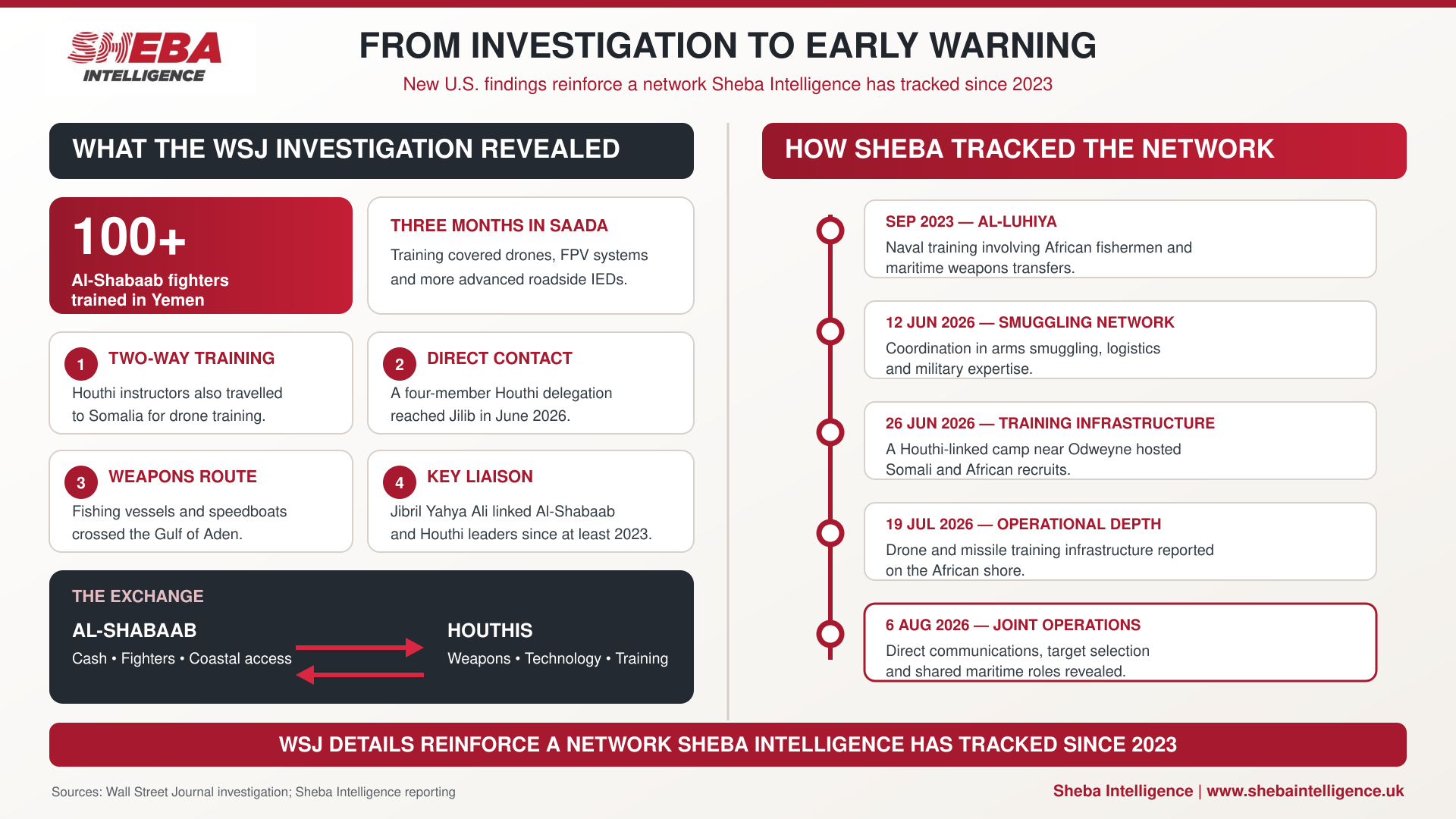
The Houthis are also building human networks across the Horn of Africa, recruiting migrants and local actors as smugglers, facilitators, intelligence assets and fighters, according to her testimony.
Al-Dawsari described growing cooperation with al-Shabaab in Somalia and al-Qaeda in the Arabian Peninsula as particularly concerning. She said hundreds of al-Shabaab members had received military and ideological training in Houthi-controlled parts of Yemen, while Houthi military engineers regularly traveled to al-Shabaab-controlled territory to provide technical instruction in drone adaptation and weapons maintenance.
She cited UN reporting indicating that the Houthis supplied both groups with advanced weapons, including drones, as well as training and technical expertise. The parties have also reportedly discussed cooperation in targeting international shipping.
In Yemen, the Houthis and AQAP have agreed to exchange intelligence, provide sanctuary to one another’s members and coordinate attacks against government forces, according to the testimony. Al-Dawsari also linked the convergence of these networks to the revival of Somali piracy, citing UN reporting that the Houthis and al-Shabaab had discussed using piracy to disrupt shipping in the Gulf of Aden and off Somalia.
More Than an Iranian Proxy
While emphasizing Iran’s central role in building Houthi capabilities, Al-Dawsari cautioned against viewing the group solely as an extension of Tehran.
The Houthis, she argued, have developed their own regional ambitions, capabilities and networks and increasingly see themselves as an independent regional power. Their relationships now extend beyond Iran to Russia and China, including diplomatic protection, commercial links, procurement networks and reported access to targeting support.
She cited interdiction data indicating that approximately 60 percent of the components and materials used in the Houthi Qasef-2K drone originated in China, compared with around 15 percent from Iran.
The group is consequently emerging as a hub where previously separate networks—Iran and the Axis of Resistance, al-Qaeda affiliates, smugglers, criminal organizations and other US adversaries—are beginning to converge.
Empowering the Yemeni Government
Al-Dawsari concluded that the United States “cannot bomb its way out” of the Houthi problem and that diplomacy without meaningful leverage will not resolve it.
The principal source of leverage, she argued, is territory. Houthi control over large population centers, ports, infrastructure and resources allows the group to generate revenue, recruit personnel, manufacture and store weapons, control smuggling routes and rebuild capabilities damaged by airstrikes or sanctions.
She therefore called for a strategy aimed at enabling Yemenis to retake territory from the Houthis. This would not require US ground forces, which she described as unnecessary and counterproductive, but would require American leadership coordinated with regional allies, particularly Saudi Arabia.
Recommended support would include political backing, intelligence, training and military capabilities focused on surveillance and reconnaissance, command and control, counter-drone systems, air defense and maritime security. Assistance should also be tied to improvements in unified leadership, accountability and governance within the Yemeni government.
Airstrikes, sanctions, interdictions and the Houthis’ designation as a Foreign Terrorist Organization would remain part of this approach. But Al-Dawsari argued that these measures must serve a wider strategy aimed at reducing the territorial, economic and military base that enables the group to replenish its arsenal.
“The objective cannot simply be to destroy the next missile or intercept the next drone,” she said. “It must be to reduce the territorial, economic, and military base that allows the Houthis to keep producing them.”