Coalition Intercepts Three Houthi Ballistic Missiles Targeting Riyadh and Khamis Mushait as Widespread Airstrikes Hit Houthi Positions Across Yemen
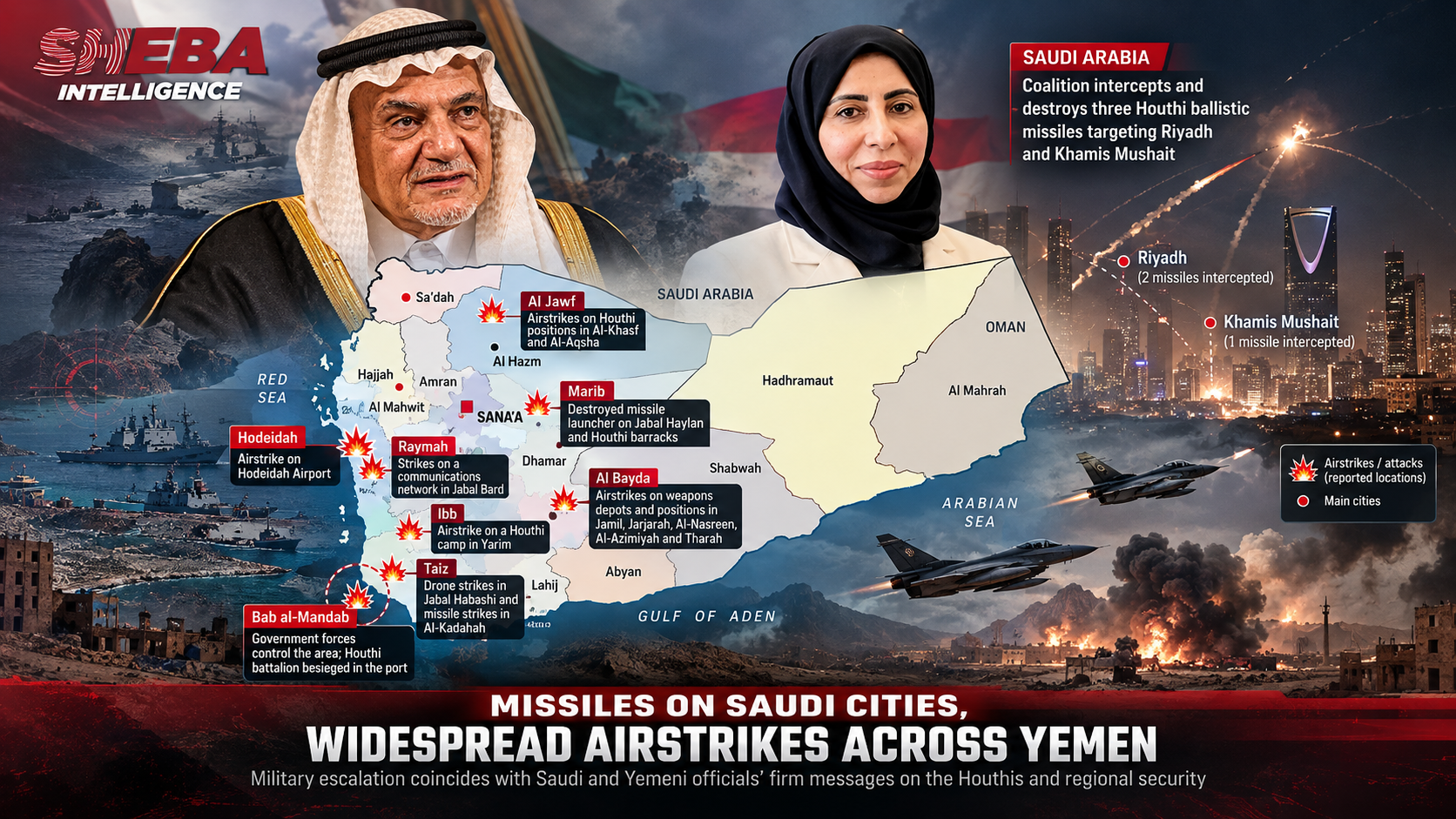
The Saudi-led Coalition to Support Legitimacy in Yemen announced on Thursday that its air defenses had intercepted and destroyed three ballistic missiles launched by the Houthis toward the Saudi capital, Riyadh, and the southern city of Khamis Mushait, marking the latest escalation in cross-border missile attacks against the Kingdom.
The interceptions coincided with extensive airstrikes targeting Houthi military positions, missile launchers, weapons storage facilities, and fortified positions across several Yemeni governorates as part of the ongoing military campaign known as Operation “Dawn of Yemen.”
Coalition spokesman Major General Turki Al-Maliki said air defense systems had intercepted and destroyed two ballistic missiles targeting Riyadh and a third missile launched toward Khamis Mushait.
Saudi Civil Defense authorities reported material damage to a kindergarten and medical clinics in Riyadh after debris from an intercepted Houthi missile fell in the capital, highlighting the risks posed to civilian infrastructure even when incoming missiles are successfully intercepted.
The latest attacks followed a series of Houthi strikes against Saudi facilities and airports in recent days, including King Khalid International Airport in Riyadh and Abha International Airport, as coalition forces intensified operations against missile launch sites and military storage facilities inside Yemen.
Extensive Airstrikes Target Houthi Positions Across Yemen
Meanwhile, the governorates of Marib, Al-Jawf, Al-Bayda, Taiz, Ibb, Hodeidah, and Raymah witnessed a series of airstrikes, drone attacks, and precision missile strikes targeting Houthi military installations, troop concentrations, weapons depots, and communications infrastructure.
In Al-Jawf Governorate, Al Arabiya's correspondent reported that airstrikes targeted Houthi concentrations, trenches, and fortified positions in the Al-Khasf and Al-Aqsha areas west of Al-Hazm, the provincial capital, amid continuing military operations along the governorate's front lines under Operation “Dawn of Yemen.”
In Marib Governorate, field reports indicated that warplanes destroyed a missile launcher positioned atop Mount Haylan. Yemeni combat aircraft also struck a Houthi military barracks below the mountain.
The strikes came as government forces continued simultaneous ground and air operations across several fronts in the governorate.
In Al-Bayda Governorate, Al Hadath's correspondent reported that combat aircraft targeted Houthi weapons depots and military positions across several districts.
The strikes hit locations in the Jamil, Jarjarah, and Al-Nasreen mountains in the Al-Nasif area of Al Humayqan, as well as Mount Al-Azimiyah in Al-Bayda city and the Tharah mountain pass in Mukayras.
Additional airstrikes targeted Houthi positions in Al-Sawiyah, Mukayras, and the Hilmus and Jamil mountains in Al-Zahir District, extending the aerial campaign to mountainous areas where Houthi units maintain military positions.
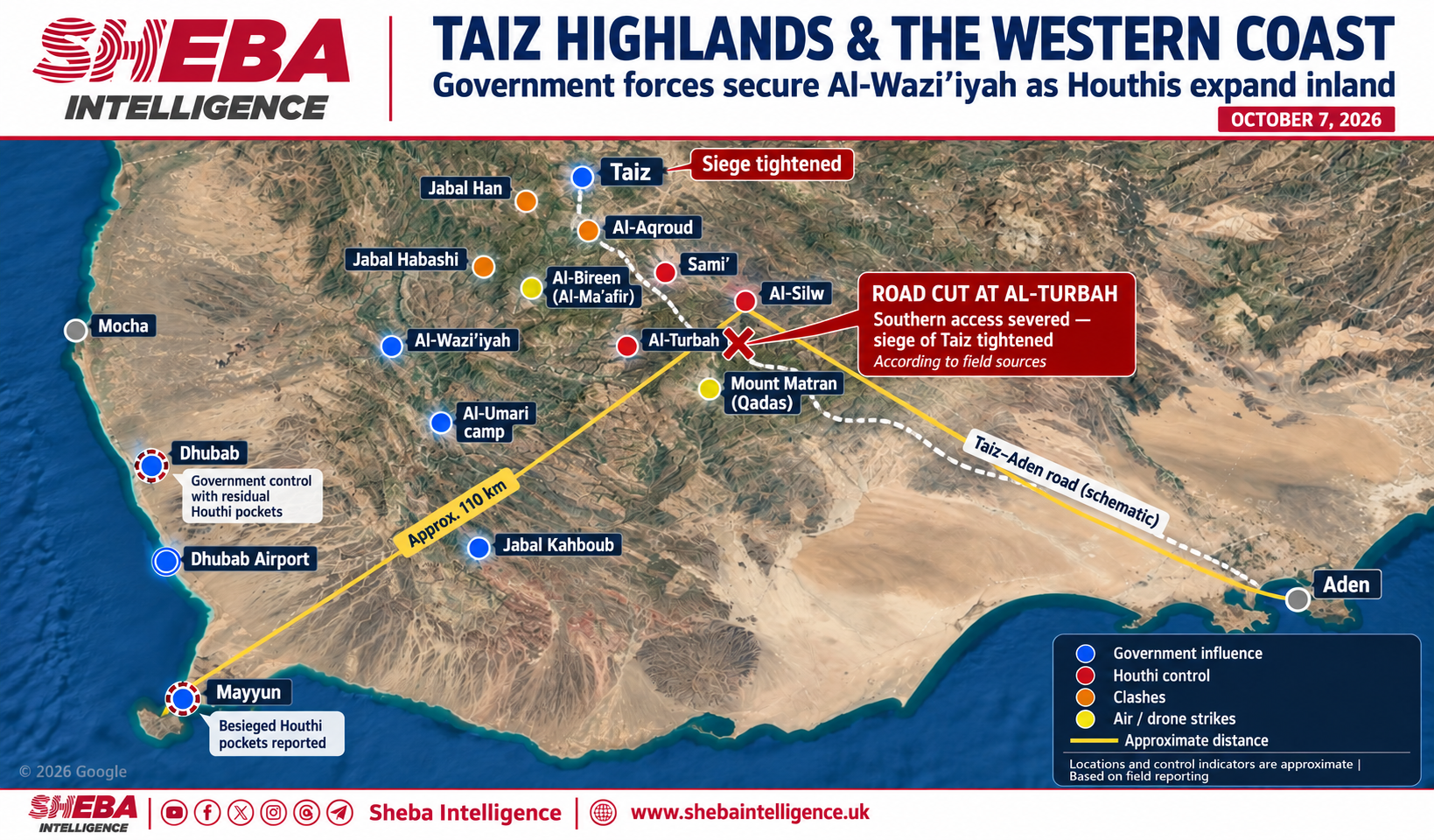
In Taiz Governorate, drones operated by the Yemeni Armed Forces carried out strikes against Houthi fighters in Jabal Habashi District.
Meanwhile, missile units affiliated with the Nation's Shield Forces announced precision strikes targeting Houthi positions and fortifications in the Al-Kadahah area as part of Operation “Dawn of Yemen.”
In Ibb Governorate, airstrikes targeted a Houthi military camp in the Yarim area, northeast of the provincial capital, extending the air campaign beyond the main active front lines.
Along the western coast, an airstrike targeted Hodeidah Airport, while combat aircraft struck a communications network on Mount Bard in Kusmah District of Raymah Governorate.
The reported strikes reflect an expanding air campaign targeting missile-launch capabilities, weapons storage facilities, field fortifications, and military communications infrastructure alongside government ground operations.
Government Forces Consolidate Control of Bab al-Mandab as Houthi Battalion Remains Besieged
In a significant battlefield development along Yemen's western coast, military sources reported that the Giants Brigades and Nation's Shield Forces had consolidated control over the entire Bab al-Mandab area, while a Houthi battalion remained surrounded inside the port.
According to the sources, government forces offered the besieged battalion an opportunity to surrender, with guarantees of safe passage for its personnel.
However, the battalion had not responded to the offer or withdrawn from the port at the time the information was received.
The sources also indicated an unconfirmed possibility that officers from Iran's Islamic Revolutionary Guard Corps (IRGC) were among those surrounded inside the facility. Their presence and identities have not been independently established.
The developments carry considerable strategic significance given Bab al-Mandab's position connecting the Red Sea with the Gulf of Aden and its central role in the ongoing military operations along Yemen's western coastline.
Prince Turki Al-Faisal: Saudi Arabia Is Delivering on Its Commitments to Restore the Yemeni State
On the political front, Prince Turki Al-Faisal, Saudi Arabia's former intelligence chief, reaffirmed the Kingdom's commitment to supporting Yemen's internationally recognized government in restoring state authority and confronting Houthi threats.
In an opinion article published Thursday by Asharq Al-Awsat under the title “A Promised Word and a Desired Deed”, Prince Turki referred to Crown Prince Mohammed bin Salman's address to the Shura Council the previous week, in which he reiterated Saudi Arabia's comprehensive support for the Yemeni government through the Coalition to Support Legitimacy.
That support, he noted, is intended to enable the government to restore its authority throughout Yemen and reestablish stability.
Prince Turki argued that Saudi Arabia had allowed years for diplomatic efforts and peaceful settlement initiatives to prevent further conflict, but repeated Houthi attacks and threats to Saudi national security had led to a new phase of military confrontation.
He linked the launch of military operations and reported Houthi setbacks across several fronts to Saudi Arabia's earlier commitments, alongside Yemeni Presidential Leadership Council Chairman Rashad Al-Alimi's declaration that recapturing the capital, Sana'a, had become a central objective of the campaign.
Prince Turki emphasized that Saudi Arabia had never sought to acquire Yemeni territory and that its support extended beyond military assistance.
He cited recent Saudi directives to regularize the residency status of Yemenis living in the Kingdom without valid documentation, following a request from President Al-Alimi, as an example of the broader Saudi commitment to Yemen.
Yemeni Foreign Minister: Yemen Will Not Become an Iranian Bargaining Chip
In a parallel political statement, Yemeni Foreign Minister Afrah Al-Zouba said the government had entered a new phase aimed at restoring state authority after exhausting opportunities for de-escalation.
Speaking in an interview with Asharq Al-Awsat published Thursday, Al-Zouba stressed that any future political settlement must ensure the restoration of state institutions and place weapons and decisions concerning war and peace exclusively under legitimate government authority.
She said the government had not abandoned the possibility of peace but rejected any arrangement that would allow an armed force to operate outside state institutions.
According to Al-Zouba, Operation “Dawn of Yemen” is intended to end the Houthi takeover and restore national sovereignty.
The foreign minister also linked the restoration of government control over Yemeni territory to international maritime security in the Red Sea and Bab al-Mandab.
She emphasized that protecting commercial vessels at sea would remain insufficient as long as coastal areas could be used to launch attacks against international shipping.
Al-Zouba praised Saudi Arabia's political, military, and economic support, noting that the success of the ongoing operations should be measured not only by territorial gains but also by the restoration of security, stability, and conditions allowing displaced civilians to return home.
She called on the international community to move beyond political statements and provide practical assistance to strengthen the Yemeni government's defense, security, and maritime capabilities.
She also urged stronger enforcement of United Nations Security Council Resolution 2216, particularly its arms embargo provisions, to prevent military supplies from reaching the Houthis, including shipments originating from Iran.
Al-Zouba stressed that Yemen would not be used as an Iranian bargaining chip in regional conflicts, while highlighting continued coordination with the United States and international partners on security, stability, and the protection of maritime routes.
Background: Operation “Dawn of Yemen” Expands With Coalition Air Support
The latest military and political developments follow the announcement by Presidential Leadership Council Chairman Rashad Al-Alimi on October 4 of the launch of military operations to retake areas under Houthi control and restore state authority throughout Yemen.
On October 5, the Saudi-led coalition announced that 100 fighter aircraft had participated in the opening phase of Operation “Dawn of Yemen,” destroying 324 high-value military targets.
The coalition also confirmed that continuous air support would be provided to government forces, alongside measures to secure the airspace and maritime approaches around the Bab al-Mandab Strait.
Since the operation began, the front lines in Marib, Al-Jawf, Taiz, Saada, Hajjah, and the western coast have witnessed simultaneous ground offensives and aerial operations.
Meanwhile, airstrikes have expanded to Houthi military installations in other governorates, as the group continues launching ballistic missiles toward Saudi territory.
The developments underscore the increasingly interconnected nature of the military campaign in Yemen, cross-border missile escalation against Saudi Arabia, and the security of international shipping through Bab al-Mandab.
They also coincide with Riyadh's renewed commitment to supporting the restoration of Yemeni state institutions and the Yemeni government's insistence that decisions over weapons, war, and peace must ultimately return to legitimate state authority.