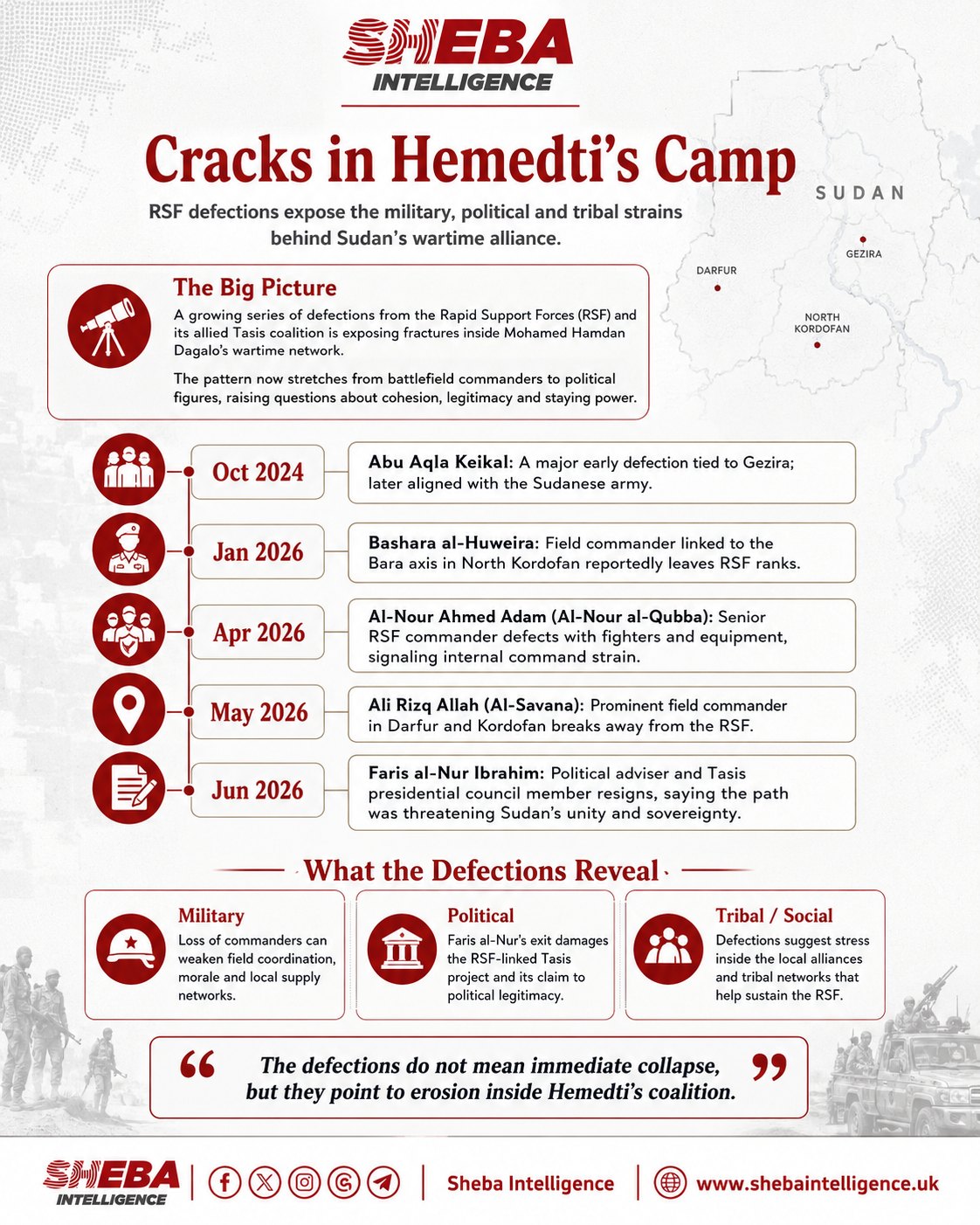
A widening wave of defections from Sudan’s Rapid Support Forces and its political umbrella, the “Tasis” alliance, is raising new questions about the cohesion of Mohamed Hamdan Dagalo’s coalition as the war enters a more fragmented and dangerous phase.
The latest blow came with the resignation of Faris al-Nur Ibrahim, a former political adviser to Hemedti, from the presidential council of the Tasis alliance and from his position as governor of Khartoum region in the RSF-linked parallel administration. His departure is significant because it moves the defection trend beyond the battlefield and into the political structure that the RSF has tried to use as a governing alternative in areas under its influence.
Al-Nur said he had initially supported Tasis as a temporary transitional project aimed at serving civilians, preserving institutions and preparing the ground for peace. But he later concluded that the project had shifted away from those goals and was moving toward a path that threatened Sudan’s unity, sovereignty and independence.
His resignation follows a series of high-profile military defections that have hit the RSF since late 2024. The first major symbolic rupture came in October 2024, when Abu Aqla Keikal, a commander associated with Gezira State and the Sudan Shield Forces, defected to the Sudanese army. His move was treated by the army as both a military and psychological gain, particularly because Gezira had become one of the central battlegrounds of the war.
The trend intensified in 2026. Major General al-Nour Ahmed Adam, known as al-Nour al-Qubba, defected from the RSF in April and joined the Sudanese Armed Forces. He was one of the highest-ranking RSF commanders to leave the group, reportedly moving from Darfur with fighters and military equipment. His defection was linked in several reports to internal disputes over command roles, especially after the RSF expanded its control in parts of Darfur.
In May, another major field commander, Ali Rizq Allah, known as al-Savana or al-Safana, also broke away from the RSF. He had been involved in operations in Darfur and Kordofan, two regions that form the RSF’s strategic and social depth. Around the same period, field commander Bashara al-Huweira was also reported among the figures who left RSF ranks in North Kordofan, particularly around the Bara axis.
Taken together, these defections suggest that the RSF’s problem is no longer limited to isolated battlefield losses. They point to pressure inside the alliance itself: tribal networks, field commanders, political partners and regional power brokers are reassessing the costs of remaining tied to Hemedti’s project.
The military implications are serious. The RSF has long relied on flexible local alliances, tribal mobilisation and semi-autonomous field commanders to sustain operations across Darfur, Kordofan, Khartoum and central Sudan. When such commanders defect, they may take with them not only fighters and vehicles, but also local knowledge, tribal channels, supply routes and morale.
The political implications may be even more damaging. Through Tasis, the RSF attempted to convert military control into political authority, presenting itself as part of an alternative civilian-administrative project. The resignation of Faris al-Nur weakens this narrative. Unlike commanders who left military fronts, al-Nur’s departure strikes at the political legitimacy of the RSF-linked administration and raises doubts about whether Tasis can survive as more than a wartime façade.
The defections also reflect a deeper moral and legal pressure. The RSF and allied militias face widespread accusations of atrocities, ethnic violence, sexual violence, looting and attacks on civilians, particularly in Darfur, Khartoum and Kordofan. For some political figures and local allies, remaining inside the RSF camp may now carry reputational and legal risks that outweigh the benefits of wartime alignment.
However, the defections do not yet amount to an immediate collapse of the RSF. The group still retains strong positions in Darfur and parts of Kordofan, and continues to operate through decentralized military networks. But the cumulative effect of defections is politically corrosive. Each departure signals to other allies that the coalition around Hemedti may no longer be as durable as it appeared at the start of the war.
The timing is also important. International concern is rising over possible RSF escalation around al-Obeid in North Kordofan, a strategic city with hundreds of thousands of civilians. If the RSF pushes further toward the city while losing commanders and political allies, the group may face a dual challenge: sustaining battlefield momentum while containing internal fragmentation.
The broader picture is that Hemedti’s alliance is being tested on three fronts at once: militarily, through the loss of commanders and local networks; politically, through cracks in the Tasis project; and socially, through tensions inside the tribal and regional alliances that helped build the RSF’s wartime power.
For now, the defections are best understood not as the end of the RSF, but as a sign of erosion. The force remains dangerous and capable, but its coalition is no longer immune to fragmentation. From Keikal to al-Qubba, al-Savana and Faris al-Nur, the pattern shows that Sudan’s war is not only being fought between the army and the RSF; it is also being fought inside the alliances that keep both sides alive.