Drones with Advanced Technology and Guided Munitions Emerge in Yemeni Army Operations Near Bab al-Mandab
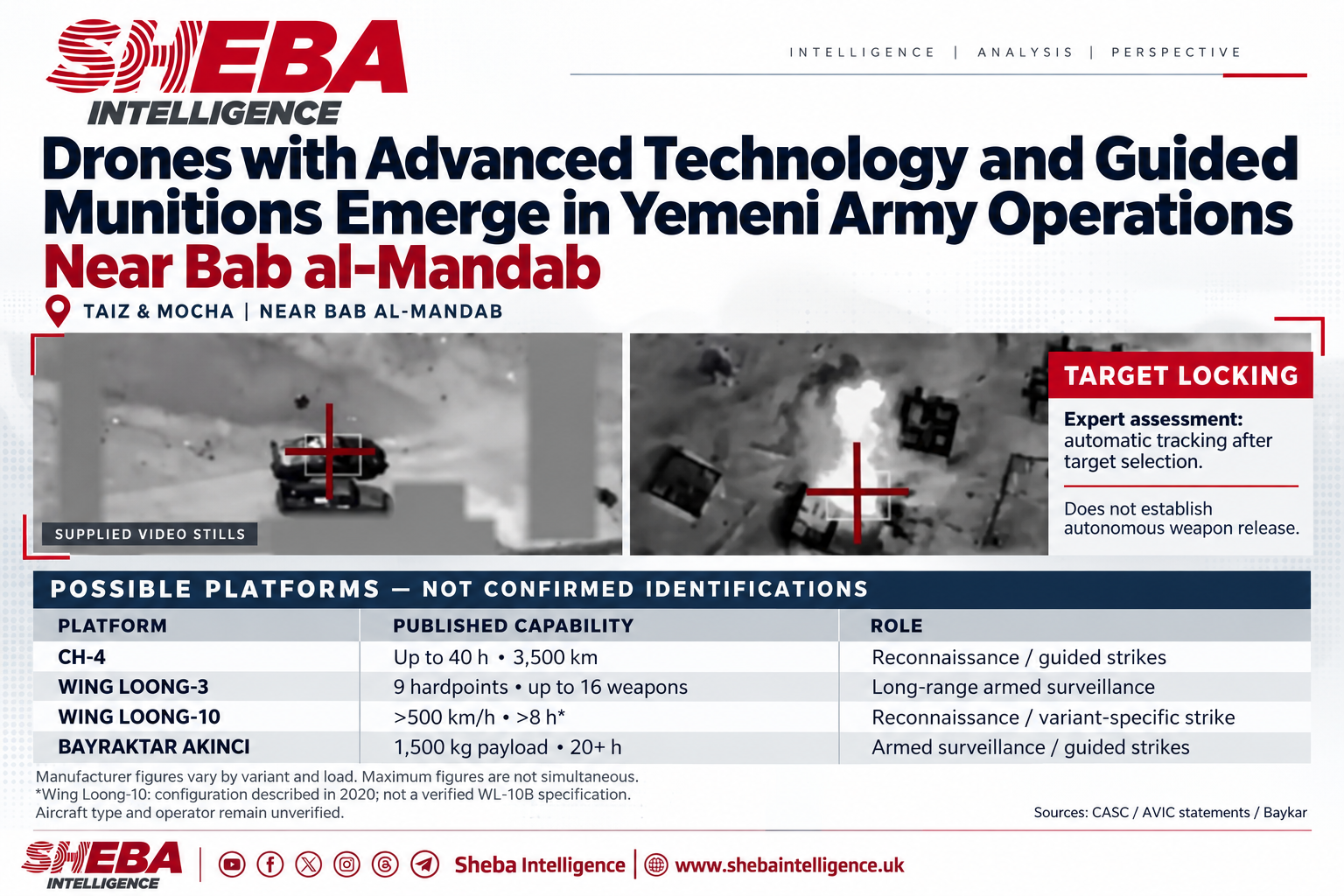
The Yemeni army has released footage of drone strikes targeting positions in Taiz and Mocha, near Bab al-Mandab, using precision-guided munitions. An expert speaking to Sheba Intelligence said the footage indicates the use of advanced systems capable of locking onto targets and tracking them automatically.
According to the expert’s assessment, the video shows signs of target-locking technology, which allows an aircraft’s surveillance system to maintain a lock on a stationary or moving target once selected. Cameras and sensors then track the target automatically, reducing the need for continuous manual adjustments by a ground operator. This does not mean the decision to release a weapon is automated.
The expert said these features are consistent with capabilities available on advanced combat drones such as China’s CH-4, Wing Loong-3 and Wing Loong-10, and Türkiye’s Bayraktar AKINCI. Similarities in surveillance and tracking technology, however, are insufficient to establish that any of these aircraft carried out the strikes.
The expert assessed that the footage points to a class of armed drones with capabilities beyond those of the tactical systems that dominated earlier army operations. He said he had not previously identified this class in published footage of operations in Taiz and Mocha.
If confirmed, the assessment would suggest an expansion of the air support available to government forces, from reconnaissance, artillery fire correction and small-drone attacks to platforms combining prolonged surveillance, automated tracking and precision-guided strikes.
The aircraft type and the munitions used have not been independently verified. Available information also does not establish whether the drones are operated by the Yemeni army or by another party providing air support.
From Tactical Support to Long-Range Strikes
Previous Sheba Intelligence investigations documented government forces using drones for reconnaissance, target identification, artillery fire correction and munition drops across several fronts. The reporting included a Chinese G50platform assessed as having been adapted for combat, alongside five platforms displayed by the Nation Shield Forces, indicating an emerging tactical capability for reconnaissance and battlefield support.
In its reporting on long-range strike capabilities, Sheba Intelligence identified aircraft displayed under the names “Ayban” and “Nuqum” as belonging to the SKYWASP family. On September 18, the platform reported their use in strikes around Sana’a, citing a military source and analysis of video footage. These one-way attack drones differ from recoverable armed aircraft that release guided munitions—the category the expert believes may be involved in the latest operations.