Exclusive: Houthis Activate Maritime Blockade Center as Saudi-Linked Shipping Ban Takes Effect
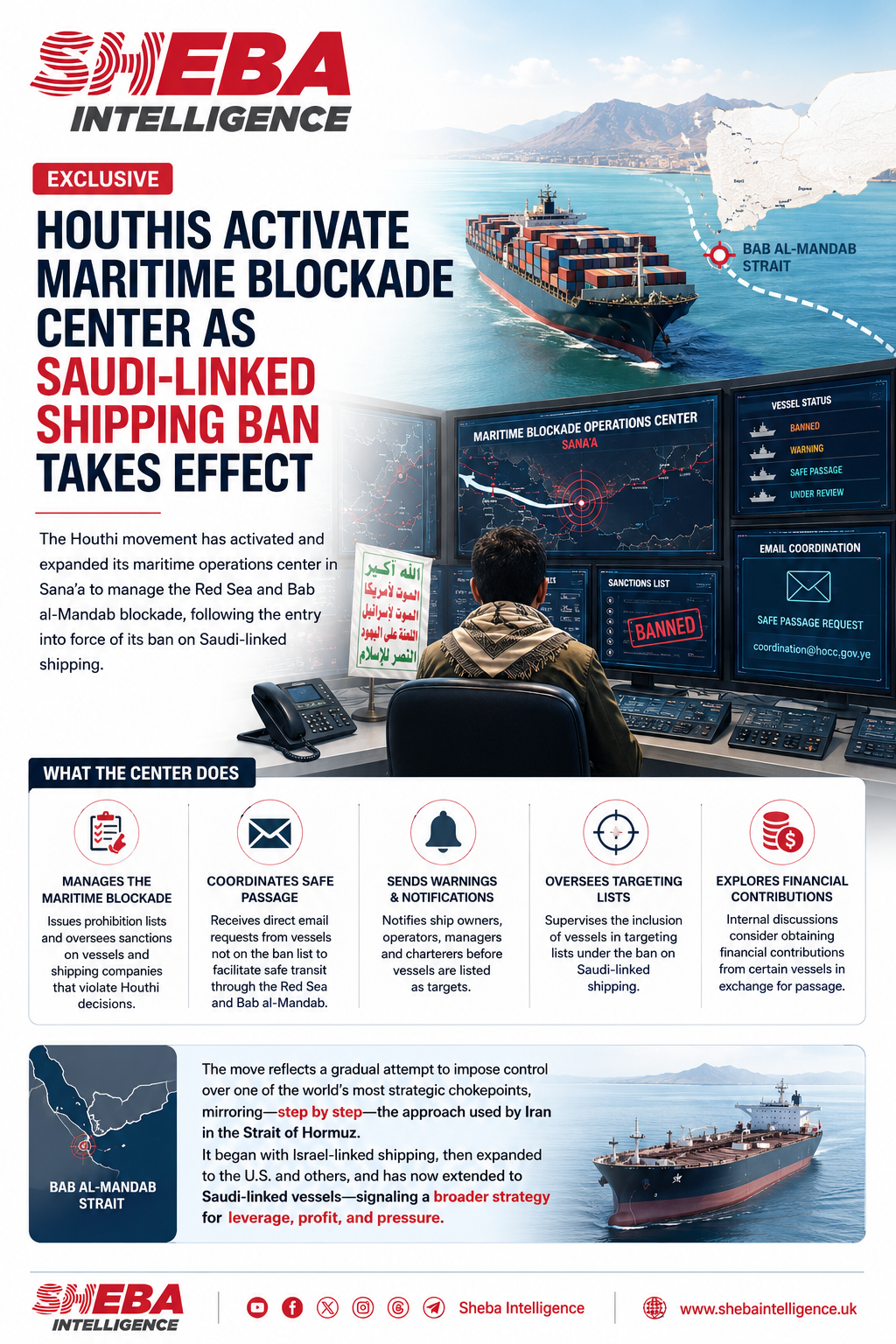
According to information obtained by Sheba Intelligence, the Houthi movement has expanded the activation of its Red Sea and Bab al-Mandab maritime operations center as its ban on Saudi-linked shipping enters into effect, marking a shift from military threats toward a more organized system for administering the blockade.
Sources said the Sana’a-based center is now responsible for managing prohibition lists, overseeing the classification of vessels and companies deemed to be in violation of Houthi directives, and sending warnings and notifications to shipowners, operators, managers, and charterers before their vessels are added to targeting lists.
The center also receives direct coordination requests by email from commercial vessels not covered by the ban, with the stated purpose of facilitating what the Houthis describe as “safe passage” through the Bab al-Mandab Strait and the Red Sea. This arrangement reflects an effort to combine military pressure with an administrative mechanism designed to regulate maritime traffic according to rules imposed by the group.
Sources further said internal discussions have considered the possibility of securing financial contributions or other forms of support from certain vessels in return for facilitating their passage, particularly ships whose ownership structures or commercial affiliations remain unclear. The proposals have not yet been formally adopted, but their consideration points to an effort to derive benefits from maritime control beyond immediate military objectives.
The center builds on mechanisms previously used during Houthi campaigns against vessels linked to Israel, and later the United States and the United Kingdom. Its expanded activation alongside the Saudi shipping ban suggests that the group is seeking to establish a more permanent structure for exerting pressure on international navigation, rather than relying solely on attacks and public threats.
The emerging model appears intended to give the Houthis increasing influence over traffic through the Bab al-Mandab by combining blacklist management, direct communication with shipping companies, advance warnings, and selective passage coordination. It may also create the basis for extracting future political, financial, or commercial benefits from vessels seeking to avoid disruption or attack.
This gradual expansion points to a broader attempt to turn the Bab al-Mandab into a tool of regional leverage, in a manner that increasingly resembles Iran’s use of its position around the Strait of Hormuz. While the Houthi system remains less developed, its trajectory suggests a long-term effort to move from disruption toward a form of coercive control over one of the world’s most strategically important maritime chokepoints.
The center’s expanded activation coincides with a rapidly escalating maritime confrontation. Following the Houthi announcement of a ban on Saudi-linked shipping, commercial vessels associated with Saudi Arabia were targeted in the Red Sea, triggering Coalition airstrikes against Houthi military sites and launch positions in Yemen. Against this backdrop, the activation of the center appears intended to provide a permanent administrative framework for managing future maritime restrictions, coordinating communications with commercial shipping, and supporting the group’s broader effort to institutionalize its influence over navigation through the Bab al-Mandab Strait.