Fateh-110 Debris Links Houthi Attacks on Mokha to Iran’s Missile Program
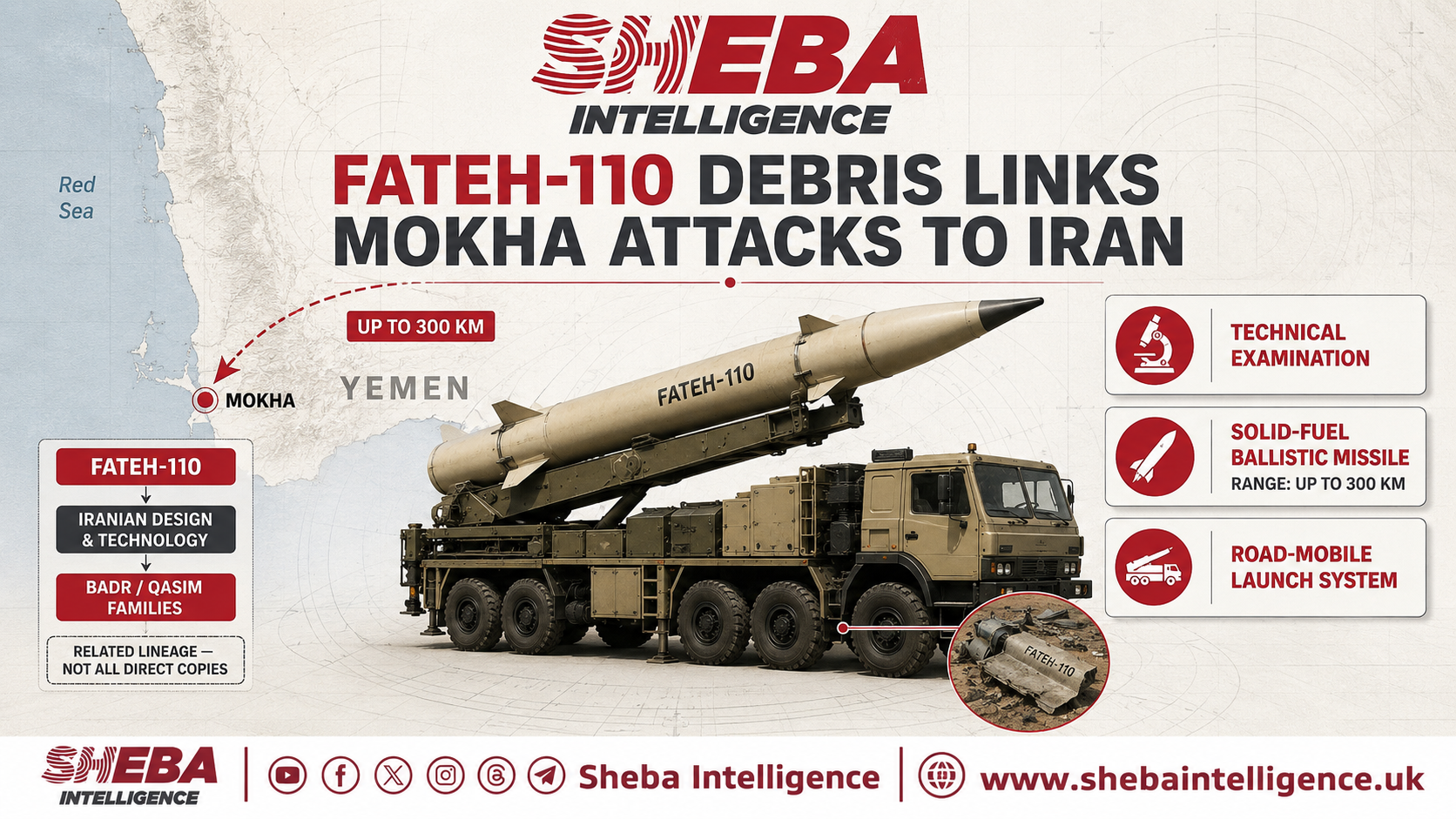
Technical examinations of missile debris recovered after recent Houthi attacks on Mokha, its port and Yemen’s western coast identified the weapons as Iranian Fateh-110 ballistic missiles, according to National Resistance spokesman Maj. Gen. Sadiq Dowaid.
Dowaid said the missiles use solid fuel, have a range of up to 300 kilometres and can be fired from mobile launchers or concealed commercial trucks. The findings reinforce earlier evidence that Iran’s support for the Houthis extends beyond the transfer of components and technical expertise to missile systems derived from established Iranian programs.
No photographs, serial numbers or detailed forensic results have been released publicly. Independent verification would require examination of the recovered engines, guidance units, structural components and manufacturing marks to determine whether the weapons were complete Iranian-built Fateh-110 missiles or closely related systems assembled in Yemen.
A Mobile Precision-Strike System
The Fateh-110 is a single-stage, road-mobile ballistic missile developed by Iran for short-range precision strikes. Its principal variants have a range of between 200 and 300 kilometres and can carry a warhead weighing approximately 500 kilograms.
Solid-fuel propulsion reduces the preparation time required before launch compared with liquid-fuel missiles. Mobile platforms also allow firing units to relocate rapidly, limiting the time available to detect and target them.
These characteristics make the Fateh-110 suitable for attacks on military bases, command centres, ports, logistics facilities and other fixed targets within the Yemeni theatre. Its range allows the Houthis to strike Mokha from launch areas well inside territory under their control without deploying launchers close to active frontlines.
The reported identification corresponds with an earlier Sheba Intelligence investigation into Houthi missile capabilities, which documented the development of a layered missile arsenal using Iranian weapons, components, designs and technical support.
Badr and Qasim: Two Different Development Paths
The Badr and Qasim families should not be treated as a single missile lineage.
The Badr series belongs to a category of relatively low-cost, short-range battlefield rockets that were progressively upgraded with guidance and airburst capabilities. The original Badr-1 was an unguided rocket, while the Badr-1P introduced a guidance system. The Badr-F added an airburst fragmentation warhead designed to detonate above the target and disperse shrapnel over a wider area.
Some characteristics of the Badr family resemble the broader development of large-calibre artillery rockets in China, Syria and Iran. The Syrian M-302, for example, was derived from China’s unguided 302 mm WS-1 system and produced in variants with ranges of approximately 100–150 kilometres.
However, available forensic evidence does not establish that the Houthi Badr-1 is a direct copy of the M-302. The two systems also differ in calibre. Published technical assessments generally describe Badr missiles as locally manufactured systems incorporating external design knowledge and Iranian guidance technology.
UN experts previously examined wreckage from a Badr-1P and found that parts of its body had been produced locally using industrial steel piping. The finding supports the assessment that the Houthis manufacture or assemble parts of the Badr series inside Yemen rather than receiving every missile as a complete imported weapon.
The Qasim-1 and Qasim-2 follow a different development path and show a closer relationship to Iran’s solid-fuel Fateh missile family. Their configuration, propulsion and mobile-launch concept indicate Iranian design influence followed by local adaptation.
They can therefore be described as Fateh-derived or Fateh-influenced systems. Identifying them as exact copies of the Fateh-110 would require detailed comparison of their engines, guidance units and structural components. Publicly available evidence also does not confirm that both Qasim variants have an identical range of 300 kilometres.
Why These Missiles Were Chosen
The selection of short-range solid-fuel missiles for the current campaign appears operationally deliberate.
Mokha, Marib and other targets inside government-controlled territory fall within the effective reach of tactical missile systems launched from Houthi-held areas. The Houthis therefore do not need to expend longer-range weapons to attack these locations.
Short-range systems are also less expensive to manufacture, assemble and replace than strategic missiles such as Zolfaghar, Palestine, Shahab or Kheibar Shekan. Their use allows the group to sustain repeated attacks while preserving longer-range systems for targets in Saudi Arabia, Israel or the wider Red Sea theatre.
The frequency of recent strikes indicates either the existence of a usable stockpile or a continuing capacity to assemble and prepare short-range missiles. The size of that inventory cannot be determined without reliable information on storage sites, production rates and the number of operational launchers.
Guidance modifications have increased the value of these weapons. Rockets originally designed for attacks on broad areas can be equipped with navigation, flight-control and correction systems that improve their ability to hit ports, military compounds and other fixed targets.
Solid-fuel propulsion also reduces launch-preparation time, while mobile launchers allow firing units to disperse, conceal their equipment and relocate quickly after an attack. The two missile families can perform different operational roles: the Badr-F’s airburst fragmentation warhead is suited to troop concentrations and exposed facilities, while Qasim-family missiles are better suited to fixed targets requiring greater accuracy and destructive power.
This combination of adequate range, lower cost, mobile deployment and improved accuracy makes short-range missiles more suitable for a sustained campaign against Mokha and Marib than strategic weapons designed for distant regional targets.
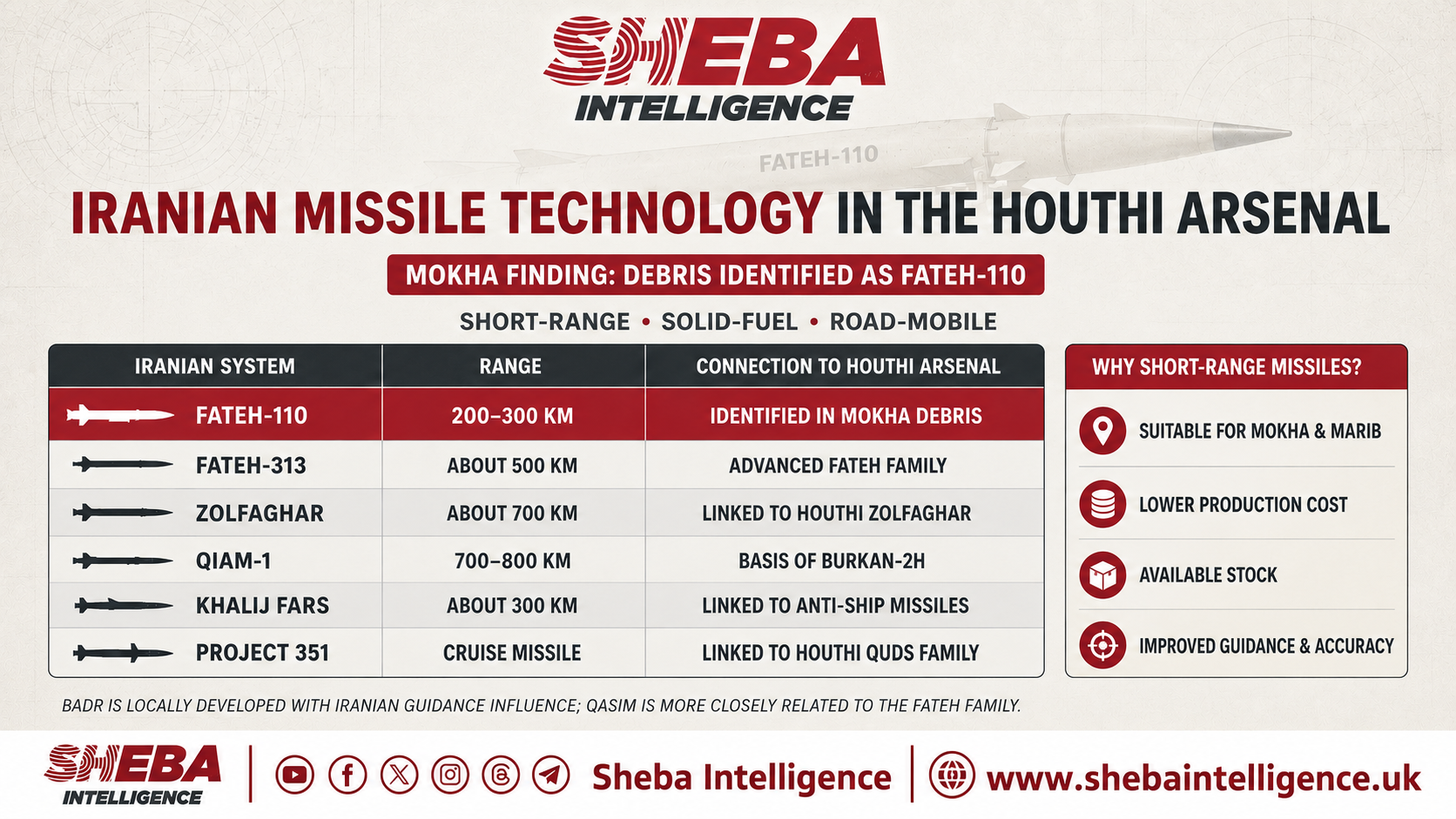
The Houthi missile force is based on several parallel supply and development channels. It includes complete Iranian systems or major imported sections, critical components transferred through smuggling networks, and missiles manufactured or assembled locally with Iranian technical assistance.
The reported identification of Fateh-110 debris in Mokha, combined with the continued use of Badr- and Qasim-family missiles, points to a deliberate reliance on short-range solid-fuel systems during the current escalation. These weapons provide sufficient range to strike Mokha and Marib, cost less than strategic missiles and can be deployed repeatedly from mobile or concealed launch positions.
Their improved accuracy has transformed them from battlefield rockets into weapons capable of sustaining pressure on ports, command centres, military facilities and other critical infrastructure while allowing the Houthis to preserve longer-range missiles for regional operations.