Food Insecurity and Agricultural Challenges in Yemen (Video)
Millions of Yemenis suffer from food insecurity due to the war that has continued for over eight years in Yemen. The war has devastated the economy, making hunger and malnutrition the most urgent challenges in Yemen. According to United Nations reports, more than 17.3 million Yemenis suffer from food insecurity, and 51% of children and 24% of women need treatment for acute malnutrition.
In light of this dilemma and the disrupted import chains due to the Russian war in Ukraine, questions about the reality of agriculture in Yemen seek answers. This report presents the reality of agriculture in Yemen and the degree of impact of the war on it.
Agriculture in Social, Economic and Productivity Indicators
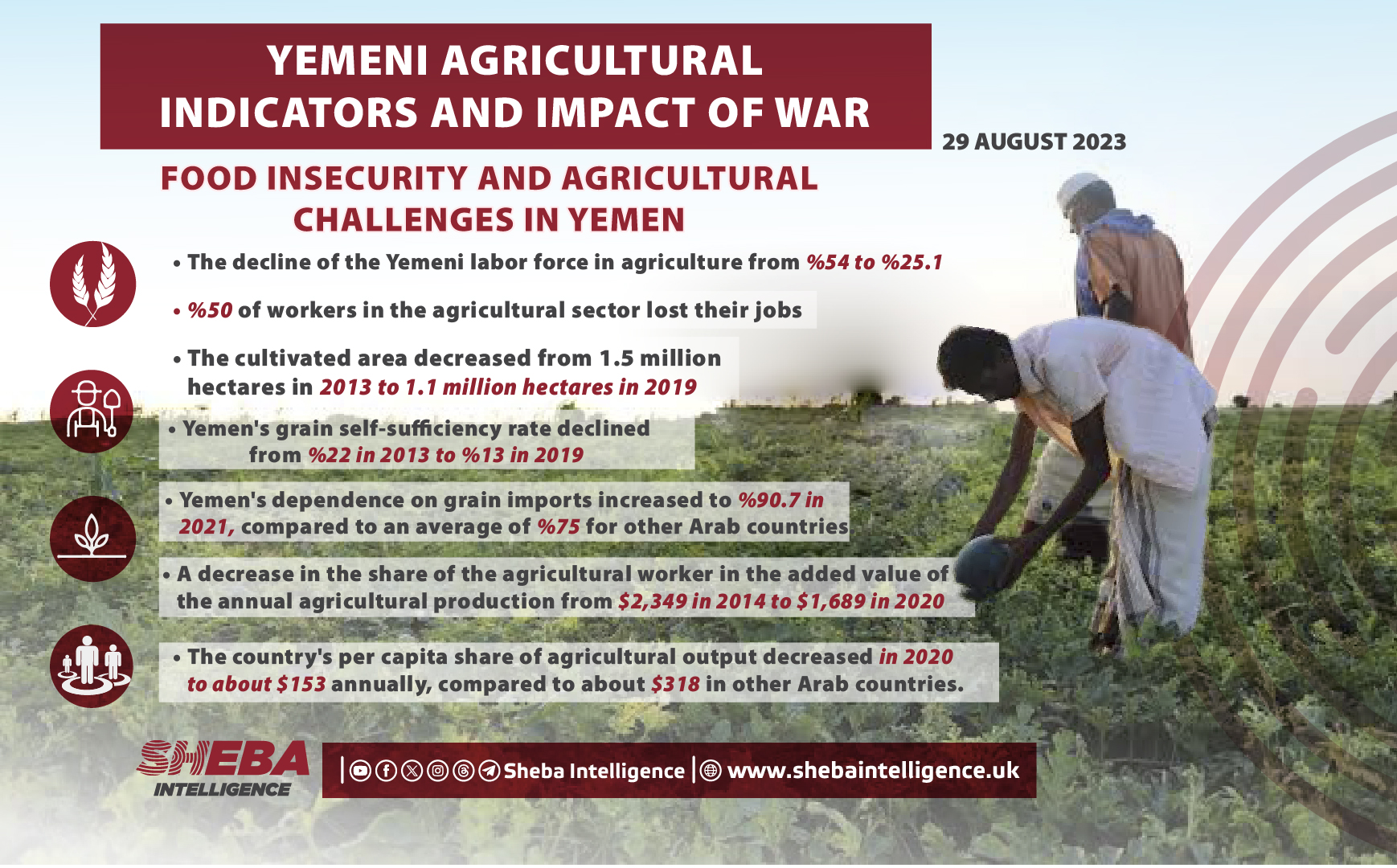
Although 73.5% of the population in Yemen consider agriculture their primary source of income, only 25.1% of the Yemeni labor force worked in the agricultural sector in 2019, compared to about 54% of the labor force in the country in 2014.
During the war, 50% of workers in the agricultural sector lost their jobs because of the conflict. The number of agricultural holders in 2020 reached 1,191,981 holders 1, the same number as in 2014.
The size of the cultivated area of cultivated vegetable crops declined from 1.5 million hectares in 2013 to less than 1.1 million hectares in 2019 out of 1,452,438 arable hectares. Yemen's grain self-sufficiency rate dropped from 22% in 2013 to 13% in 2019, which raised Yemen's dependence on grain imports to 90.7% in 2021, compared to an average of 75% for the rest of the Arab countries.
The previous indicators were reflected in the agricultural sector's contribution to Yemen's economy, as the agricultural worker's share of the added value of the annual agricultural output declined from $2,349 in 2014 to $1,689 in 2020. As a result, the per capita share in agricultural production in Yemen in 2020 became about $153 annually, compared to about $318 in Arab countries.
Yemen is known as a fertile and diversified agricultural land. In valleys of the coastal plains, fruit crops and cash crops are grown, while grain and fodder crops grow in the highlands and slopes. Mountainous territories, which include the largest agricultural areas, depend on rainwater, and some types of grain are grown there.
Cultivated area per Item
|
Item |
2016 |
2017 |
2018 |
2019 |
2020 |
|
Cereal |
519٫765 |
512٫659 |
504٫737 |
528٫078 |
554٫687 |
|
Fodder |
133٫257 |
133٫813 |
131٫415 |
136٫878 |
142٫602 |
|
Fruits |
89٫092 |
88٫832 |
85٫708 |
92٫002 |
93٫421 |
|
Cash crops |
78٫371 |
77٫645 |
74٫778 |
82٫644 |
72٫644 |
|
Vegetables |
65٫67 |
65٫198 |
63٫502 |
69٫956 |
71٫002 |
|
Legumes |
39٫288 |
39٫155 |
37٫927 |
48٫037 |
50٫559 |
|
Qat |
167٫405 |
166٫699 |
166٫745 |
166٫891 |
169٫848 |
|
Total |
1092٫848 |
1084٫001 |
1064٫812 |
1124٫486 |
1154٫763 |
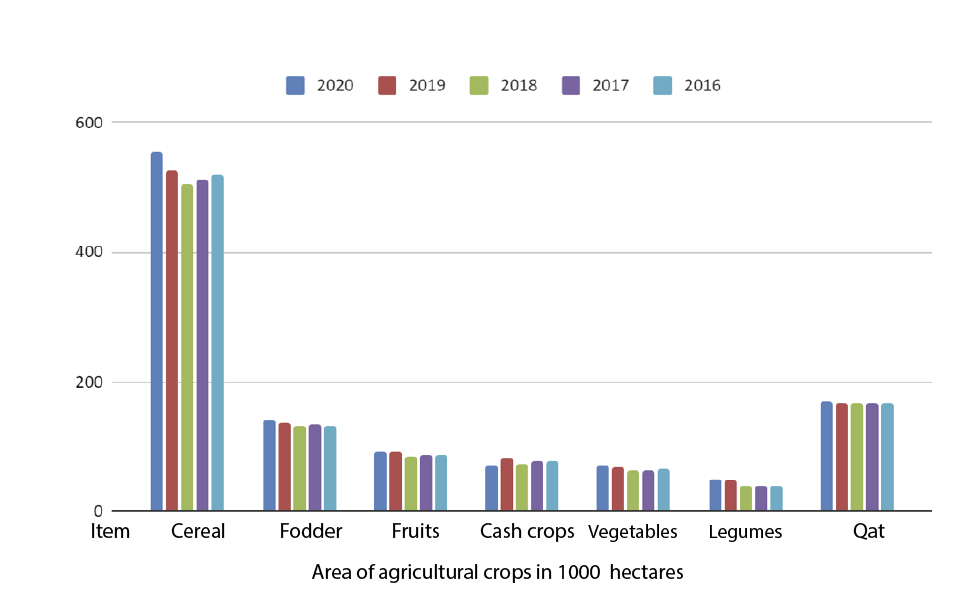
Figure (1) Area of crops in Yemen between 2016-2020
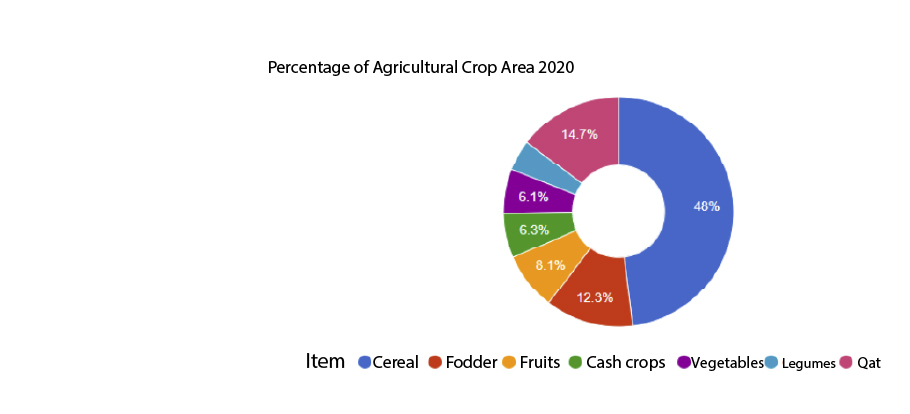
Food security in Yemen
The world is facing an unprecedented hunger crisis, especially after the Russian-Ukrainian war, on which Yemen depended for 40% of its grain and fertilizers.
The food security situation in Yemen has deteriorated sharply, and the situation was even more serious in 2022, with 17.4 million people in need of immediate assistance, meaning that about 60% of the population is living in crisis or acute food insecurity situations.
What is worrying is that there are 31,000 people facing severe hunger levels now and the number looks set to rise to nearly 170,000 by the end of 2023, according to the UN reports.
In addition, there are about 2.2 million children under the age of five, of whom 538,000 suffer from severe acute malnutrition, and about 1.3 million pregnant and lactating women suffer from acute malnutrition in 2023.
Most of these children and women live in Yemen's countryside, which includes the country's agricultural areas. The main causes of food insecurity in Yemen are mostly related to war and economic collapse.
Most of the government employees in areas controlled by the (Ansar Allah) Houthi group have not received their salaries for years. The value of the national currency has also declined by more than half during the past years of war coupled with rises in fertilizer prices and the weak purchasing power of Yemeni citizens.
A recent data analysis shows that trends in food imports over the past five years are stable, although slightly below the pre-war average. However, imported food commodities account for about 70% of food by volume, and dependence on imported grains is estimated at 97%.
Imported foodstuffs make up 83% of the daily calories for Yemenis. While stable imports are vital to food security in Yemen, these high percentages mean that Yemen remains highly vulnerable to external shocks, global dynamics, and domestic challenges.
Problems Facing Agriculture in Yemen
A series of civil wars - the most recent of which is now in its eighth year - distorted the agricultural policies at the national and local levels. Pest outbreaks such as the desert locust and more frequent droughts and floods have steadily eroded the country's agricultural assets. In this section, we highlight the most important problems facing agriculture in Yemen, which influence food security and income stability for the rural population.
First, Climate Change: Climate change poses additional risks in Yemen, especially for those most in need. Heavy rains have led to flash floods in recent years, causing deaths and widespread damage to homes, infrastructure, and crops. There is an inconsistent equation in recent years, where rain-dependent agricultural lands suffer from droughts and are hit by unexpected rains and floods, which leads to the erosion of land and agricultural infrastructure.
Secondly, the war: The fighting that spread on several front lines caused the contamination of agricultural lands with landmines or air and artillery bombardment. With the fuel crises, particularly the cooking gas shortage during the war, trees were cut down and used for cooking or operating bakeries. The battles and drought led to the death of more than two million fruitful palm trees in Al-Hodeidah province to the west of Yemen. Because of the war, agricultural production in Yemen decreased dramatically, and lands were abandoned due to the displacement of farmers and agricultural workers. Farmers' lands became combat lines or were planted with mines. The lack of fuel led to an increase in production and transportation costs and the high cost of irrigation.
In Tehama, an agricultural region, all agriculture activities that depended on groundwater were suspended, and the cultivated area decreased to 39% of what it was before the war. The yields fell to 42%, compared to the pre-war time. The Ministry of Agriculture and Irrigation of the Houthi government, which is not recognized internationally, revealed that the total losses of the agriculture sector in Yemen amounted to over $11 billion during the years of war. These losses are attributed to the war and the siege imposed on Yemen.
Thirdly, the deterioration of fertile lands: The agricultural lands in Yemen deteriorated due to the expansion of urban development and the cracks in the land. The cultivation of the "Qat" plant prevailed in agricultural lands at the expense of food crops. Yemen has four fertile agricultural areas, most of which are in the northern regions of Sanaa, Amran, Saada, and Dhamar. They cover about 58% of the country's needs for grain crops, vegetables, and fruits.
Fourthly, the high costs: Farmers complain about the high costs of fertilizers and agricultural inputs, which have affected their activities in their lands. This prompted many farmers in Al-Jawf, Abyan, Hadramout, Saada and Al-Hodeidah to leave their lands without cultivation. As a result, Yemen's grain production decreased by 22% in 2022, besides the slide in the production of fruits and vegetables. However, grain production increased by 120% after the breakout of the Russian war in Ukraine.
Fifthly, water: Yemen faces a significant water problem. Most agriculture depends on rainwater and groundwater, which is being depleted without official supervision. The following figure presents the dependence of agricultural lands on water, which drives Yemeni farmers to grow agricultural products that do not require much water.
Sixthly, the decline of authorities' support: The fragmentation created by the war led to the reduction or cessation of the work of agricultural cooperatives. The war caused the authorities to ignore the agricultural sector as they paid attention to the fighting or other economic and commercial sectors. Rural areas.
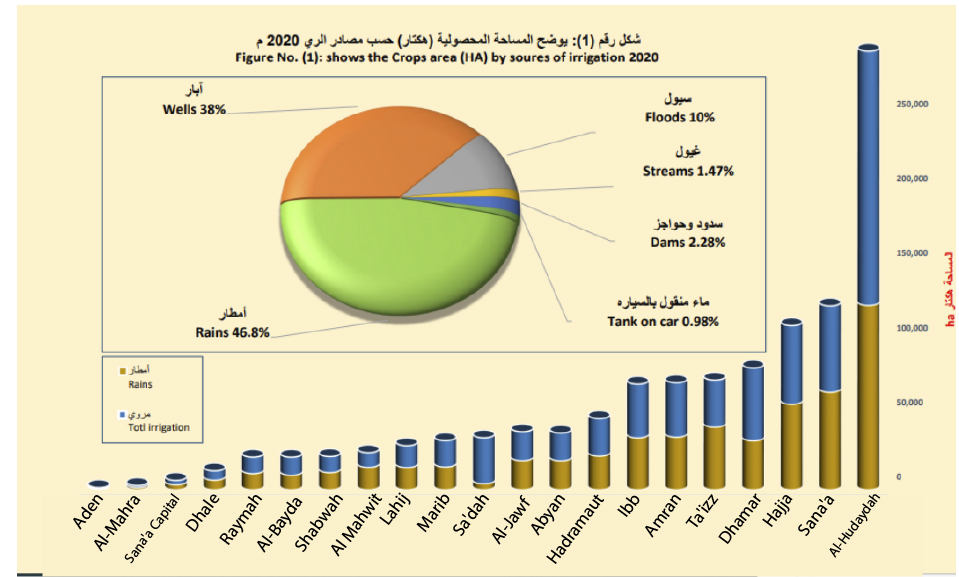
also began quitting agriculture, and farmers resorted to trade activities. So, the population in the countryside became dependent on canned food.
Seventhly: Migration from the countryside: The decline in agricultural activity led young people to migrate to the cities to search for work or join the parties to the conflict as fighters. This caused a decrease in the agricultural production in their areas.
References
- Yemeni Annual Agricultural Census 2014, 2016, 2017, 2018, 2019, 2020.
- Govt. Yemen, Agriculture in Yemen ..The Key for Future Food and Social Security/ September 2021.
- FBLN, A combined approach to assess groundwater resources depletion in data-scarce areas; a case study in Wadi Zabid, Yemen/ 17 November 2021/.
- ACAPS, FAO, IOM, Food affordability in conflict-torn Yemen in light of the Ukraine war 2023 /Jun 2023.
- IPC, Yemen: IPC Acute Food Insecurity and Malnutrition Snapshot - Acute Food Insecurity: January - December 2023; Acute Malnutrition: October 2022 - September 2023 /May 2023.
- UNDP, Impact of War on Development in Yemen/2020
- World Bank, Breaking the Cycle of Food Crises in Yemen/ May 2023.
- UNDP, Combating Food Insecurity in Yemen: From Individual Needs to Country-Level Resilience/ January 2023.