From Al-Luhiya to Somaliland: Somalia Enters the Red Sea Shadow War

The regional rivalry reshaping the Red Sea is increasingly moving south into the Gulf of Aden, where Somalia’s fragile political landscape, armed networks and contested ports are becoming part of a broader struggle over maritime influence between Yemen and the Horn of Africa.
Security information obtained by Sheba Intelligence indicates growing coordination between Yemen’s Houthi movement and al-Shabaab, al-Qaeda’s branch in Somalia, particularly in areas related to smuggling, logistical support and the exchange of military expertise.
In parallel, Somali intelligence sources told Sheba Intelligence that the United Arab Emirates has opened a training camp in Somaliland for Yemeni forces linked to Abu Dhabi.
According to the sources, the forces undergoing training were previously part of formations affiliated with the UAE-backed Southern Transitional Council, led by STC president Aidarous al-Zubaidi.
Somaliland at the center of regional calculations
The information comes at a time when Somaliland is gaining greater importance in the calculations of regional and international powers. Over the past years, the UAE has played a significant role in strengthening the self-declared region’s external partnerships, including its position in port politics and maritime security arrangements.
The issue became more sensitive after Israel recognized Somaliland in late December 2025, a move that triggered wide reactions in Somalia and across the region and deepened concerns that competition over the Red Sea and Gulf of Aden could increasingly spill into the Somali arena.
Somali sources said the Houthis have developed weapons-smuggling mechanisms toward Somali armed groups. If further substantiated, the information could place the Somali coast facing Yemen in a more sensitive position within the security equation surrounding Bab al-Mandab and the Gulf of Aden.
Bab al-Mandab and the Gulf of Aden after Houthi attacks
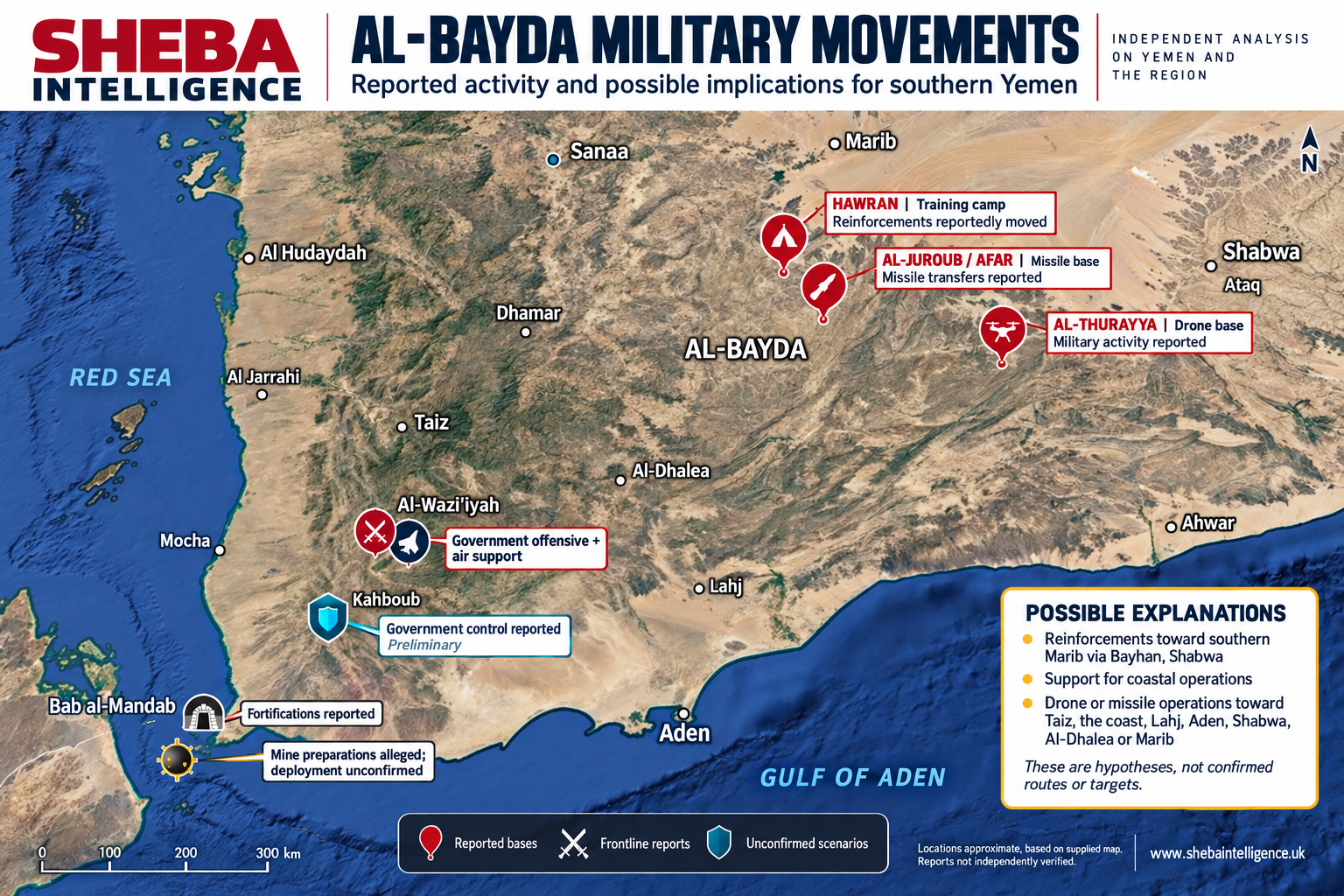
These developments carry particular significance after Houthi attacks in the Red Sea pushed Bab al-Mandab and the Gulf of Aden back to the center of international attention.
The security geography between Yemen and the Horn of Africa is no longer seen only as a traditional smuggling corridor. It is increasingly becoming an open space for the movement of weapons, fighters and logistical support, with maritime routes, islands and coastal areas playing a growing role in linking local armed groups with wider regional networks of influence.
Security sources say smuggling networks between Yemen and Somalia may become more complex as three factors increasingly overlap: Houthi activity across the sea, al-Shabaab’s presence inside Somalia, and expanding regional involvement in Somaliland and ports overlooking the Gulf of Aden.
Earlier signs of jihadist activity between Yemen and Somalia
The new information does not emerge in isolation. Over the past period, several indicators have pointed to jihadist and security routes stretching between Yemen and Somalia.
Puntland security forces previously announced the arrest of a Yemeni man suspected of belonging to the Islamic State group during a military operation in the Af’as area of the Al-Miskaad mountains in Somalia’s northeastern Bari region.
Major General Mohamud Jama Fadhigo, spokesman for the Al-Miskaad military operations, said the detainee had stated that he came from an ISIS base in the Shakala area and was part of a three-man group tasked with arranging the transport of food supplies to the group’s mountain positions.
Although the incident appeared limited in military terms, its significance lies in the suspect’s nationality and the location of the arrest. The Al-Miskaad mountains are among ISIS’s most important areas of activity in Somalia and sit within a security environment connected to the maritime space near the Gulf of Aden.
A forged Yemeni passport and a senior al-Shabaab figure
In mid-May, international media reported that Abdishakur Bahi, a senior al-Shabaab figure targeted by a U.S. drone strike in February in al-Ghaydah, in Yemen’s eastern Al-Mahra governorate, had been carrying a forged Yemeni passport.
According to those reports, the passport was allegedly issued by the Houthi-controlled authorities in Sana’a under the name Abdulqader Yahya Ali Ahmed al-Zubaidi.
If fully verified, the incident would represent a highly sensitive indicator of the level of facilitation that figures linked to al-Shabaab may have obtained inside Yemen, and of the routes that may connect armed groups on both sides of the Gulf of Aden.
UN report points to cooperation in smuggling and expertise
The UN Panel of Experts on Yemen, in its October 2025 report, also pointed to indicators of cooperation between the Houthis and al-Shabaab in arms smuggling and the exchange of military expertise.
The available information does not establish the existence of a formal alliance between the Houthis and al-Shabaab. However, it does point to a growing pattern of pragmatic coordination built around smuggling routes, logistical support and the exchange of military know-how across the Gulf of Aden.
This pattern makes the sea between Yemen and Somalia less of a separating line between two unstable arenas and more of a connecting space for smuggling networks, armed groups and overlapping regional interests.
Earlier training in Al-Luhiya and African fishermen
These indicators gain additional significance in light of an earlier Sheba Intelligence report published in September 2023, months before the Red Sea crisis escalated.
The report revealed at the time that a Houthi naval force had received training in Al-Luhiya, on Yemen’s Red Sea coast, and that African fishermen had attended the training.
According to the information published then, the fishermen were expected to provide logistical support to the Houthis, particularly in transferring weapons from larger vessels at sea to smaller boats and storing them on nearby islands or coastal areas.
Although the report did not identify the nationalities of the African participants or explicitly link them to al-Shabaab, the information now appears more significant in light of later reports about smuggling networks and possible cooperation between the Houthis and armed groups in the Horn of Africa.
Al-Shabaab exploits domestic political tension
Inside Somalia, al-Shabaab is seeking to exploit political tension and public anger to strengthen its propaganda narrative and attract new supporters.
The group recently issued a statement portraying diplomatic relations between the United States and Somalia as contrary to Somali interests. It accused Washington of supporting Somali officials whom it claims are involved in corruption and interference in the country’s internal affairs.
Al-Shabaab also tried to exploit public anger over the exclusion of Somali international referee Omar Abdulkadir Artan from an international tournament, presenting itself as a defender of Somali national dignity.
But the broader purpose of the group’s messaging appeared to be linked to its attempt to highlight U.S. operations against its leaders and accuse Washington of causing civilian harm during those operations.
Political tension creates room for armed groups
These developments coincide with rising political tension inside Somalia. The director of the National Intelligence and Security Agency recently met opposition leaders after government forces were deployed around the premises of some opposition figures, raising fears that political tensions could slide into armed confrontation.
Al-Shabaab has historically benefited from such environments. Political fragmentation and public grievances allow the group to expand recruitment, exploit social anger and strengthen its security and propaganda presence in fragile areas.
As internal polarization deepens, Somalia becomes more vulnerable to external penetration, particularly amid regional competition over ports, coastlines and maritime corridors.
The Gulf of Aden enters a more complex phase
Taken together, these developments suggest that Somalia is no longer merely a domestic battlefield against al-Shabaab. It is becoming part of a wider map of competition over the Red Sea and the Gulf of Aden.
Possible coordination between the Houthis and al-Shabaab raises risks to shipping, smuggling routes and coastal security. At the same time, the Emirati role in training Yemeni forces inside Somaliland adds another layer to the conflict, one that could deepen Somali polarization and increase the sensitivity of relations between Mogadishu, Somaliland, federal member states and external powers.
Between the Houthis’ cross-sea networks, al-Shabaab’s calculations inside Somalia and Emirati security moves in Somaliland, the Gulf of Aden appears to be entering a more complex phase. Terrorism, smuggling and regional rivalry are increasingly converging with Somalia’s state fragility and Yemen’s unresolved fragmentation.