Mahan Air Flight to Sana’a: New Information Points to Medical Evacuation Mission for Senior Houthi Figure
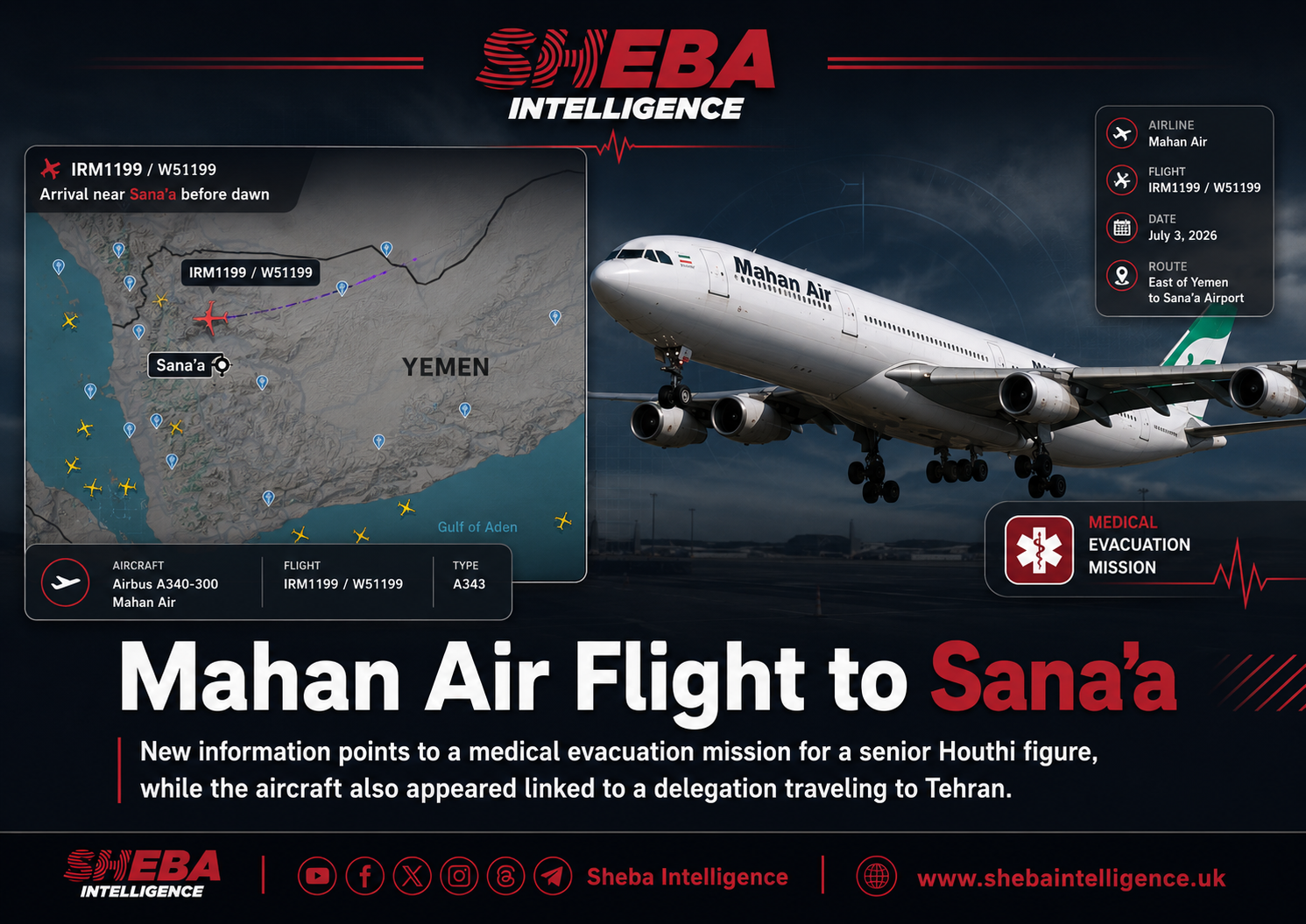
New information indicates that flight IRM1199 carried a medical evacuation team to transfer a senior figure at the top of the Houthi hierarchy to Tehran after he suffered angina linked to complications from chronic kidney failure.
New information obtained by Sheba Intelligence indicates that the Iranian aircraft operated by Mahan Air, which arrived at Sana’a International Airport before dawn on Friday, was carrying an Iranian medical evacuation team tasked with transporting a senior figure at the top of the Houthi hierarchy to Tehran for treatment.
According to the information, the senior Houthi figure suffered angina linked to complications from chronic kidney failure, prompting urgent arrangements for a direct Iranian aircraft to land in Sana’a and transfer him for medical care.
Flight-tracking screenshots reviewed by Sheba Intelligence show the aircraft operating under flight code IRM1199 / W51199. The aircraft was identified as an Airbus A340-300 — A343, operated by Mahan Air. The screenshots placed the aircraft over Yemeni airspace between around 02:01 and 02:23 UTC, equivalent to 05:01–05:23 Sana’a time, as it approached the capital from the east before landing at Sana’a International Airport.
Initial information had suggested that the flight was linked to transporting a Houthi delegation to Tehran to attend the funeral ceremonies of late Iranian Supreme Leader Ali Khamenei. However, the new information indicates that the aircraft also carried a medical evacuation team, and that the most sensitive part of the mission involved transferring a senior Houthi figure to Iran for treatment.
According to the information, the aircraft had been expected to arrive the previous day, but the flight was postponed. This forced the delegation or concerned team to leave the airport and return later after renewed arrangements were made for the Iranian aircraft’s arrival.
From a technical perspective, the use of an Airbus A340-300 is consistent with the nature of the mission. The aircraft is a long-range, wide-body, four-engine jet that can accommodate accompanying teams, medical equipment, or passengers requiring special care during flight. The Tehran–Sana’a sector is also well within its operating capability. The direct air distance between the two cities is roughly 2,300–2,400 km, a route that can usually be covered in around three hours if flown directly or near-directly.
If the aircraft used a wider route through or near Omani airspace, the flight time could extend to nearly four hours. This remains technically and politically plausible, especially given the sensitivity of airspace over the Gulf and the Red Sea, and the potential need for a lower-friction corridor.
The flight carries additional sensitivity because of the carrier’s profile. Mahan Air has been under U.S. sanctions for years over accusations that it provided transportation and logistical support linked to Iran’s Islamic Revolutionary Guard Corps and the Quds Force. The arrival of a Mahan Air aircraft in Sana’a therefore reopens questions about the use of Sana’a airport as a direct channel between the Houthis and Tehran, not only for political travel but also for sensitive arrangements involving the group’s senior leadership.
These details suggest that the flight may be one of the clearest recent indicators of the continued special air channel between Sana’a and Tehran despite restrictions on the airport. It also raises questions about the understandings that allowed the aircraft to reach Sana’a, the air corridor it used, and the regional parties that may have facilitated or tolerated its passage.