Makkah Defense Pact Faces First Test from IRGC, Houthis and Iraqi Militias
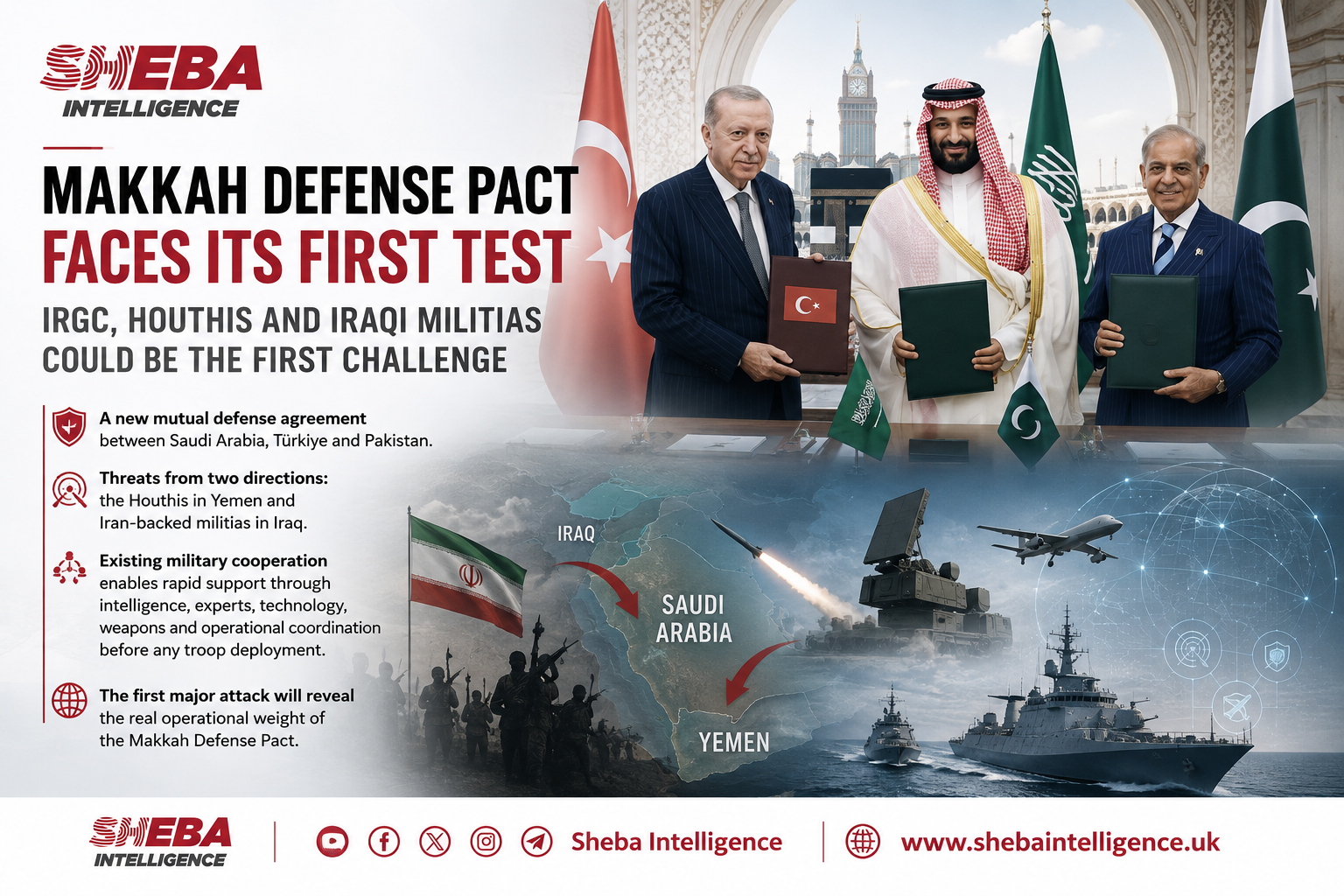
The newly signed Makkah Joint Defense Agreement between Saudi Arabia, Türkiye and Pakistan could face an early test from an Iran-linked, multi-front threat involving the Houthis in Yemen and Iraqi militias operating under the supervision of Iran’s Islamic Revolutionary Guard Corps (IRGC).
Signed in Makkah on August 7, the agreement establishes that an armed attack against any of the three countries will be considered an attack against them all, while expanding broader defense cooperation and collective deterrence.
The pact comes amid heightened regional tensions and appears to formalize a level of military cooperation that had already been developing among the three countries, particularly following recent maritime security coordination. This suggests that its practical value may extend well beyond the prospect of deploying Turkish or Pakistani forces.
In the event of an attack on Saudi Arabia, cooperation could begin at a much lower threshold through intelligence sharing, military advisers, air and missile defense support, weapons and technology, and maritime or air coordination. Capabilities developed or tested through previous cooperation could therefore be available before any decision to request direct military intervention.
A Threat from Two Directions
The timing is significant. Saudi Arabia has warned of potential coordinated attacks from two directions: the Houthis from Yemen in the south and Iran-backed militias operating from Iraq in the north, with the IRGC accused of overseeing the escalation.
Riyadh has already blamed Iran-backed Iraqi militias for drone attacks targeting Saudi energy infrastructure, while the Houthis have simultaneously escalated threats and operations along the Kingdom’s southern frontier and in the Red Sea.
Such a multi-front strategy could seek to stretch Saudi defensive resources while placing energy facilities, airports, ports and maritime routes under simultaneous pressure.
The Pact’s First Operational Test
The immediate question is therefore not whether Türkiye and Pakistan would send troops to Saudi Arabia, but how quickly existing military cooperation could be activated following an attack.
If the Makkah agreement builds on mechanisms already established through previous defense and maritime cooperation, its first response could involve intelligence, experts, technology, weapons and operational coordination rather than large-scale troop deployments.
This potentially changes the deterrence equation for Iran and its allied armed groups. An attack on Saudi Arabia would no longer be assessed solely against Saudi capabilities, but against Riyadh’s potential access to a wider pool of Turkish and Pakistani military expertise and resources.
The first major attack after the agreement could therefore reveal its real military weight: whether it remains primarily a political deterrence framework or rapidly functions as an operational defense network.
The Houthis, the IRGC and Iraqi militias may become the first actors to test the Makkah Defense Pact — and that test could begin with the activation of an already developing military network long before three armies are called into battle.