Portable ADS-B Receiver Seen with Houthis: Could It Help Track Large UAVs?
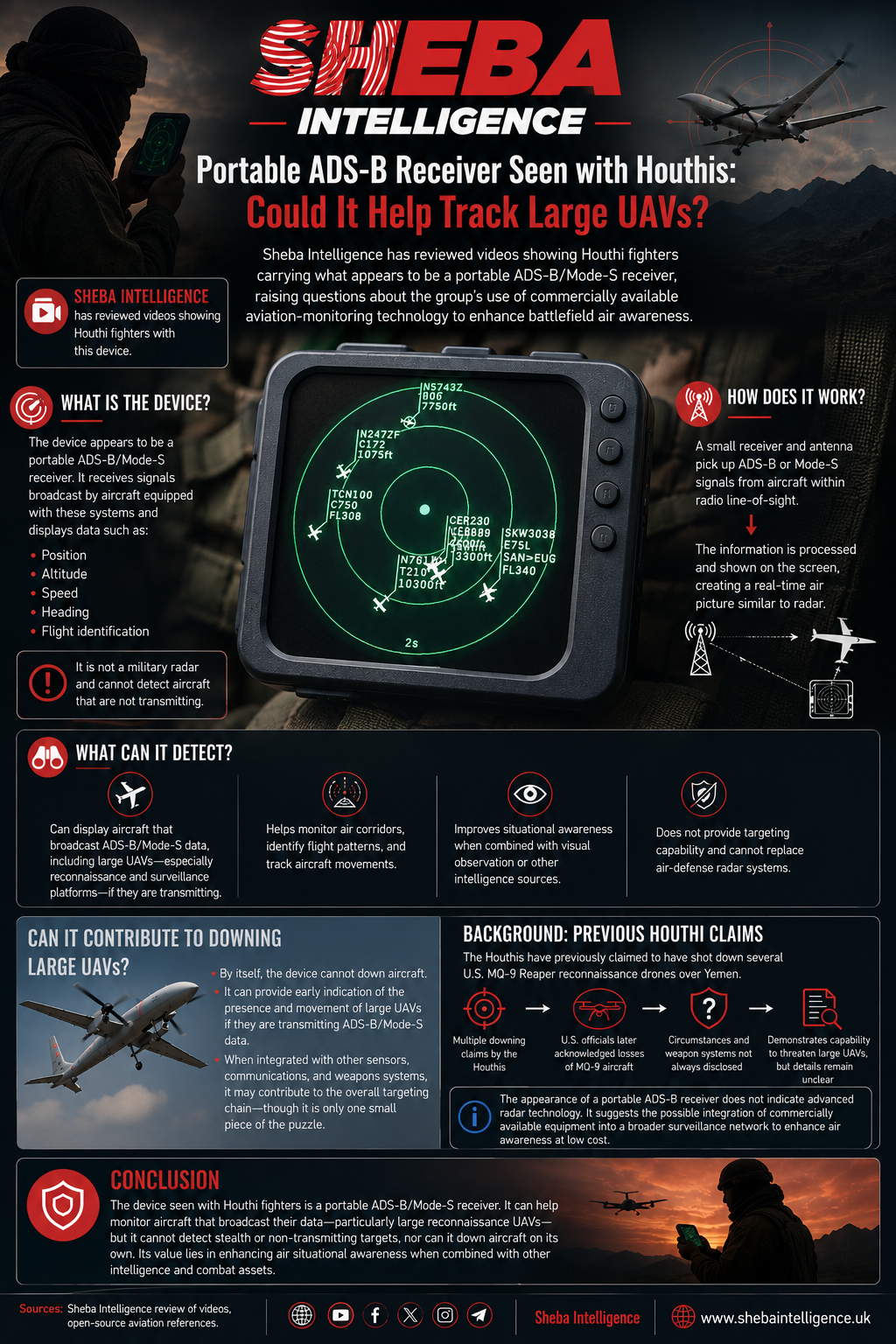
Sheba Intelligence has reviewed recently circulated videos showing Houthi fighters carrying what appears to be a portable ADS-B/Mode-S receiver, raising questions about the group's use of commercially available aviation-monitoring technology to improve battlefield air awareness.
The device shown in the footage closely resembles a handheld ADS-B/Mode-S receiver capable of collecting signals voluntarily transmitted by aircraft equipped with these systems. It can display information such as aircraft position, altitude, speed, heading, and identification in near real time. However, it is not a military radar and cannot independently detect aircraft that are not broadcasting compatible signals.
While limited in capability, the receiver could provide operators with a basic picture of nearby air activity. If integrated with visual observation, human intelligence, or other surveillance assets, it may help improve situational awareness across multiple fronts.
The device may also be capable of displaying "large UAVs—particularly reconnaissance and surveillance platforms—"provided they are transmitting ADS-B or Mode-S data during flight. This could assist operators in monitoring air corridors, identifying recurring flight patterns, or tracking aircraft movements, but it does not provide targeting capability or replace air-defense radar systems.
Its main limitation is that it relies entirely on aircraft voluntarily transmitting compatible signals. Aircraft or drones operating with ADS-B/Mode-S disabled will not appear on the display, and the receiver cannot independently detect or track non-transmitting targets.
Background
The Houthis have previously claimed responsibility for downing several U.S. MQ-9 Reaper reconnaissance drones during the Yemen conflict. In multiple cases, U.S. officials later acknowledged the loss of MQ-9 aircraft, although they did not publicly confirm the precise circumstances or the weapon systems involved. These incidents demonstrate that the group has developed some capability to threaten large unmanned aircraft operating over Yemen.
The appearance of a portable ADS-B receiver in the hands of Houthi fighters does not by itself indicate the possession of advanced radar technology. Instead, it suggests the possible integration of commercially available aviation-monitoring equipment into a broader surveillance network designed to enhance battlefield air awareness at relatively low cost.