
Exclusive: Houthis and Iraqi Militias Prepare Coordinated Retaliatory Campaign Against Saudi Arabia
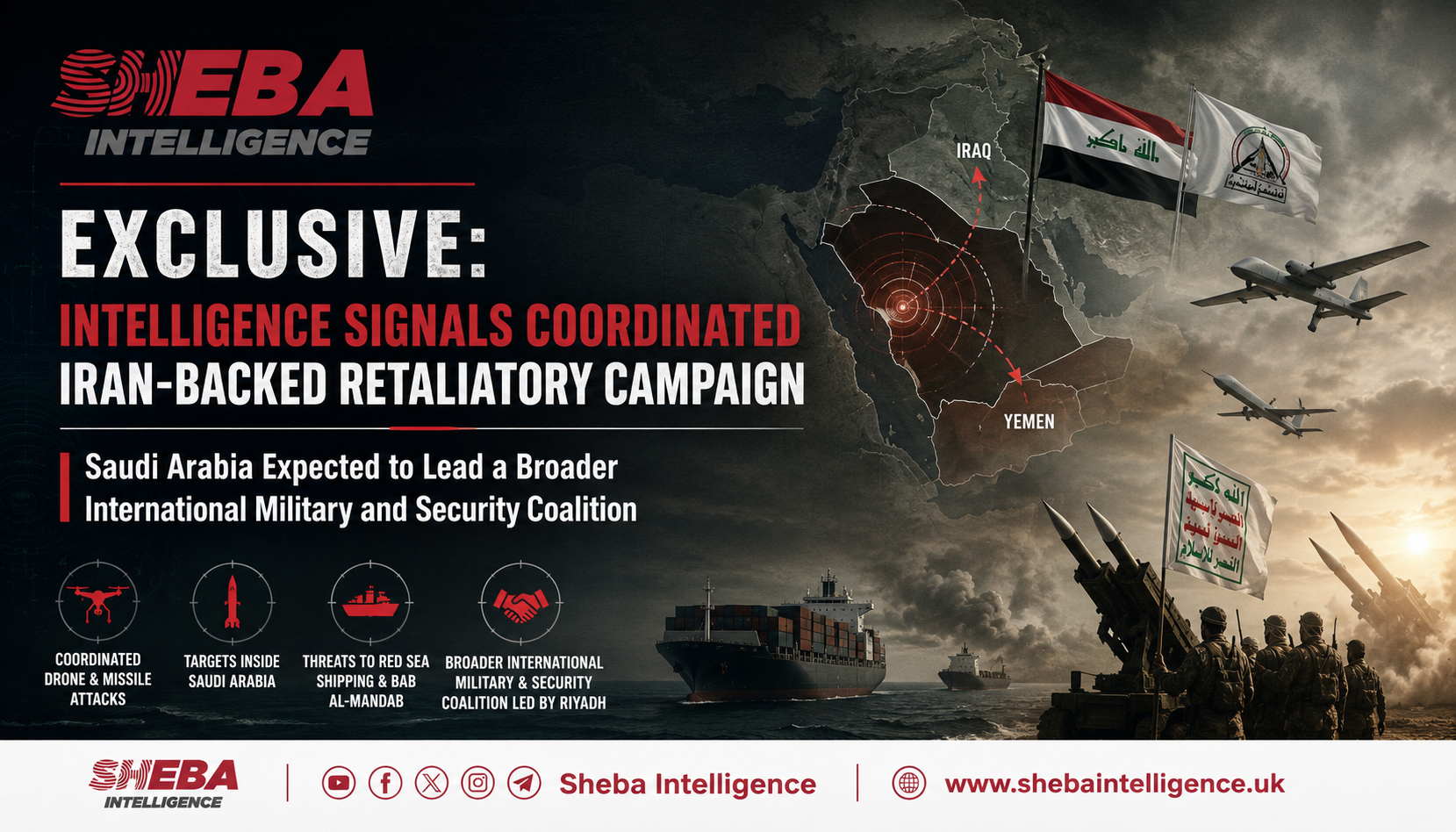
Intelligence Indicates Attacks Could Expand to Red Sea Shipping and Prompt a Broader International Military and Security Coalition
Intelligence sources told Sheba Intelligence that Iran-backed armed groups in Yemen and Iraq are preparing a coordinated retaliatory campaign targeting Saudi Arabia and international shipping through the Red Sea and Bab al-Mandab.
According to the intelligence sources, the operation is being coordinated between the Houthi movement and the Iraqi militia Asa’ib Ahl al-Haq, with the objective of imposing both military and economic costs by combining attacks on Saudi strategic assets with operations aimed at disrupting one of the world’s most critical maritime corridors.
The reported preparations follow Saudi Arabia’s coordinated air campaign with the U.S. Central Command (CENTCOM) against Iran-backed militias in Iraq after two drone attacks targeted Saudi energy infrastructure.
Joint Operations Structure
According to intelligence obtained by Sheba Intelligence, the Houthis and Iran-backed Iraqi militias have established a joint operations centerresponsible for coordinating missile and drone attacks under a unified command structure.
The center oversees operational planning, intelligence sharing, target selection, attack synchronization, missile allocation, and launch-site coordination, enabling simultaneous operations across multiple theaters.
Planned Escalation
The intelligence reviewed by Sheba Intelligence indicates, that the planned campaign extends beyond attacks on Saudi territory to include increased pressure on international maritime traffic through the Bab al-Mandab Strait.
The objective is to increase the economic cost of the confrontation by threatening commercial shipping and disrupting a strategic global trade route while linking the Iraqi and Yemeni theaters within a coordinated operational framework.
According to the intelligence sources, planners also assess that attacks against Saudi strategic infrastructure or significant disruptions to international shipping could trigger a broader international response. Sources indicate such a scenario may accelerate the formation of an international military and security coalition, led by Saudi Arabia in coordination with the United States and partner nations, to protect freedom of navigation, safeguard critical energy infrastructure, and deter further attacks by Iran-backed armed groups.
The latest intelligence further reinforces Sheba Intelligence’s earlier assessment that the Houthi movement has shifted from announcing maritime threats to implementing an organized blockade framework through a dedicated operations center overseeing shipping restrictions in the Red Sea and Bab al-Mandab. The reported retaliatory campaign appears to build upon that operational infrastructure, linking attacks on Saudi Arabia with sustained pressure on international maritime traffic.
Background
Saudi Arabia recently announced that, in coordination with U.S. Central Command (CENTCOM), it had carried out precision strikes against Iran-backed militias in Iraq following two drone attacks targeting Saudi energy infrastructure.
Earlier reporting by Sheba Intelligence documented increasing operational links between the Houthis and Iran-backed Iraqi militias amid the recent regional escalation. The latest intelligence indicates that this coordination has evolved into a more integrated operational framework capable of supporting synchronized retaliatory operations across multiple fronts.
Assessment
If confirmed, the establishment of a joint Houthi-Iraqi operations center would represent a significant step in the operational integration of Iran’s regional proxy network. It would enhance the ability to coordinate simultaneous attacks from multiple theaters, increasing pressure on Saudi Arabia while elevating security risks to international shipping through the Red Sea and Bab al-Mandab.
Such a development would also reinforce concerns that future regional confrontations may increasingly involve coordinated multi-front operations rather than isolated attacks, expanding both the geographic scope and strategic impact of the conflict.