
Assassination of Homeland Shield Commander Caps a Week of Escalation Across Yemen
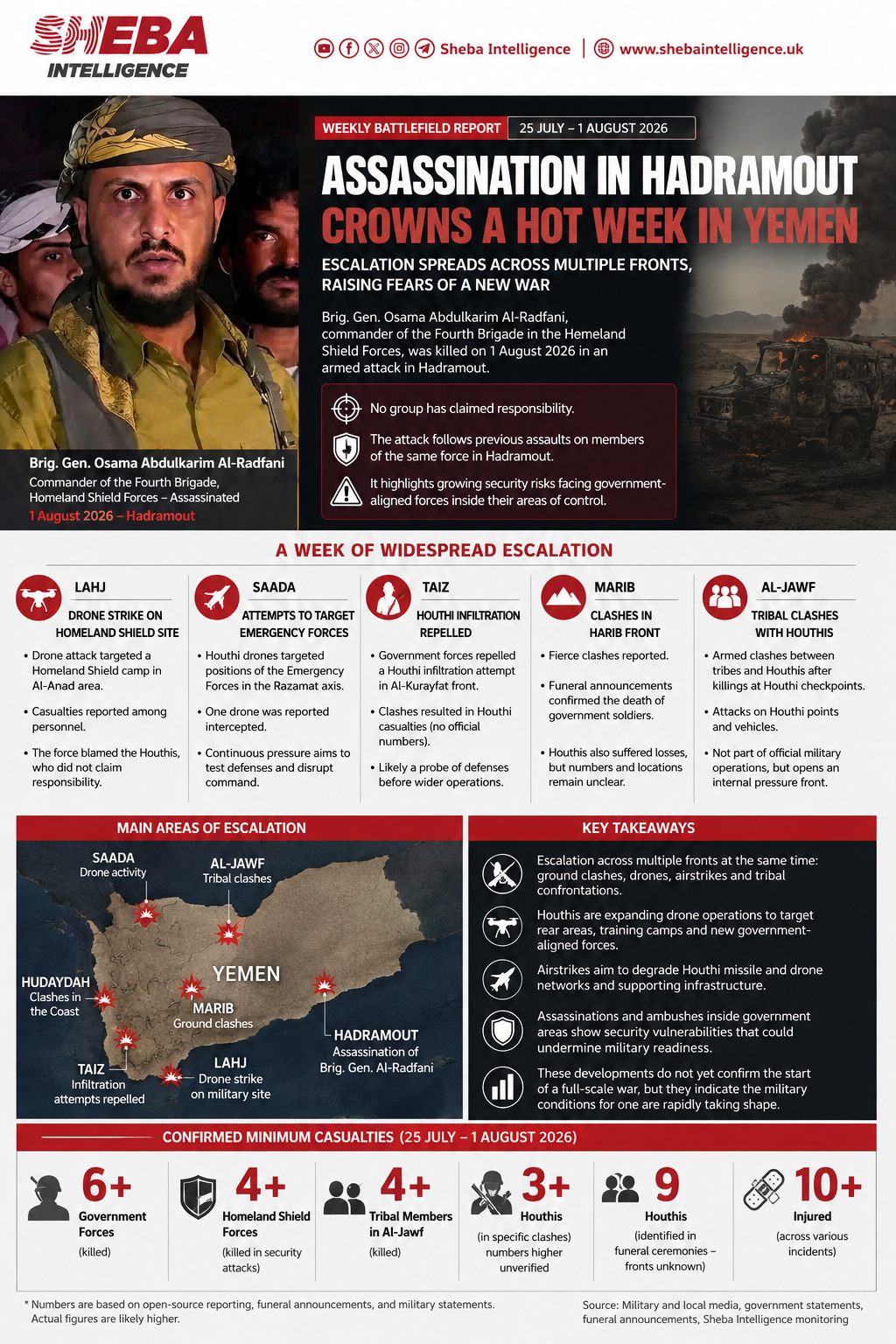
The assassination of a senior Homeland Shield Forces commander in Hadramout has concluded a volatile week marked by renewed clashes, drone attacks and growing military activity across several Yemeni fronts, raising concerns that the country may be moving toward another major round of war.
Brigadier General Osama Abdulkarim al-Radfani, commander of the Fourth Brigade within the Homeland Shield Forces, was killed on August 1 in an armed attack in Hadramout. No group immediately claimed responsibility, and available information does not establish a direct Houthi role.
The operation is nevertheless significant because it targeted a commander from one of the government-aligned formations expected to play a larger role in future military and security arrangements. It also followed earlier attacks against members of the same force in Hadramout, highlighting security vulnerabilities around its deployments and supply routes.
The assassination came after several days of simultaneous pressure on forces aligned with Yemen’s internationally recognized government.
In Lahj, a drone struck a Homeland Shield military site in the Al-Anad area, causing casualties among personnel. The force blamed the Houthis, although the group did not publicly claim the attack. The incident indicated that Houthi drone operations are no longer focused only on frontline positions, but may also be targeting training camps, troop concentrations and rear military facilities.
In Saada, government-affiliated Emergency Forces reported further Houthi drone activity against their positions, including attempts to target commanders and military units. One drone was reportedly intercepted in the Razamat axis. Such attacks appear intended to test air defenses, disrupt command structures and keep opposing units under continuous pressure without launching a large ground offensive.
Ground fighting also intensified in Taiz, where government forces said they repelled a Houthi infiltration attempt in the Al-Kurayfat sector east of the city. Military sources reported Houthi casualties but did not provide detailed figures. Similar limited assaults are often used to probe defenses, identify weak positions and improve tactical deployment before broader operations.
Other fronts in Marib, Al-Jawf and Al-Dhalea also recorded exchanges of fire, attempted advances and strikes on military positions. Funeral announcements confirmed the deaths of government soldiers in the Harib front south of Marib, while Houthi burial ceremonies indicated additional losses among the group’s fighters without clearly identifying when or where they were killed.
In Al-Jawf, the military picture was further complicated by armed clashes between the Houthis and local tribes. The fighting followed killings at Houthi checkpoints and later expanded into attacks on Houthi vehicles and positions. Although these confrontations were not formally part of government military operations, they risk opening an internal pressure front against the group in a strategically important governorate linking Saada, Marib and the Saudi border.
The week also saw airstrikes against suspected Houthi missile, drone and weapons infrastructure. The strikes appeared designed to weaken launch networks and operational facilities rather than support a single battlefield. Their timing, alongside renewed ground clashes and drone attacks, suggested that the current escalation is broader than routine ceasefire violations.
The emerging pattern does not yet prove that either side has decided to launch a full-scale war. It does, however, resemble the early preparation of a new operational environment: defensive positions are being tested, newly formed government-aligned forces are being targeted, drones are reaching rear areas, tribal tensions are becoming militarized and air operations are again striking Houthi capabilities.
The assassination of al-Radfani adds another layer of risk. Government-aligned forces may be required to confront the Houthis while simultaneously protecting commanders, bases and transport routes inside areas nominally under government control.
For that reason, the latest developments point not only to renewed Houthi-government confrontation, but also to a more fragmented security environment in which frontlines, drone warfare, tribal unrest and targeted killings could converge.
Yemen has not yet returned to open war, but the past week has shown that the military and security conditions for such a conflict are increasingly taking shape.