
Mokha Port Forced Out of Service as Government Forces Conduct 181 Operations in Marib and Other Fronts
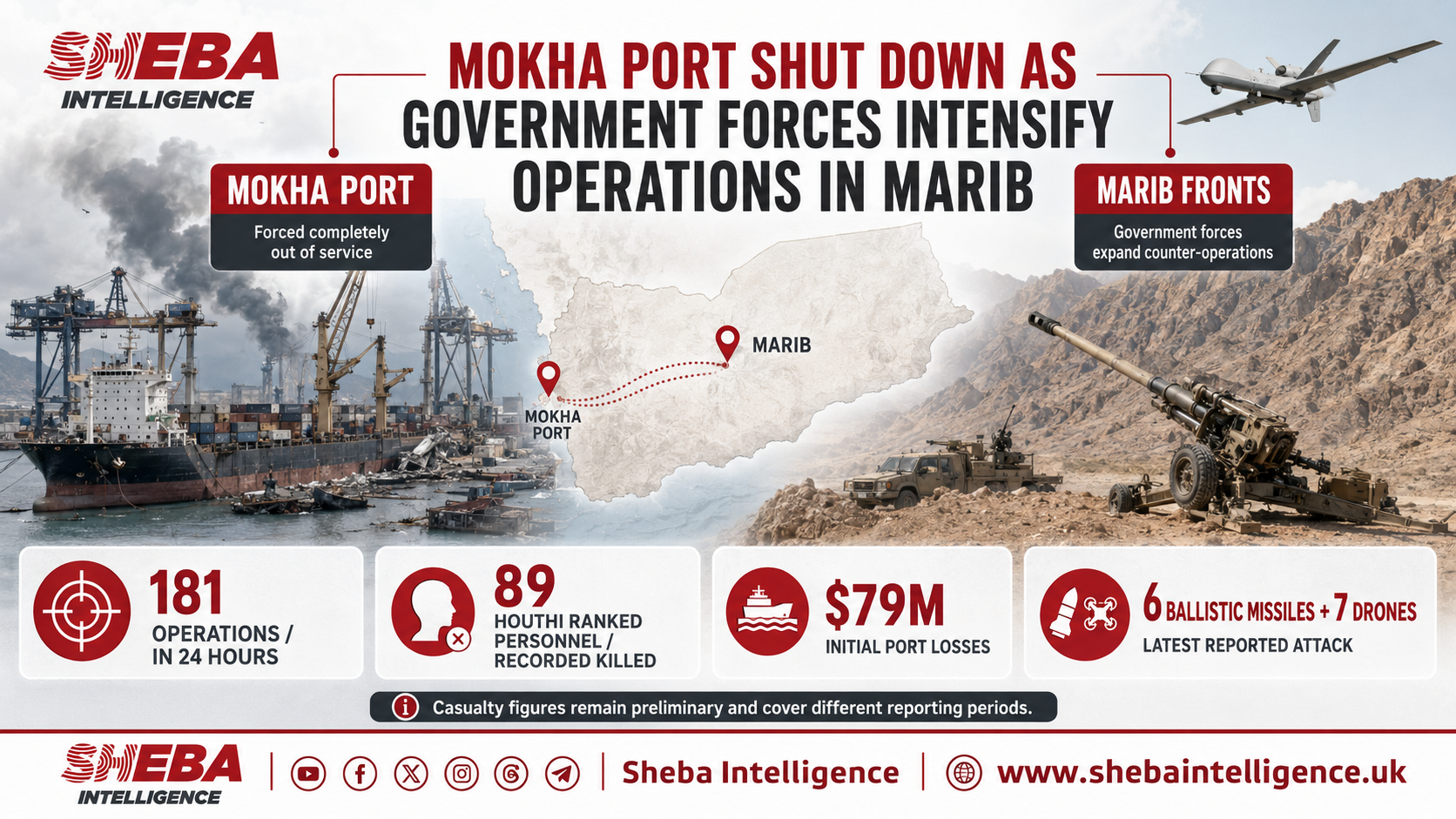
Mokha Port has been forced completely out of service following a series of Houthi ballistic missile and drone attacks that caused an estimated $79 million in initial damage. In response to the wider escalation, government forces announced 181 operations against Houthi positions and threat sources within 24 hours, with a significant concentration on the Marib fronts. The full human cost on both sides remains unclear.
The Yemeni Armed Forces spokesperson said the operations involved drones, artillery and multiple-launch rocket systems. They targeted military positions, weapons depots, firing positions and capabilities used by the Houthis to launch attacks.
A significant portion of the strikes focused on the Al-Kassara, Al-Balaq, Al-Mashjah, Al-Jadaan, Al-Rawda and Al-Nasr fronts, as well as areas north of Marib city. Other operations were conducted in Al-Jawf, Taiz, Al-Dhalea, Lahj and the western coast.
According to the statement, dozens of Houthi fighters were killed or wounded, while military vehicles, equipment and weapons depots were destroyed. The army did not provide a detailed casualty count, and the results of all 181 operations have not been independently verified.
89 Houthi Ranked Personnel Recorded Killed
A review of Houthi funeral and obituary announcements identified 25 additional deaths among ranked personnel. When added to a previous count of 64, the monitored total rises to 89, provided that no names appear in both lists.
The new list includes six brigadier generals, nine colonels, four majors, three captains, one lieutenant and two warrant officers. Under a strict military classification, the cumulative total comprises 87 commissioned officers and two warrant officers.
Ten of the newly recorded deaths were associated with Sanaa, seven with Hajjah, three with Saada, two each with Amran and Dhamar, and one with Ibb.
The 89 deaths cannot all be attributed to the 181 government operations. Houthi obituaries do not consistently disclose when or where each individual was killed. The figure should therefore be treated as a cumulative open-source count rather than a casualty total for the latest 24-hour operations.
Repeated Attacks Shut Down Mokha Port
The Yemeni Armed Forces said the Houthis fired six ballistic missiles at Mokha Port on Friday evening. The initial toll included one port security officer killed, two sailors missing and eight people wounded, including two members of port security.
In a subsequent attack, government military media reported that the Houthis launched six ballistic missiles and seven drones at Mokha. Ground-based air defences intercepted two of the drones.
The port’s director-general said the attacks had forced the facility completely out of service, killed ten people and wounded 22 others. Initial material losses were estimated at approximately $79 million.
It remains unclear whether these casualty figures cover the entire series of attacks or a specific period. No consolidated list of victims has been released, and figures contained in successive statements may overlap. They should not be treated as a final cumulative toll until the government issues a unified account.
Military Pressure in Marib, Economic Pressure in Mokha
The escalation is developing along two central axes. Government forces are intensifying operations against Houthi positions in Marib, while the Houthis are concentrating missile and drone attacks on Mokha and its commercial port.
Disabling the port carries consequences beyond the immediate damage. It disrupts trade and supply flows, affects local livelihoods and limits maritime access to the western coast. Its location near the Bab al-Mandab Strait also gives the attacks wider implications for Red Sea security.
The escalation followed a Sheba Intelligence report identifying increased activity by the Houthis’ missile forces in Saada, including the movement of missile systems, field preparations and the deployment of radar-equipped vehicles. Intelligence sources assessed that the activity was linked to possible attacks toward the Red Sea and the Saudi border, although the intended targets and missile types have not been independently confirmed.