
Houthi Death Toll Triples as Drone Strikes Hit Field Commanders
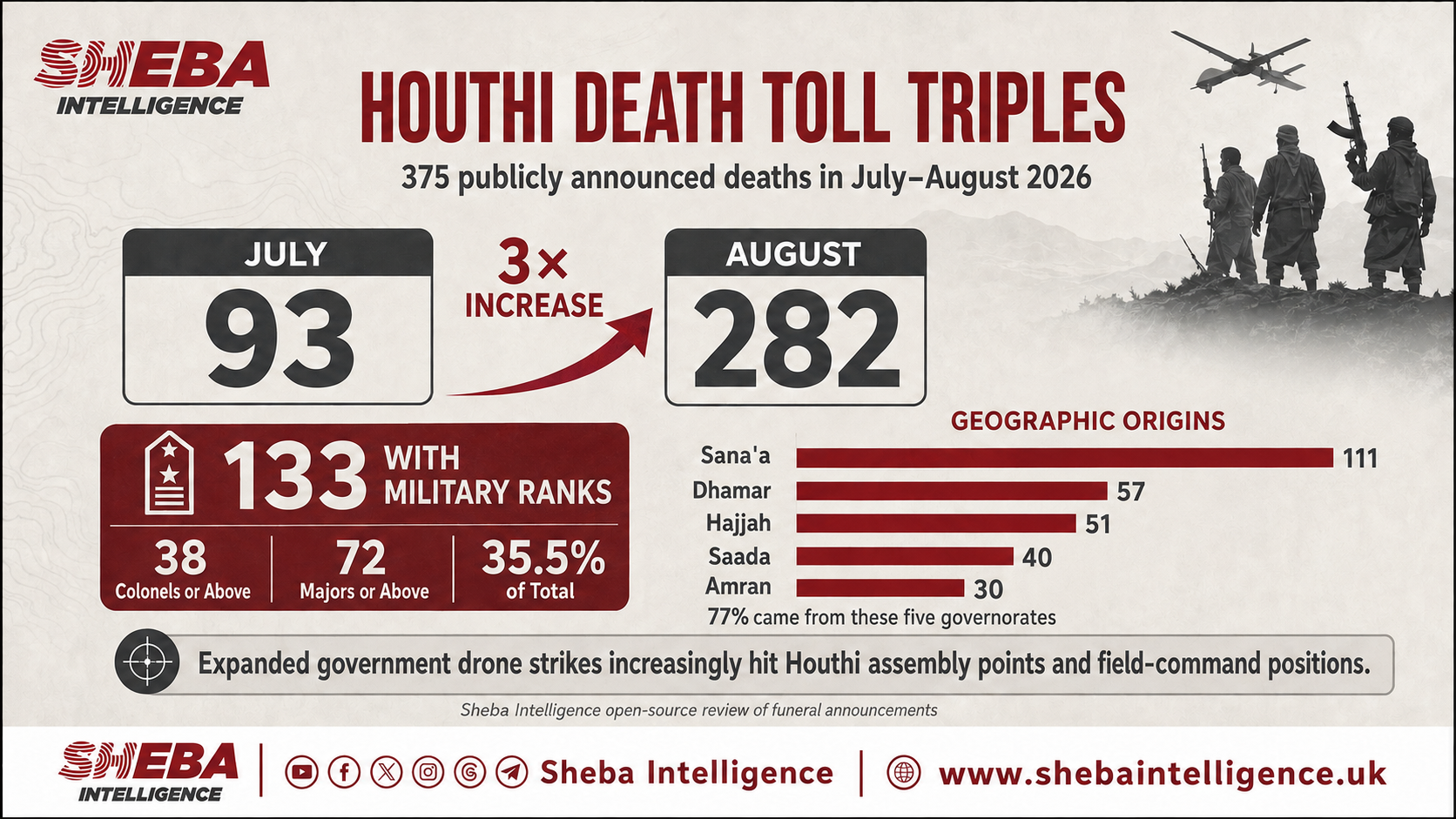
Open-source funeral records identify 375 Houthi fighters killed in July and August, including 133 announced with military ranks
At least 375 Houthi fighters and field commanders were publicly mourned during July and August 2026, according to a Sheba Intelligence review of funeral announcements and other publicly available records.
The figures point to a sharp rise in Houthi losses following the group’s military escalation in June across Marib, Al-Jawf, Taiz, the western coast, Al-Dhalea and the northern border fronts.
The number of publicly announced deaths rose from 93 in July to 282 verified names in August—more than tripling within one month. The increase was particularly pronounced among personnel carrying military ranks: 29 were announced in July and 104 in August.
In total, 133 of the 375 dead were identified with military ranks, including 38 at the rank of colonel or above and 72 at the rank of major or above. The scale of these losses indicates that the impact extended beyond frontline fighters to the field-command structure responsible for organising units, directing reinforcements and maintaining contact with operations rooms.
Drones Drive the Rising Death Toll
The sharp increase coincided with the expanded use of drones by Yemeni government forces to strike Houthi positions, troop concentrations, reinforcements and field commanders across several fronts.
This appears to be the principal reason the Houthi death toll rose despite the absence of large ground battles or significant changes in territorial control. Government forces were increasingly able to target Houthi personnel while they were assembling, moving towards the front or preparing attacks, rather than waiting for full-scale clashes to begin.
The impact was especially severe on field commanders. Houthi officers and supervisors are often present at barracks, assembly points and forward command positions when fighters receive instructions or prepare to move. A strike against one such location can therefore kill a commander alongside several members of the unit under his supervision.
A previous Sheba Intelligence investigation documented how government drones had become central to operations against Houthi concentrations and movements in Al-Jawf, Taiz, Hajjah, Al-Dhalea, Marib and Saada. The subsequent rise in announced officer deaths strengthens the connection between the expanded use of drones and the growing losses within the Houthi field-command structure.
The available funeral announcements do not establish the cause of death in every case. Some fighters were likely killed by artillery, snipers or during limited ground engagements. However, the scale and timing of the increase—without a corresponding major ground offensive—indicate that drone strikes were a leading factor.
Why So Many Officers Were Killed
Houthi ranks do not always correspond to professional qualifications or responsibilities within a conventional military. The group has awarded military ranks to ideological commanders, local supervisors and field leaders who rose through its wartime structure.
Colonels, lieutenant colonels and majors often command formations, supervise sectors, direct reinforcements or coordinate between fighters and operations rooms. Some brigadier generals and other senior officers operate from command centres or oversee several units and fronts.
The high number of ranked personnel should therefore be understood within this structure. Rank inflation may account for part of the total, but many of those killed occupied practical command roles and were responsible for managing fighters in the field.
In August alone, the publicly announced dead included one major general, nine brigadier generals and 25 colonels. The losses also included dozens of lieutenant colonels, majors, captains and lieutenants.
Their deaths represent more than a numerical loss. The Houthis can recruit replacement fighters through mobilisation campaigns, but replacing commanders who have accumulated operational experience and authority within the movement is more difficult.
The Houthis’ Human Reservoir
The geographic distribution shows that the human cost remains concentrated in the Houthis’ traditional recruitment base.
Sana’a and its surrounding areas accounted for the largest number of announced deaths during the two months, followed by Dhamar, Hajjah, Saada and Amran. Together, these five areas accounted for 289 of the 375 names—around 77% of the total.
When Al-Jawf and Al-Mahwit are included, more than four-fifths of the announced dead came from a connected northern and central belt that forms the group’s principal ideological and human reservoir.
The Houthis have expanded most effectively in poor tribal districts where access to education, public services and employment is limited. In such areas, the group combines religious mobilisation, tribal relationships, economic need and social pressure to recruit teenagers and young men.
Military ranks, social status and benefits promised to fighters’ families can also provide incentives in communities where alternative routes to education, employment and advancement are scarce.
The distribution demonstrates that the burden of the conflict is not shared equally across Houthi-controlled territory. The provinces most closely tied to the movement’s ideological and mobilisation networks continue to supply a disproportionate share of both fighters and commanders.
Losses Across the Contact Lines
The funeral announcements coincided with government-reported operations on the principal contact lines in Marib, Al-Jawf, Taiz, southern Hodeidah and the western coast, Al-Dhalea, Saada and the northern border areas.
In Marib, Houthi forces moved reinforcements and attempted to increase pressure along the western and northwestern fronts and around Harib. In Al-Jawf, operations were reported around Qanaw and across the desert corridors linking the governorate with Marib and the Saudi border.
Government forces in Taiz announced strikes against Houthi positions and movements alongside the disruption of infiltration attempts. Similar operations were reported in southern Hodeidah following Houthi attacks and concentrations near the contact lines.
Al-Dhalea, Saada and the border fronts also remained active, with government forces announcing strikes on Houthi positions, movements and reinforcements.
The funeral records do not identify the battlefield on which each person was killed. They nevertheless show the geographic origins of the personnel deployed by the group, while the operational announcements indicate the main fronts where losses were being inflicted.
A Human Cost Without Territorial Gains
The figures suggest that the escalation launched by the Houthis in June has turned into an increasingly costly campaign for the group’s manpower and field leadership.
Despite the high number of deaths announced in July and August, the Houthis did not achieve a major territorial breakthrough. Government forces disrupted several movements and limited attacks while targeting concentrations before they could develop into broader ground operations.
The most significant change was therefore not on the map, but in the cost of assembling and moving forces. The expanded use of government drones has made Houthi barracks, reinforcement routes, assembly points and field-command positions increasingly vulnerable.
The 375 publicly announced deaths represent a minimum documented toll rather than the full scale of the group’s losses. They do not include fighters whose funerals were not publicised, whose bodies were not recovered or whose deaths were withheld for security reasons.
Even as a minimum figure, however, the record shows that the June escalation produced a sharp human cost. The tripling of announced deaths in August and the growing share of field commanders indicate that the Houthis are losing not only fighters, but also part of the experienced layer responsible for leading them.