
WSJ Investigation Reinforces Sheba Intelligence’s Reporting on Houthi–Al-Shabaab Cooperation
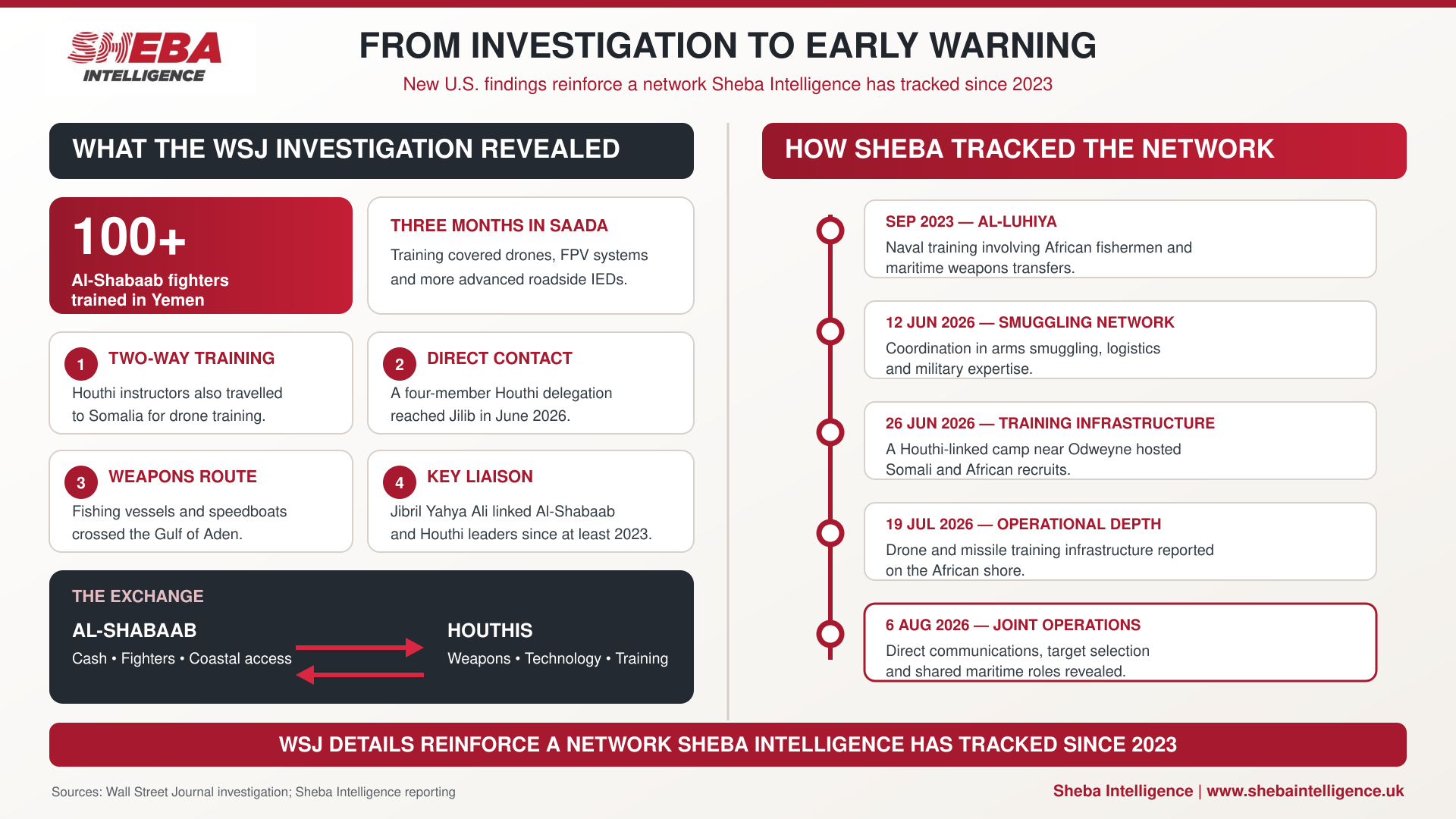
New details about weapons transfers, drone training and joint maritime planning confirm a network Sheba Intelligence has tracked since 2023
A Wall Street Journal investigation has revealed that cooperation between Yemen’s Houthis and Somalia’s Al-Shabaab has developed into an organised exchange of weapons, money, military training and operational support across the Gulf of Aden.
The investigation provides new names, numbers and operational details that reinforce a relationship Sheba Intelligence has tracked since September 2023—from maritime training involving African fishermen to arms smuggling, camps in Somaliland and reported joint attacks against shipping in the Red Sea and Gulf of Aden.
According to the Journal, at least 100 Al-Shabaab fighters travelled to Yemen for Houthi training, while Houthi instructors also moved to Somalia. A four-member Houthi delegation reportedly reached Jilib, the de facto capital of Al-Shabaab-controlled territory, in June 2026.
The findings suggest that the relationship has moved beyond transactions between smugglers and individual operatives. It now includes direct contact, two-way movement of personnel and efforts to build operational capability on both sides of one of the world’s most important maritime corridors.
The Liaison Killed in Al-Mahra
The Journal identified Somali militant Jibril “One-Armed” Yahya Ali as a central liaison between Al-Shabaab and the Houthi leadership since at least 2023.
An internal assessment by Yemen’s Counterterrorism Service described him as a key figure in facilitating weapons transfers and the exchange of military expertise. He reportedly travelled covertly between Somalia and Yemen, received a furnished apartment in Sanaa and was issued a forged Yemeni passport under an alias.
Jibril was killed near Al-Ghaydah in Yemen’s eastern Al-Mahra governorate on February 12, 2026. Two sources familiar with the operation told the Journal that the strike was carried out by the United States.
Sheba Intelligence had previously reported the killing of an Al-Shabaab figure in the same February strike in Al-Ghaydah. Information available at the time identified the man as Abdishakur Bahi and said he was carrying a forged Yemeni passport issued under the name Abdulqader Yahya Ali Ahmed Al-Zubaidi.
The overlapping location, timing and passport details indicate that the reports may concern the same operative, although the difference between the names requires further verification. The Journal’s investigation now provides a fuller account of his alleged role as the principal link between the two organisations.
A Smuggling Route Sheba Intelligence Tracked from Al-Luhiya
The Journal said front companies in Yemen concealed weapons inside shipments declared as civilian products. The cargo was moved through Mukalla and other Yemeni ports before crossing the Gulf of Aden aboard speedboats or fishing vessels.
The weapons were reportedly unloaded in poorly monitored coastal areas of northern Somalia and transported to Al-Shabaab combat units in the south.
This method closely matches information published by Sheba Intelligence in September 2023. The platform revealed that a Houthi naval force had received training in Al-Luhiya on Yemen’s Red Sea coast alongside African fishermen.
The fishermen were expected to transfer weapons from large ships at sea to smaller boats and store them on islands or in coastal areas. The 2023 report did not identify their nationalities or link them directly to Al-Shabaab, but it exposed an early component of the maritime logistics network later used between Yemen and the Horn of Africa.
In June 2026, Sheba Intelligence connected these earlier indicators to the emerging relationship in its report, From Al-Luhiya to Somaliland: Somalia Enters the Red Sea Shadow War. The report described growing coordination in arms smuggling, logistical support and the exchange of military expertise.
Fighters and Drone Training
A U.S. military intelligence official told the Journal that at least 100 Al-Shabaab fighters travelled to Yemen to receive Houthi training in advanced weapons and the production of more lethal roadside bombs.
One group reportedly spent three months in Saada during 2026 learning to assemble drones and operate first-person-view systems. Houthi instructors also travelled to Somalia to train Al-Shabaab personnel in drone operations.
These findings correspond with Sheba Intelligence reporting on the establishment of training infrastructure on the African side of the Gulf of Aden.
On June 26, Sheba Intelligence revealed that the Houthis were developing a camp in the Golis Mountains near Odweyne in Somaliland. The investigation said the facility hosted Yemeni fighters, Somali and other African recruits, foreign specialists and personnel trained to operate missiles and drones.
Sources also reported that drone and ballistic-missile components had been transferred to the area in separate shipments. The camp was intended to provide the Houthis with alternative operational depth on the African side of the Gulf of Aden.
A later Sheba Intelligence report said a July 14 airstrike targeted the same facility. AFRICOM did not publicly confirm the operation, but the reported strike suggested that the camp had become operationally significant.
Direct Contact Reaches Jilib
The Journal reported that a four-member Houthi delegation sailed from Yemen in June, landed on Somalia’s southern coast and travelled to Jilib to meet Al-Shabaab representatives.
The visit provides new evidence of direct organisational contact. It also supports earlier Sheba Intelligence reporting that the relationship was no longer confined to arms smugglers, overlapping maritime routes or informal exchanges.
According to Sheba Intelligence sources, direct communications were detected between senior Houthi operatives and Al-Shabaab through an external intelligence coordination station responsible for managing Houthi activity outside Yemen.
Those contacts reportedly focused on planning maritime operations, selecting targets and assigning responsibilities between the two sides.
From Cooperation to Joint Maritime Operations
The clearest indication of the relationship’s development came in an August 6 Sheba Intelligence exclusive.
Intelligence sources told the platform that several recent attacks against vessels in the Red Sea and Gulf of Aden had been conducted through operational coordination between the Houthis and Al-Shabaab.
The network reportedly monitored commercial shipping, tracked vessels linked to Saudi Arabia, provided targeting intelligence and supported operations against commercial and military ships.
Depending on the mission, the operational model could employ armed drones, guided missiles, naval mines, explosive-laden boats and unmanned surface vessels.
Its wider objective was to establish a parallel maritime front on the African coast opposite Bab al-Mandab, operating alongside attacks launched from Houthi-controlled Yemen.
The Journal’s reporting on delegations, training exchanges and weapons transfers now provides further detail about the personnel and logistical channels capable of supporting such a network.
Berbera as a Shared Target
The Journal also reported that the Houthis sought to coordinate with Al-Shabaab against Israeli activity in Berbera, fearing that the port could become a permanent platform for surveillance or attacks against Yemen.
In return, the Houthis reportedly promised Al-Shabaab more advanced weapons and training.
Sheba Intelligence had previously tracked Houthi attempts to expand their focus toward Somaliland under the stated objective of confronting Israel. Its reports documented military preparations, training infrastructure, drone and missile expertise and efforts to build alternative positions across the Gulf of Aden.
The development indicates that Somaliland is no longer simply adjacent to the conflict in Yemen. It is increasingly becoming an arena where Houthi networks, Somali armed groups and regional powers compete for access, intelligence and operational depth.
A Wider Regional Network
Other Sheba Intelligence investigations have documented the broader infrastructure supporting the Houthis’ expansion beyond Yemen, including financial networks designed to evade sanctions, attempts to reactivate air routes as maritime smuggling came under pressure, and the transfer of Iranian military technology to armed groups outside Yemen.
These reports do not all address Al-Shabaab directly. Together, however, they show how the Houthis have developed the financing, transport, training and technology-transfer mechanisms required to operate through partners across the Red Sea and the Horn of Africa.
The emerging relationship is based on practical interests. Al-Shabaab brings money, fighters and access to the Somali coast. The Houthis provide weapons, drone technology, training and experience in maritime warfare.
AFRICOM Commander Gen. Dagvin Anderson warned that the Houthis are establishing a foothold capable of destabilising one of the world’s most important economic chokepoints.
The threat is therefore no longer limited to Yemen or Somalia. A coordinated network operating on both sides of the Gulf of Aden could increase pressure on international shipping, complicate attribution and interdiction, and extend the Houthi maritime campaign from the Red Sea into the western Indian Ocean.