
Houthi Push for Al-Kadhah, a Gateway Toward Bab al-Mandab, Fails in Western Taiz
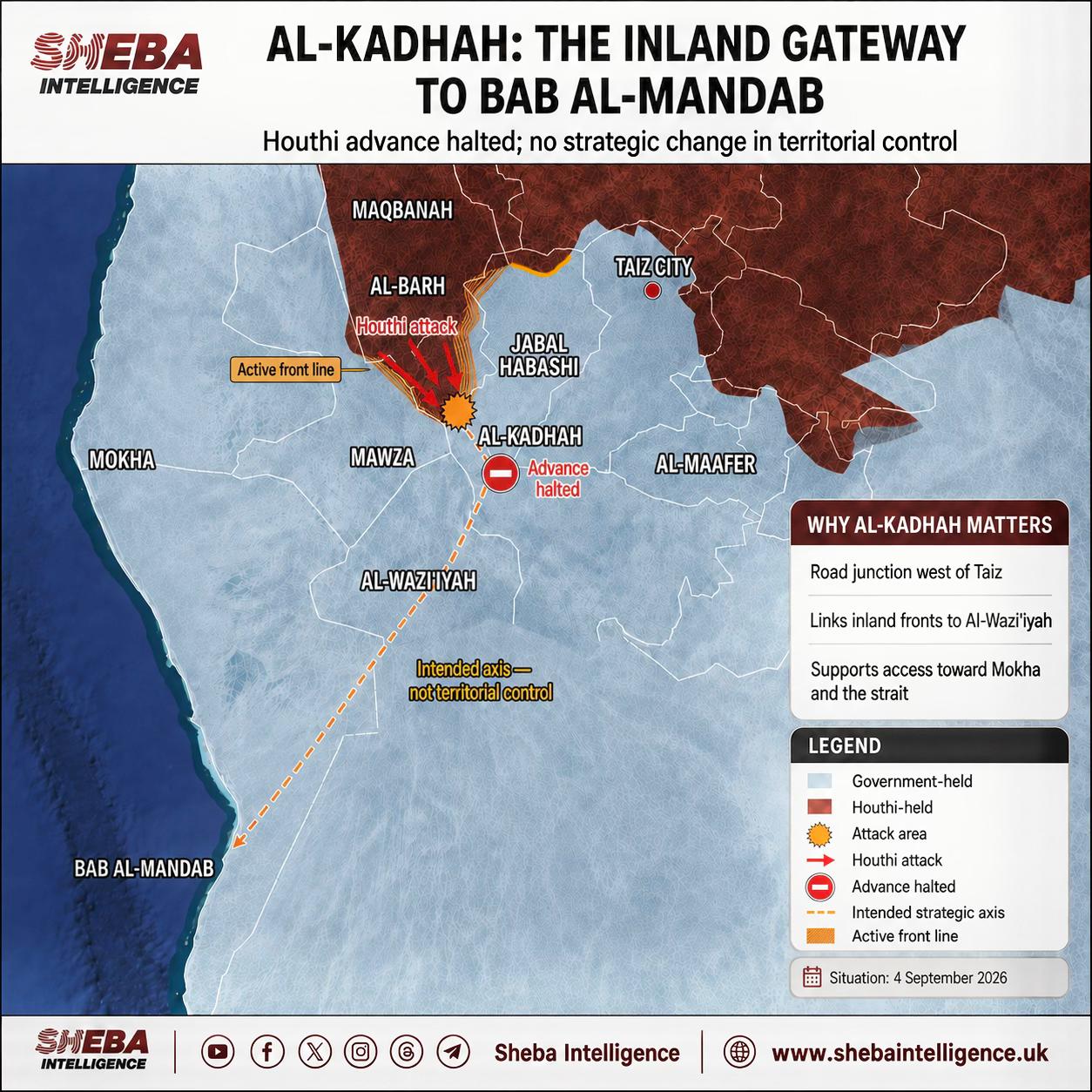
Government forces halt a coordinated ground offensive, while fighting continues to retake Jabal Numan and prevent the Houthis from establishing a foothold overlooking the coastal road network
Yemeni government forces have thwarted a Houthi offensive aimed at capturing Al-Kadhah, a strategic road junction in western Taiz that could have opened an axis of pressure toward Al-Wazi’iyah and the inland approaches to Bab al-Mandab, multiple field sources told Sheba Intelligence.
The Houthis attempted to break through the southwestern edge of Jabal Habashi district and advance from Al-Sharajah and Al-Rahbah toward Al-Afirah. The movement was designed to reach commanding heights overlooking the Al-Kadhah road before pushing toward the town itself.
Government forces and local Popular Resistance units halted the wider advance after prolonged fighting. The Houthis did, however, move onto Jabal Numan during the initial phase of the attack. Fighting is now concentrated around the mountain as government units attempt to retake it and prevent the group from consolidating the position.
The assault has not produced a strategic change in the front line. Al-Kadhah and the roads leading toward Al-Wazi’iyah and the coast remain under government control.
Why Al-Kadhah Was the Main Objective
Al-Kadhah is important because it sits along a network connecting western Taiz with Al-Wazi’iyah, Mokha and the government-held coastal belt near Bab al-Mandab.
Capturing the town would not have placed the Houthis directly at the strait. It would, however, have allowed them to threaten a key inland route supporting government forces around Mokha and the southern Red Sea coast.
The fighting around Jabal Numan should therefore be understood as part of the battle for the approaches to Al-Kadhah. The mountain overlooks villages and commanding positions around Al-Ashruh and Bani Bukari, as well as the Al-Birayn market and the road leading toward Al-Kadhah.
Its capture represents a limited tactical gain rather than a breakthrough toward the coast. Its military value depends on whether the Houthis can hold it, deploy weapons and observation systems there, and use it to support another advance.
Coordinated Assault Across Western Taiz
The fighting began early Thursday and continued for about 15 hours across Al-Barah and Al-Kadhah, as well as Suqm, Hadiyah and Al-Barashah in Maqbanah district near the administrative boundary between Taiz and Hodeidah.
The National Resistance’s military media said Houthi attacks were repelled along the Al-Barah and Hodeidah axes, with government forces forcing the attackers back from several contact lines and disabling military vehicles.
The 52nd Infantry Brigade also reported shooting down three Houthi reconnaissance and attack drones over the battlefield. Yemen’s official Saba news agency confirmed the fighting in Al-Barah and Al-Kadhah and the interception of the three drones over Jabal Habashi.
The ground attack coincided with the launch of about 14 ballistic missiles and several drones toward Mokha, Al-Khawkhah and other areas along the western coast. Government forces said the missiles did not affect their combat operations.
A field source said the Houthis also used electronic systems to jam and monitor communications in Maqbanah and Jabal Habashi. The activity appeared intended to disrupt coordination between defending units and track their movements during the attempted flanking operation.
There is no independent evidence that the Houthis intercepted the content of encrypted communications. Monitoring signals and locating active communication devices, however, could support artillery and drone operations.
Fighting Limited to the District’s Southwestern Edge
The clashes do not extend across Jabal Habashi as a whole. The district covers approximately 305 square kilometres, while the current fighting is concentrated along its southwestern boundary with Maqbanah.
This distinction is important because reports of fighting “in Jabal Habashi” could suggest a deeper territorial penetration than has occurred. The Houthis failed to reach Al-Kadhah or overturn the broader map of control, although the battle for Jabal Numan remains unresolved.
A Ground Component of the Bab al-Mandab Campaign
The failed advance adds a ground dimension to a broader pattern of Houthi pressure around Mokha and the approaches to Bab al-Mandab.
On August 20, Sheba Intelligence reported unusually large Houthi reinforcements moving toward Taiz, Mokha and the western coast. The deployments followed weeks of missile and drone attacks against Al-Kadhah, Maqbanah, Mokha and Al-Khawkhah.
That report traced the preparations to a July 19 high-level meeting in Sanaa that identified three priority theatres for a possible wider war: Marib–Al-Jawf, Taiz–Bab al-Mandab and the Saudi border. Earlier in July, Sheba Intelligence had also reported preparations for a naval exercise simulating the closure of the strait and the movement of missiles and drones toward coastal positions.
A separate Sheba Intelligence investigation said senior Islamic Revolutionary Guard Corps commander Abdul Reza Shahlai later met senior Houthi military leaders to discuss what sources described as a new phase of the war. The reported plan centred on pressure against Marib and an intensified western-coast campaign through Mokha toward Bab al-Mandab.
According to those sources, Iranian military experts subsequently assessed government defensive positions around Marib and the western coast. Limited attacks were described as a means of testing response times, command arrangements and vulnerabilities ahead of potentially larger operations.
The latest assault does not indicate that the Houthis were close to reaching Bab al-Mandab. Government-held territory and several defensive lines still separate the group from the strait. It does, however, show how an inland attack through western Taiz could be used to pressure the defensive depth protecting Mokha and the coast.
Pressure From Both Shores
The ground offensive also coincided with new information about a wider Houthi plan for the maritime corridor.
On September 3, Sheba Intelligence revealed efforts to develop a parallel maritime front on the Somali coast in coordination with Al-Shabaab. The reported plan includes transferring drone and missile capabilities, assigning surveillance and logistical roles, monitoring Saudi-linked vessels and using maritime intermediaries to track shipping.
If implemented, the arrangement would place vessels under pressure from the Yemeni and African shores while extending the operational theatre from the southern Red Sea into the Gulf of Aden.
The western Taiz offensive fits the Yemeni side of that broader picture: missile and drone pressure on Mokha and the coast, combined with attempts to weaken the inland defensive belt protecting routes toward the strait.
The operation nevertheless failed to achieve its immediate objective. The Houthis did not capture Al-Kadhah, did not open an axis toward Al-Wazi’iyah and did not alter the strategic balance around Bab al-Mandab. The continuing battle for Jabal Numan remains significant primarily because holding the mountain could support another attempt against the Al-Kadhah route.