
Government Counteroffensive Disrupts Houthi Bid to Cut Taiz Off from Yemen’s Western Coast
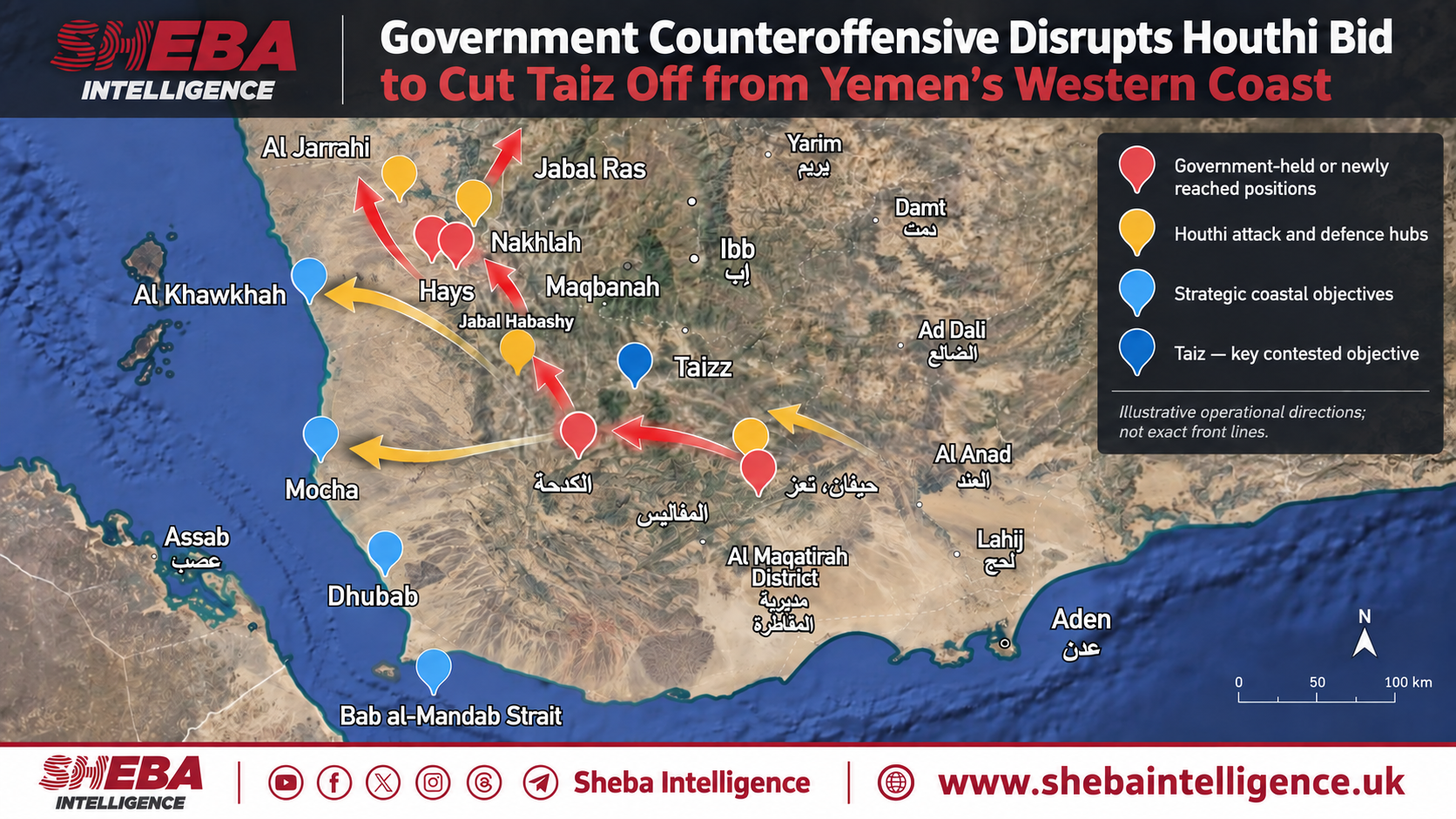
Yemeni government forces have shifted from containing Houthi attacks to launching counteroffensives across several fronts in Taiz and Hodeidah, recapturing positions in Hayfan and Hays while opening a new axis south of Al-Jarrahi.
The operations have begun to reverse some of the Houthis’ initial gains and complicate their attempt to pressure the routes connecting Taiz with Mokha and the western coast. They have also forced the group to defend a wider front stretching from southern Taiz to Hodeidah.
Strategic Heights Recaptured in Hayfan
Forces from the Fourth Hazm Brigade advanced in the Al-Mafalis area of the Hayfan front, taking control of the Al-Wathrah, Saeed Taha, Dhiban, Al-Khudairah and Al-Najdain heights.
The positions overlook Souq Al-Khazjah and Houthi supply routes leading toward northwestern Lahj and southern Taiz. Holding them would restrict the group’s ability to move fighters and equipment between adjacent fronts and place pressure on positions it had controlled for years.
The advance also creates a southern pressure point on the Houthi deployment around Taiz, potentially forcing the group to divert reserves away from the more active fronts in Maqbanah, Jabal Habashi and Al-Kadha.
Government Forces Reverse Houthi Gains around Hays
On the western coast, government forces recaptured Wadi Nakhla and Al-Fash east of Hays, as well as most of the positions lost in the Dubas and Saqam areas northeast of the city. They also reported further advances in the Al-Mahraq mountains along the Saqam axis.
The operation has prevented the Houthis from consolidating their initial push toward Hays and reduced the immediate threat to the road leading south toward Al-Khokha, Mokha and Bab al-Mandab.
The recovery of the surrounding high ground is particularly important because it limits the Houthis’ ability to observe government movements and target rear supply routes. Instead of serving as a launch point for a Houthi advance, Hays has become the centre of a broader government counteroffensive.
Field sources also reported advances into Hayjat Ubaid and toward the southern approaches to Jabal Ras district. These claims have not yet been independently verified, and it remains unclear whether government forces have consolidated control over the newly reached areas.
A New Front South of Al-Jarrahi
The National Resistance, supported by Giants Brigades units, has launched a counterattack south of Al-Jarrahi district. National Resistance drones targeted Houthi reinforcements and movements as ground forces advanced from positions farther south.
There is no confirmed evidence that government forces have entered Al-Jarrahi town. The significance of the operation lies instead in opening an additional pressure axis between Hays, Jabal Ras and southern Al-Jarrahi.
If sustained, the offensive could threaten the western flank of the Houthi deployment and compel the group to divert forces from the Taiz fronts to protect its positions in southern Hodeidah.
The Battle to Keep Taiz Connected to the Coast
In western Taiz, government forces recaptured Al-Khazzan Hill in Jabal Habashi and prevented the Houthis from achieving a decisive breakthrough along the Al-Kadha axis. Fighting continues in Maqbanah and across the high ground linking the three areas.
Al-Kadha remains central to the battle because it protects a key road connecting Taiz city with Mokha. Houthi control of the surrounding heights would expose the route to sustained fire and could gradually isolate Taiz from the western coast.
Although control of several positions in Maqbanah and Jabal Habashi remains contested, the defence of Al-Kadha and the recovery of positions in Jabal Habashi have so far prevented the Houthis from converting their initial advances into a strategic gain.
A Wider Front Increases the Cost of the Houthi Offensive
The counteroffensive has exposed a central weakness in the Houthi operation: the group is now required to sustain attacks and defend positions across an increasingly broad battlefield.
As the fighting expands from Hayfan and Jabal Habashi to Hays and Al-Jarrahi, Houthi reinforcements and supply movements become more vulnerable to government drones and air strikes. The deployment of the Giants Brigades and Shield of the Nation forces also points to greater coordination among government-aligned formations in Taiz and along the western coast.
The advances do not eliminate the Houthi threat. The group retains the ability to deploy reinforcements and use missiles, drones and artillery to disrupt government movements. Control of parts of the high ground between Maqbanah and Jabal Habashi also remains unsettled.
However, the Houthis have not achieved their principal objective of severing Taiz’s connection with the western coast or breaking the government’s defensive line around Hays. Instead, they now face pressure from Hayfan in the south and from Hays and Al-Jarrahi in the west.
Background
The counteroffensive follows weeks of Houthi mobilisation and attacks across western Taiz and southern Hodeidah. Previous reporting documented attempts to advance through Maqbanah, Jabal Habashi and Al-Kadha toward the Taiz–Mokha corridor, alongside repeated assaults on Jabal Dubas near Hays.
These movements formed part of a broader effort to pressure the government-held western coast after missile and drone attacks on Mokha and Al-Khokha. By threatening the inland roads and high ground rather than attacking Bab al-Mandab directly, the Houthis appeared to be seeking a gradual approach that could isolate Taiz, weaken Mokha’s land connections and expand their ability to threaten the strategic maritime corridor.
The government counteroffensive has not yet produced a decisive shift in the wider conflict, but it has disrupted that approach and created the possibility that the Houthi operation could turn into a costly fight to retain territory rather than an advance toward the coast.