
Government Counteroffensive Gains Ground in Taiz, Marib and Al-Jawf as Houthis Respond with Missile Strikes
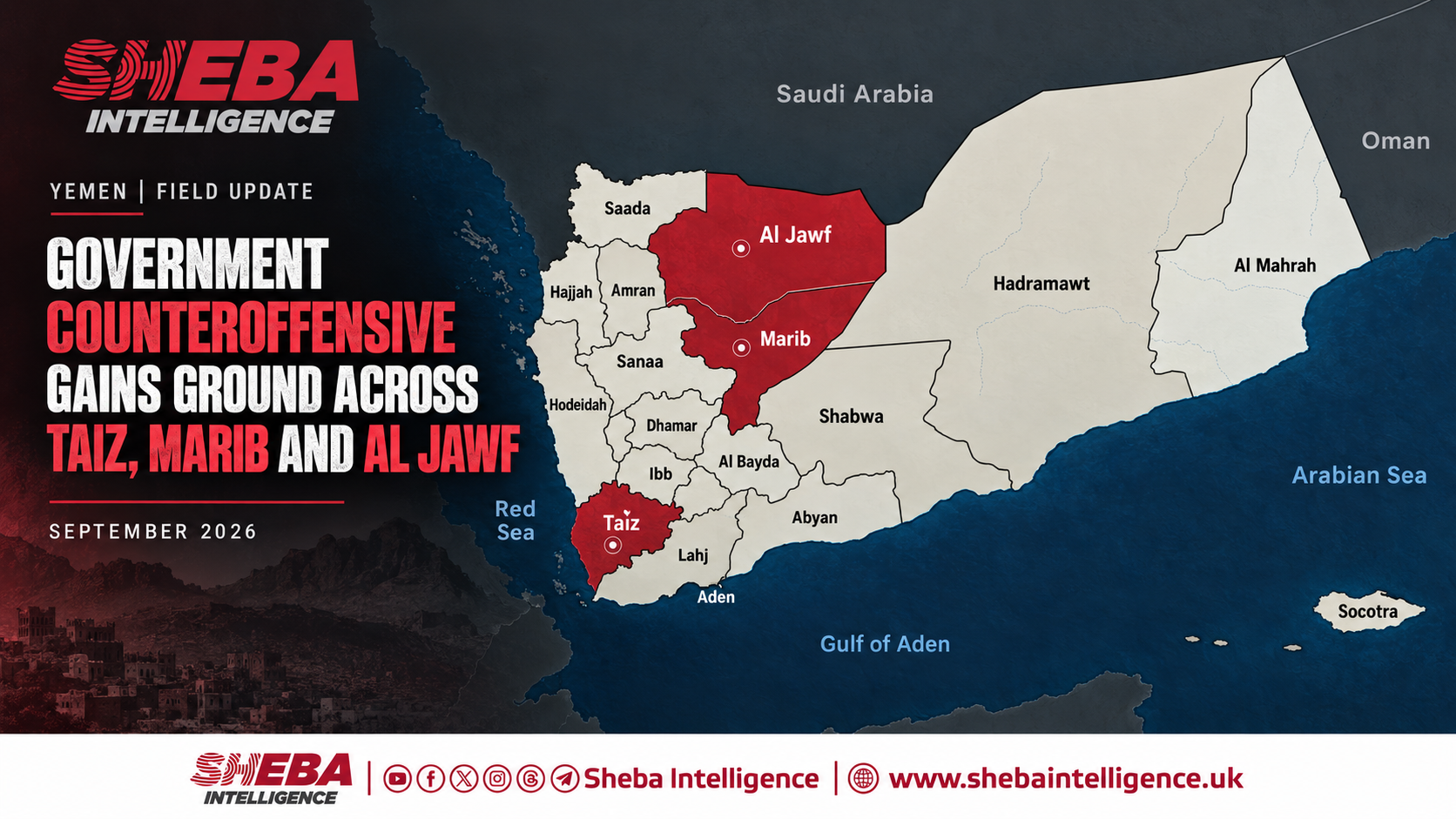
Yemeni government forces have made gains across key fronts in Taiz, Marib and Al-Jawf, signalling a shift from containing Houthi attacks to coordinated counteroffensives supported by warplanes, drones and artillery.
The operations follow weeks of Houthi mobilisation across three strategic theatres previously identified by Sheba Intelligence: the Taiz–Bab al-Mandab corridor, the Marib–Al-Jawf axis and areas near the Saudi border.
Government Forces Retake Al-Sharajah Junction
In western Taiz, government forces recaptured the Al-Sharajah junction and reopened the Taiz–Mokha road, reversing a Houthi breakthrough that had temporarily severed the city’s main connection with the western coast.
Sheba Intelligence previously reported that Houthi fighters had reached the junction after advancing through the Al-Kadaha axis, while clashes continued in Al-Makazemah and Akkad. The movement threatened not only the route to Mokha but also roads leading towards Al-Birein and the Taiz–Al-Turbah–Aden corridor.
Had the Houthis brought both routes under sustained fire or physical control, Taiz could have faced renewed isolation resembling the siege imposed on the city in 2015. Retaking the junction has disrupted that objective and prevented the group from consolidating its initial gains.
The advance is part of a broader government counteroffensive spanning Hayfan, Hays, Jabal Habashi and southern Al-Jarrahi. Government-aligned forces have recovered several positions and opened additional pressure axes, forcing the Houthis to defend a wider front stretching from southern Taiz into Hodeidah.
Houthis Turn to Missile Strikes After Retreat
Following their battlefield setback, the Houthis launched several missiles towards Taiz and other government-held areas. The timing suggests an attempt to slow the counteroffensive, strike rear positions and compensate for the loss of ground.
Sheba Intelligence had earlier obtained information indicating preparations for ballistic missile launches from sites in Hodeidah towards Mokha and Al-Khokha. Those preparations coincided with the ground campaign in western Taiz and the activation of the Al-Jawf front.
The combination of missile strikes and ground attacks appeared designed to disrupt government movements between Taiz, Mokha, Al-Khokha and the coastal fronts.
The full impact of the latest strikes on Taiz remains unclear. Further missile and drone attacks are possible as the Houthis attempt to contain the government’s advances.
Gains in Al-Kassarah as Emergency Forces Reach Raghwan
In Marib, field sources said government troops captured several positions on the Al-Kassarah front northwest of the provincial capital. Artillery and air operations simultaneously targeted Houthi positions and movements across the area.
Units from Yemen’s Emergency Forces have also reached Raghwan district in northern Marib, reinforcing the front between Al-Kassarah and Al-Jawf and increasing pressure on Houthi deployment and supply lines.
Holding new positions in Al-Kassarah would strengthen the defence of Marib’s northwestern approaches. The deployment in Raghwan could also restrict the movement of Houthi personnel and equipment between Al-Jawf and northern Marib.
Previous Sheba Intelligence reporting documented the establishment of drone launch infrastructure in Al-Jawf, the movement of reinforcements from Al-Jawf and Nihm towards Marib, and Houthi missile and drone attacks on Emergency Forces camps. Together, these indicators show that the Marib and Al-Jawf fronts form a connected operational theatre rather than two separate battlefields.
Warplanes Strike Al-Labnat and Al-Khanjar Camps
In Al-Jawf, government warplanes struck the Houthi-controlled Al-Labnat and Al-Khanjar camps, as well as reinforcements and troop concentrations east of Al-Hazm.
The airstrikes came hours after Sheba Intelligence reported that the Houthis had moved dozens of Katyusha rocket launchers, drones and reinforcements into the province in preparation for a possible offensive towards Al-Rayyan.
Government action began with pre-emptive strikes against Houthi positions, weapons stores and launch sites before expanding into a broader air operation against the two camps.
Al-Labnat, east of Al-Hazm, has served as a forward position for operations around the provincial capital and along desert routes leading towards Marib. Al-Khanjar is important because of its proximity to routes connecting northern Al-Jawf with Al-Yatmah and areas near the Saudi border.
Field reports indicated substantial Houthi losses at Al-Labnat. Unconfirmed accounts also claimed that the commander of the Houthis’ Sixth Military Region was killed in the strikes. Sheba Intelligence has not independently verified the claim, and the group has issued no official statement confirming his death or disclosing its casualties.
The camps were struck slightly more than five hours after Sheba Intelligence published details of the Houthi deployments. However, there is no evidence that the operation was launched in response to the report itself.
A Wider Houthi Escalation Strategy
The latest fighting is consistent with earlier information obtained by Sheba Intelligence about a high-level meeting in Sanaa that identified three priority theatres for escalation: Marib–Al-Jawf, Taiz–Bab al-Mandab and the Saudi border.
The apparent aim was to pressure government forces simultaneously, prevent them from concentrating reserves on the western coast and create opportunities for advances towards Marib or the approaches to Bab al-Mandab.
Al-Jawf emerged as a parallel pressure front after the Houthis failed to secure a decisive breakthrough through Al-Kadaha. Activating the province could have forced government units to redistribute personnel and equipment away from Taiz and the western coast.
Instead, pre-emptive strikes in Al-Jawf, the deployment in Raghwan, gains in Al-Kassarah and the recapture of Al-Sharajah indicate that government forces have responded across the same interconnected theatres.
Government Forces Regain the Initiative
The latest advances do not yet constitute a decisive strategic shift. Control of some high ground in western Taiz remains contested, while the Houthis retain the ability to launch missiles and drones against frontline units, supply routes and rear areas.
The developments nevertheless show that the Houthis have failed, for now, to sever Taiz from the western coast. Their preparations in Al-Jawf have come under sustained attack, while government pressure has expanded from Al-Kassarah and Raghwan to Taiz and southern Hodeidah.
If government forces consolidate the recovered positions, secure their supply lines and maintain coordination between air and ground units, the Houthi campaign could shift from an attempted advance towards Marib and Bab al-Mandab into an increasingly costly struggle to defend its existing positions.