
Expanded Air Campaign Halts Houthi Advance and Shifts Pressure to Rear Bases
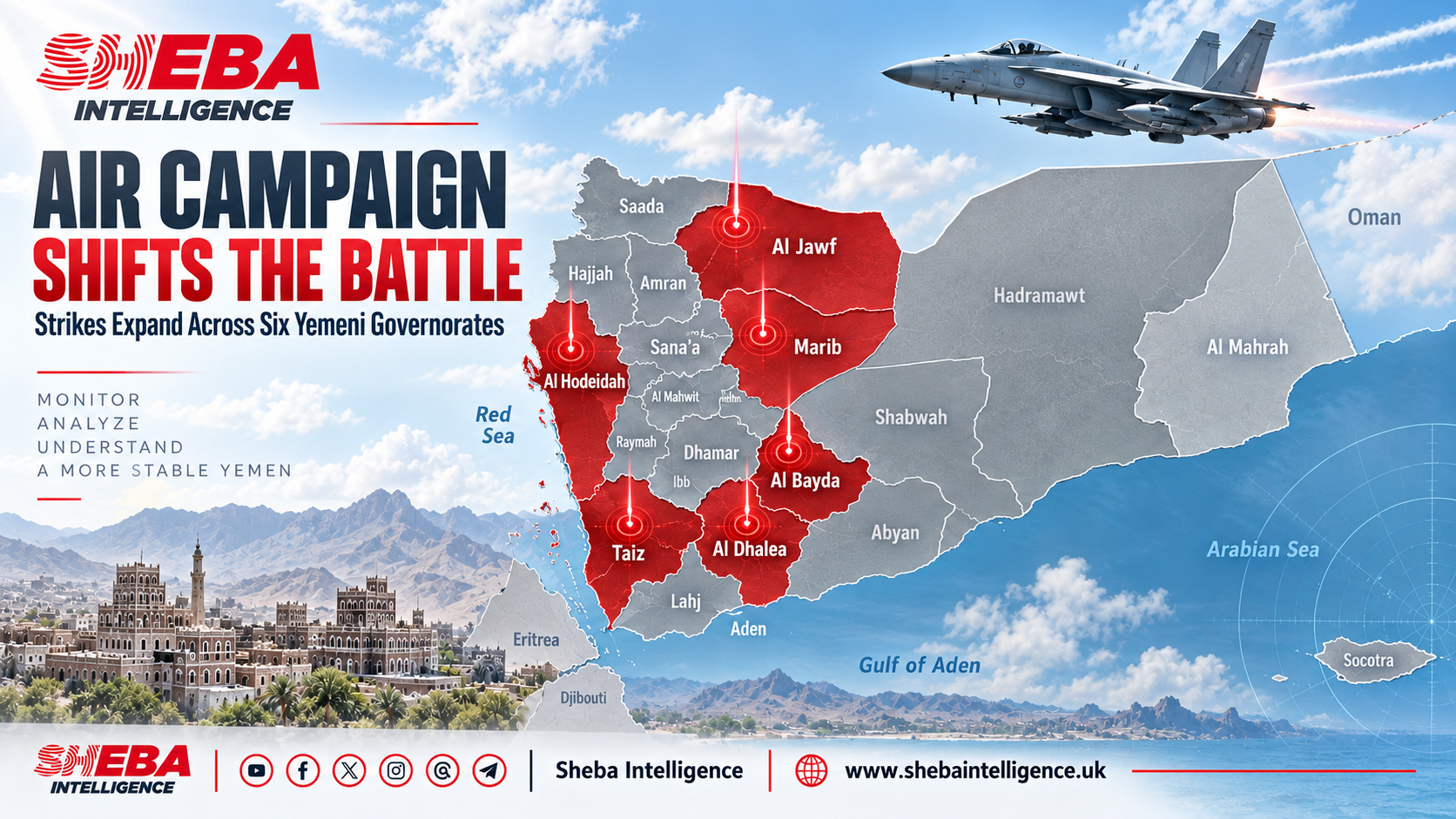
Yemeni government forces have expanded air operations against Houthi positions across five provinces, coinciding with a decline in the group’s ground offensive and the launch of government counterattacks in Taiz and along the western coast.
The developments support assessments published by Sheba Intelligence yesterday, which indicated that pre-emptive strikes were intended to prevent the Houthis from opening new fronts after their attempt to advance through western Taiz towards the coast and Bab Al-Mandab faltered.
Air Support Changes the Course of the Taiz Battle
Government warplanes directly entered the fighting in Taiz and Hodeidah, carrying out more than 15 strikes against Houthi positions, gatherings and military vehicles in Al-Barh, Al-Kadaha, Hays and southern Hodeidah.
The strikes coincided with a three-pronged government offensive in Al-Barh, the recapture of positions in Al-Kadaha and the establishment of new positions in southern Hodeidah.
Giants Brigades, National Resistance and other government units also launched counterattacks, retaking most of the positions the Houthis had entered during their latest offensive.
In the Al-Dhabab front, the Houthis shifted from large-scale attacks to a limited infiltration attempt, which government forces said they had repelled. Alongside the halt of further Houthi expansion around Al-Kadaha and Al-Sharajah, this suggests that the group has lost part of its initial offensive momentum.
Although the arrival of substantial government reinforcements contributed to the shift, air support enabled ground forces to manoeuvre and recover positions while making the massing of Houthi fighters and vehicles near the front lines increasingly dangerous.
Pre-Emptive Strikes in Al-Jawf and Marib
Some of the most significant air operations took place in Al-Jawf, where warplanes targeted Houthi positions, gatherings and suspected storage facilities in Al-Labnat, Al-Alam and Al-Hazm, the provincial capital.
Before the strikes, Sheba Intelligence had reported Houthi preparations in Al-Jawf, including reinforcements at camps and strategic positions ahead of a potential offensive. The rapid targeting of these sites indicates an attempt to disrupt those preparations before they could develop into a new ground operation.
In Marib, additional strikes hit Houthi positions on the province’s western outskirts and southern fronts, alongside artillery and drone operations around Al-Kassarah and Sirwah.
No significant change in territorial control has been independently confirmed. However, the strikes appear to have constrained the Houthis’ ability to assemble forces openly and move reinforcements between fronts.
Camps and Command Centres Targeted
The campaign extended into Al-Bayda, where government forces said they conducted more than 11 strikes within 24 hours against Houthi camps, weapons depots and military positions.
In the Murays front of Al-Dhalea, warplanes struck a Houthi position on Jabal Nasah. Government forces said the operation destroyed a command-and-control room and a thermal surveillance system, while also targeting fighters gathered at the site.
The reported damage has not been independently verified. Nevertheless, the geographical spread and nature of the targets show that the campaign has moved beyond tactical support at the front lines to disrupting Houthi command, mobilisation and weapons-storage infrastructure deeper inside the group’s territory.
Houthis Under Growing Air Pressure
The operational effect of the air campaign can be seen in the halt of the Houthi advance, the start of government counterattacks and the expansion of strikes against sites used to prepare and support ground operations.
After initially massing forces to push into government-held territory, the Houthis now face pressure to disperse personnel and vehicles, reinforce defensive positions and prepare for the possibility of sudden strikes against their camps.
The setback does not mean the threat of another offensive has ended. Government military sources told Sheba Intelligence that the Houthis may reorganise and launch attacks on several fronts following the failure of their previous push.
The group may increasingly rely on missiles, drones, shelling and limited infiltration operations rather than concentrating large ground formations that could be detected and targeted from the air.
Sustaining the current shift will depend on the continuity of air operations, the quality of battlefield intelligence and the ability of ground forces to secure recovered positions. For now, however, the direction of pressure has changed: the Houthis have moved from advancing into government-held territory to protecting their forces and rear bases from further airstrikes.