
Yemeni Government Forces Advance Beyond Al-Labnat Camp in Al-Jawf
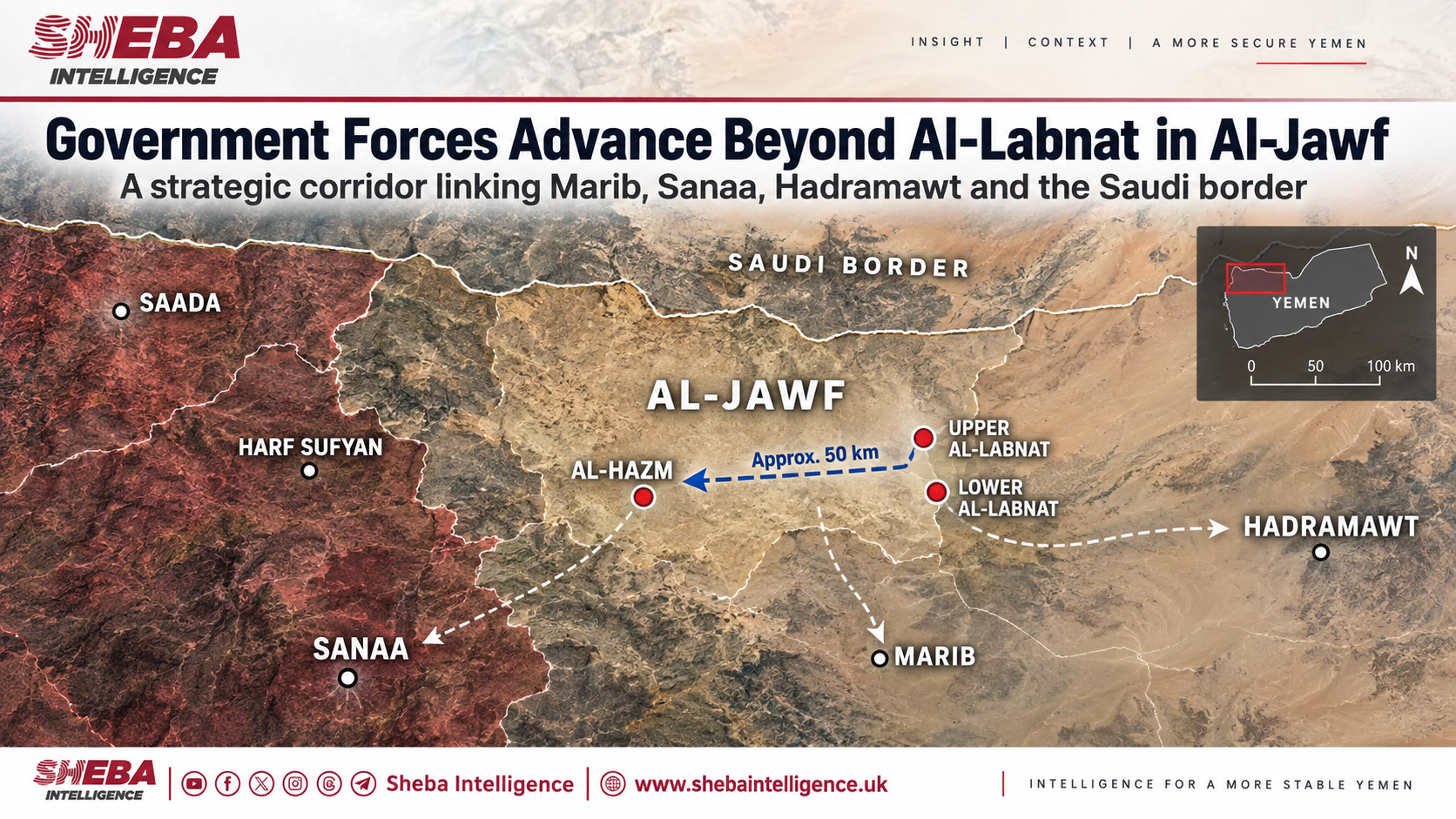
Yemeni government forces continued advancing east of Al-Hazm, the capital of Al-Jawf Governorate, after taking control of Al-Labnat military camp and moving beyond the Upper and Lower Al-Labnat areas, field sources said.
The forces launched their assault from two directions, securing the camp and surrounding territory before advancing towards positions within the Houthis’ eastern defensive belt around Al-Hazm.
The ground operation followed air strikes on the Al-Labnat and Al-Khanjar camps, as well as Houthi reinforcements and gatherings east of Al-Hazm. A Yemeni military spokesperson said the operation destroyed and neutralised Houthi personnel and capabilities inside Al-Labnat, using newly introduced military assets.
Before the strikes, Sheba Intelligence reported that the Houthis were moving reinforcements and preparing military positions in Al-Jawf as part of plans to reactivate the front. Al-Labnat has served as a forward position for operations around Al-Hazm and along desert routes leading towards Marib.
Al-Jawf is militarily important to the Houthis because of its location between Saada, Harf Sufyan, Marib, Hadramawt and the Saudi border. Its expansive desert also provides routes for moving weapons and personnel away from main roads and populated areas.
According to intelligence sources, the Houthis have used Al-Jawf as a transit point along arms-smuggling routes extending from Yemen’s eastern border through Al-Mahra and Hadramawt towards Al-Hazm and Sanaa. Previous international reports have documented the movement of components linked to Houthi military programmes through routes passing via Oman and Al-Jawf.
Repeated information received by Sheba Intelligence indicates that the Houthis established a central joint operations room in the governorate to coordinate military activity in Al-Jawf and connected fronts.
The information also points to the presence of Islamic Revolutionary Guard Corps missile specialists at an operations room in Al-Jawf, where they allegedly provide technical support related to missile and unmanned aerial vehicle capabilities. Sheba Intelligence could not independently verify the experts’ identities or the room’s precise location.
Sources said the Houthis have also established workshops and concealed facilities across the governorate for assembling and storing missiles, drones and their components, taking advantage of the desert terrain and Al-Jawf’s proximity to Saada and Harf Sufyan.
The governorate hosts part of the Houthi reserve forces assigned to the Fifth and Sixth Military Regions, according to the information, as well as a mobile military formation created to reinforce fronts facing increased pressure.
This formation is not tied to a fixed geographical front. The Houthis use it to transfer fighters and weapons between Al-Jawf, Marib, Hajjah, Hodeidah and northern battlefronts.
Al-Jawf also has historical importance for the Houthi movement. Local sources say Houthi leader Abdulmalik Al-Houthi took refuge in the governorate during the sixth Saada war, benefiting from its links with Saada and Harf Sufyan and its complex desert and tribal environment.
The Houthis captured Al-Hazm in 2020 and subsequently turned parts of Al-Jawf into forward military positions for operations towards Marib and the Saudi border. The loss of Al-Labnat camp and the government forces’ advance beyond Upper and Lower Al-Labnat come amid continuing clashes east of the provincial capital.