
Airstrikes Disrupt Houthi Offensive Preparations in Al-Bayda as Shabwa Remains at Risk
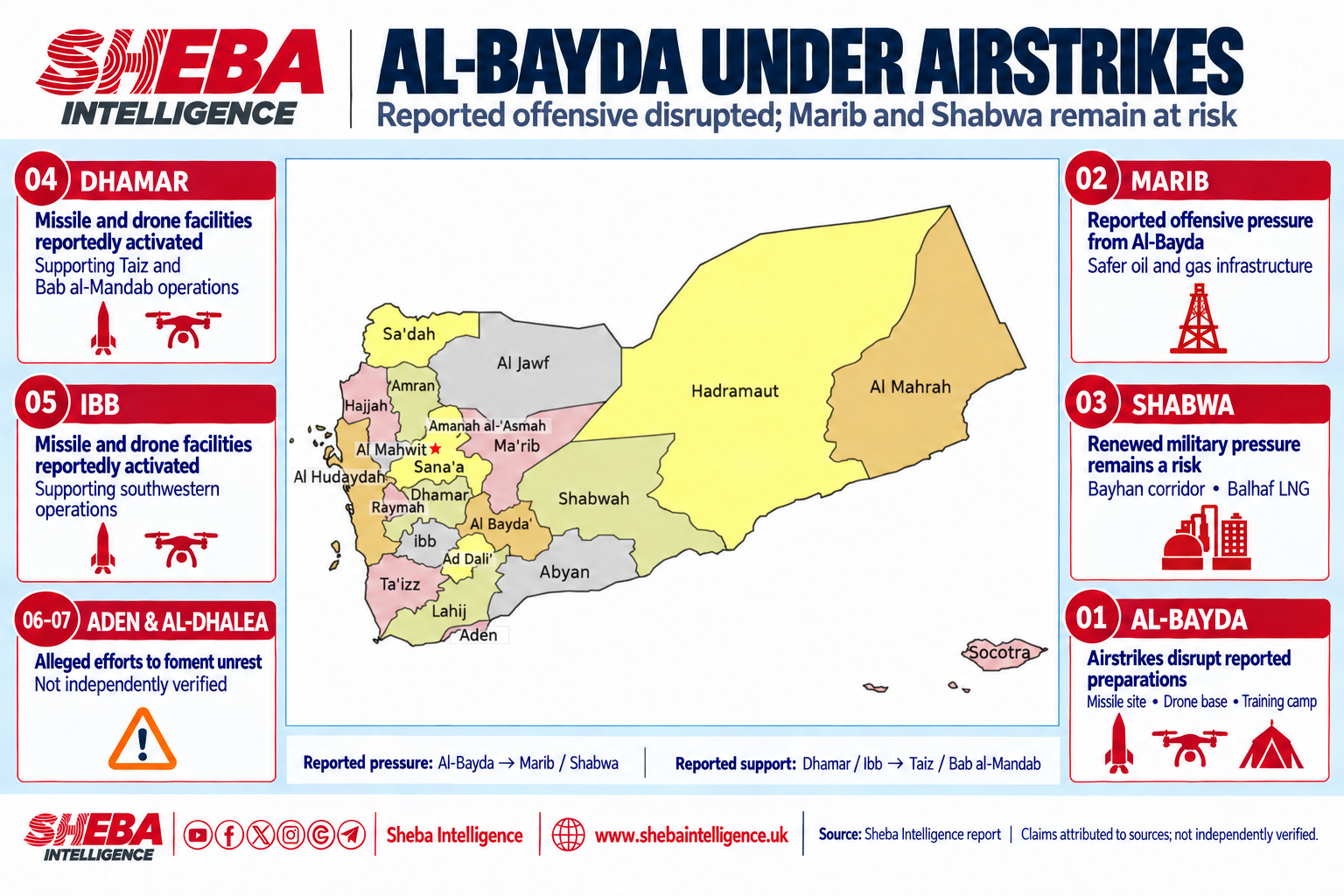
Sustained airstrikes on Houthi military positions in Al-Bayda governorate have disrupted preparations for a planned two-front offensive toward Marib and Shabwa, sources told Sheba Intelligence.
According to the sources, the strikes forced the Houthis to adjust parts of their military deployment while simultaneously activating missile and drone facilities in Dhamar and Ibb to support operations toward Taiz and Bab al-Mandab.
The preparations in Al-Bayda reportedly included activity at a missile site, a drone base and a military training camp, forming part of a broader plan to apply simultaneous pressure toward southern Marib and Shabwa.
The sources said the intensity of the air campaign complicated the implementation of that plan and reduced the Houthis’ ability to use Al-Bayda as a secure rear area for offensive preparations.
Sheba Intelligence has not independently verified all details of the reported plan or determined whether a final order to launch the offensive had been issued.
Al-Bayda Under Sustained Air Pressure
The new information comes amid repeated airstrikes on Houthi military positions across Al-Bayda.
Government forces have announced several air operations in the governorate during September, targeting military positions, vehicles, troop concentrations and missile-related infrastructure.
Sources said the air campaign has not halted Houthi military activity altogether, but has disrupted part of the preparations and forced the group to redistribute some operational functions across other governorates.
Missile and Drone Facilities Activated in Dhamar and Ibb
As Houthi capabilities in Al-Bayda came under sustained pressure, the group activated missile and drone facilities in Dhamar and Ibb, according to sources who spoke to Sheba Intelligence.
The facilities are reportedly intended to support military operations toward Taiz and Bab al-Mandab.
The development does not appear to represent a simple transfer of weapons and equipment out of Al-Bayda. Rather, the sources describe a broader effort to increase reliance on alternative operational hubs capable of sustaining missile and drone activity on the southwestern fronts.
According to the sources, this dispersal is designed to preserve Houthi operational capacity while reducing dependence on military sites in Al-Bayda, which have become increasingly exposed to surveillance and airstrikes.
Sheba Intelligence could not independently verify the precise locations or operational readiness of all the missile and drone facilities described by the sources in Dhamar and Ibb.
Shabwa Remains Within the Threat Envelope
Despite the disruption of the reported offensive preparations, sources warned that Shabwa remains at risk of renewed Houthi military pressure.
The governorate holds strategic significance well beyond its geography because of its oil and gas infrastructure, particularly the Balhaf LNG facility on the Arabian Sea coast.
According to the sources, any Houthi breakthrough into Shabwa could open a wider route for pressure on energy-producing and export areas across southern and eastern Yemen.
The concern extends farther east to the Masila oil fields in Hadramout, although there is currently no evidence indicating that an offensive toward Masila is imminent.
Energy Resources at the Center of the Military Calculus
Concerns over Shabwa are closely linked to the continuing battle for Marib, home to some of Yemen’s most important oil and gas infrastructure, particularly around Safer.
The sources said the substantial military cost the Houthis continue to bear in their attempts to increase pressure on Marib reflects the strategic importance of gaining access to major energy resources.
From this perspective, Marib and Shabwa may not represent two separate fronts, but rather elements of a broader contest over territory, supply routes, energy infrastructure and strategic access.
The recent developments around Bab al-Mandab, according to the sources, have further heightened concern that the Houthis could attempt to replicate elements of the same model elsewhere: applying sustained military pressure while exploiting internal divisions and security vulnerabilities until defensive lines are weakened or breached.
Concerns Over Internal Destabilization
In a more politically sensitive assessment, sources told Sheba Intelligence that individuals and networks previously associated with the United Arab Emirates are allegedly involved in arrangements that could contribute to weakening the security situation in Shabwa, alongside efforts to generate unrest in Aden and Al-Dhalea.
The sources said that any large-scale internal disruption could weaken government-aligned defenses and create gaps that the Houthis might seek to exploit militarily.
Sheba Intelligence has not independently verified these allegations and has obtained no public evidence establishing direct coordination between the individuals or networks described by the sources and the Houthis.
The information is therefore being treated as an intelligence lead requiring further verification, rather than as an established fact.
Background: Sheba Intelligence Had Already Tracked the Al-Bayda Build-Up
In an earlier report, Sheba Intelligence documented unusual Houthi military activity in Al-Bayda, including a drone facility, a ballistic missile site and a military training camp.
The report identified activity at a drone facility in Al-Thurayya in the Al Mifa’ area, movements linked to ballistic missiles around Al-Juroub in the Al-Rashidah area of Afar, and troop movements and reinforcements associated with a training camp in Al Amer, Hawran.
At the time, Sheba Intelligence outlined several possible explanations for the build-up, including reinforcing the southern Marib front through Bayhan in Shabwa, or preparing missile and drone operations toward Taiz, the western coast, Lahj, Aden, Shabwa, Al-Dhalea and Marib.
The latest information now provides a clearer possible explanation for at least part of that activity.
Sources say the build-up was linked to preparations for a two-front offensive toward Marib and Shabwa, before sustained airstrikes disrupted the plan.
At the same time, the activation of missile and drone facilities in Dhamar and Ibb suggests that pressure on Al-Bayda has not eliminated Houthi operational capacity, but has instead encouraged the group to disperse its military infrastructure across several operational hubs.
The emerging picture points to three main axes of pressure: Marib and Shabwa from the Al-Bayda direction, and Taiz and Bab al-Mandab supported by operational infrastructure in Dhamar and Ibb.
This pattern suggests an effort by the Houthis to maintain pressure across multiple fronts simultaneously, despite continued air attacks on their military infrastructure.