
Inside the IRGC-Built Hybrid Communications Network Now in Houthi Combat Operations
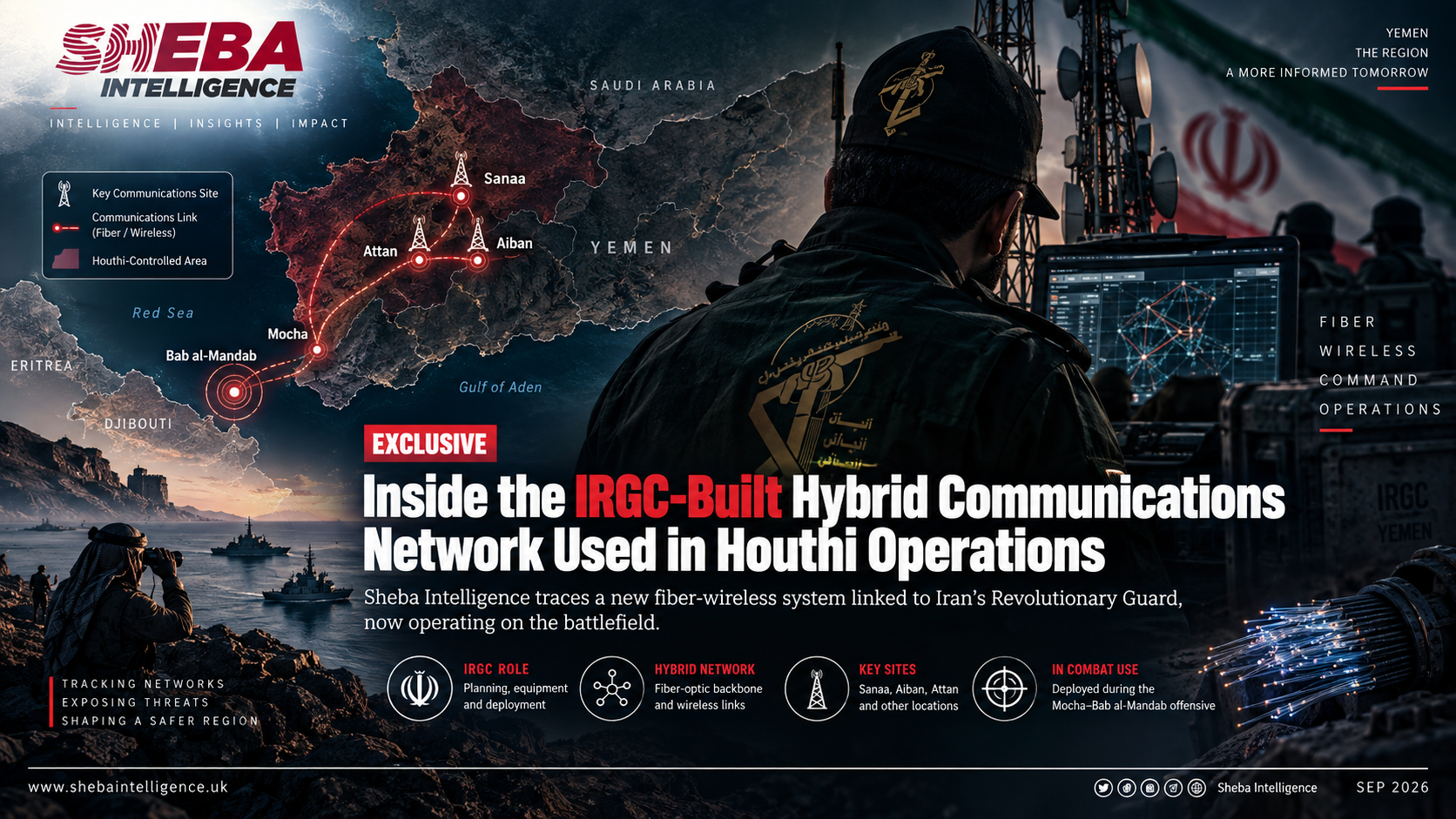
Sheba Intelligence traces a hybrid fiber-wireless system deployed during the Mocha–Bab al-Mandab offensive as Iran moves to harden Houthi command networks against penetration and disruption
Sheba Intelligence | Investigation
Sheba Intelligence has uncovered a new layer in the Houthis’ military communications architecture linked to Iran’s Islamic Revolutionary Guard Corps. The system combines fiber-optic infrastructure with modern wireless communications and has already entered operational service.
The investigation began after vehicles carrying telecommunications towers and related equipment were observed moving through Houthi-controlled areas. Tracking the movements led to information indicating that the equipment formed part of a broader project to reinforce Houthi military communications.
Information obtained by Sheba Intelligence indicates that the IRGC is directly linked to the introduction of the new communications layer. The project included the delivery of modern wireless communications equipment, the installation of new systems at existing telecommunications sites and the establishment of dedicated stations at Jabal Aiban and Attan in Sanaa.
The equipment was integrated into existing fiber infrastructure rather than deployed as an independent radio network. The result is a hybrid military communications architecture that combines fiber-optic links with wireless connectivity.
The system was later deployed during the Houthi offensive on Mocha and Bab al-Mandab, placing the new communications capability inside an active combat environment.
Its emergence also provides new context for “In the Heart of the Enemy,” an operation previously revealed by Sheba Intelligence that targeted sensitive communications infrastructure in Sanaa.
A New Layer in the Network
The Houthis already operate within a complex communications environment.
Their communications infrastructure includes Yemen’s fixed telecommunications network, commercial mobile networks, military communications systems and specialized infrastructure previously used by intelligence agencies and the former Republican Guard.
The Houthis have also developed dedicated internal networks for sensitive communications. These include a system identified by Sheba Intelligence sources as “Jihadi Communications,” used for leadership and military traffic.
The newly identified system adds another layer.
Information obtained by Sheba Intelligence indicates that key stations are connected to subordinate nodes through fiber-optic lines. Wireless equipment has been added to provide another transmission layer across the network.
The available information supports describing the system as a hybrid fiber-wireless military communications architecture.
Sheba Intelligence has not identified the manufacturers or models of the equipment. Technical details covering operating frequencies, radio protocols, encryption standards and electronic protection measures remain unavailable.
It is also not yet established whether the wireless links serve as automatic backup routes when fiber connectivity is lost or operate continuously alongside the fixed network.
The architecture does, however, provide more than one communications medium and reduces dependence on a single transmission infrastructure.
Aiban and Attan Become Key Nodes
The investigation identified Jabal Aiban and Attan as key locations in the deployment.
Information obtained by Sheba Intelligence indicates that dedicated stations supporting the new system were established at both sites. Other telecommunications towers were fitted with additional equipment as part of the same project.
The elevated terrain at Aiban and Attan provides favorable conditions for line-of-sight radio communications and broader coverage.
The full network topology remains unknown. Sheba Intelligence has not yet established the number of nodes, relay sites or the geographic reach of the system.
The communications medium alone also does not determine the security of the network. Encryption, endpoint protection, authentication, key management and operational procedures remain critical to the resilience of any military communications architecture.
First Operational Deployment at Bab al-Mandab
The system did not remain confined to Sanaa.
Information obtained by Sheba Intelligence indicates that the new communications architecture was deployed and used operationally during the Houthi offensive on Mocha and Bab al-Mandab.
The network was used for military communications during the operation and provided connectivity between command elements and forces operating in the field.
This marks a significant stage in the development of the system. It had moved from deployment into combat use.
The finding also reveals a previously undisclosed element of the Houthi campaign on Yemen’s western coast. A new military communications capability was operating behind the ground advance.
The network cannot be isolated as the sole explanation for Houthi battlefield gains.
The offensive involved ground maneuver, missile and drone attacks, pressure across multiple axes and changes in government defensive positions.
The information obtained by Sheba Intelligence indicates, however, that the new system supported command connectivity and operational coordination during the campaign.
Its use at Bab al-Mandab therefore provides the first known indication obtained by Sheba Intelligence that the new communications layer had entered active military operations.
Iran’s Lessons From Communications Breaches
The project also reflects a wider concern within the IRGC over communications security.
Information obtained by Sheba Intelligence indicates that Iranian planners have studied security and communications breaches affecting Iranian networks and Hezbollah in Lebanon.
The IRGC does not want the same vulnerabilities reproduced inside Houthi military communications in Yemen.
That concern has increased the emphasis on diversifying communications networks and transmission paths used for command and military operations.
The new architecture fits that approach. Fiber provides a fixed, high-capacity transmission backbone. Wireless connectivity adds another means of linking selected sites and nodes.
This does not make the network immune to penetration.
Fiber infrastructure can be physically targeted or accessed at vulnerable nodes. Wireless links can be detected, intercepted or jammed depending on their technical characteristics. Compromised terminals, authentication systems or encryption keys can expose a network regardless of the transmission medium.
The significance of the new system therefore lies in greater redundancy and communications resilience, not in any assumption that it is impenetrable.
Beyond Communications: Building a Wider Intelligence Network
The new communications architecture is not the only indication that the Houthis and their Iranian partners are expanding the technical infrastructure behind military operations.
On September 13, Sheba Intelligence reported that the Houthi external intelligence apparatus had reached agreements with Meentropy Technology, a Hangzhou-based Chinese company operating as MizarVision, for satellite imagery and maritime surveillance data. According to information obtained by Sheba Intelligence, the arrangement was facilitated through Iran’s military attaché’s office in China and involved Houthi liaison officers in Muscat. Sheba Intelligence could not independently verify that the reported services had become operational.
The reported arrangement was intended to provide imagery and geospatial data covering the Red Sea, Arabian Sea and waters around Saudi Arabia. The information obtained by Sheba Intelligence indicated a particular interest in monitoring Saudi and allied naval movements and supporting missile and drone operations.
The September disclosure followed an earlier Sheba Intelligence investigation in June that found the Houthis were seeking Chinese satellite imagery, coordinates and geospatial capabilities through a Muscat-based channel linked to Iran. That investigation identified Chang Guang Satellite Technology in connection with the reported discussions, although Sheba Intelligence could not establish whether the company directly supplied imagery or whether any services were obtained through an intermediary.
Taken together, the findings point to a broader effort to expand the technical infrastructure supporting Houthi operations. Satellite-derived information can extend surveillance beyond the range of ground observation, while military communications networks can move operational data between command centers and forces in the field.
There is currently no evidence establishing that the Chinese satellite services are technically integrated into the newly identified hybrid communications network. The two developments nevertheless show parallel efforts to strengthen different parts of the same operational chain: collecting information, moving data, maintaining command connectivity and supporting military operations.
“In the Heart of the Enemy”
The discovery also changes the context surrounding a recent operation inside Sanaa.
Sheba Intelligence previously revealed details of “In the Heart of the Enemy,” an operation that targeted sensitive Houthi communications infrastructure.
Information obtained during that investigation indicated that drones tracked nodes associated with a fiber-optic network before a main communications room was struck on the ground.
The operation took place alongside other attacks on communications-related infrastructure and reports of a cyberattack affecting Houthi-controlled telecommunications networks and cloud storage.
The latest investigation now identifies a technical and geographic overlap.
The newly identified military system relies on fiber-optic infrastructure and wireless connectivity. Its deployment includes facilities at Jabal Aiban and Attan. The earlier operation focused on fiber nodes and a communications facility within the same broader communications environment.
Information obtained by Sheba Intelligence indicates that degrading Houthi command-and-control connectivity was among the objectives of the operation.
The targeting was intended to weaken communications supporting military operations and reduce an operational advantage that had become increasingly important during recent campaigns.
Sheba Intelligence has not established that the communications room struck in Sanaa was the primary control center of the new system. It has also not confirmed that every fiber node identified during the operation belonged to the same network.
The evidence currently establishes an operational, technical and geographic overlap. A complete link would require further identification of the equipment, nodes and fiber routes involved.
The Battle Moves Into Command and Control
The investigation points to a broader shift in the conflict.
The IRGC is linked to the introduction of a new layer in Houthi military communications. The system integrates fiber and wireless connectivity, includes key infrastructure around Sanaa and has entered operational use on the battlefield.
Its deployment during the Mocha–Bab al-Mandab offensive shows that the project has moved beyond infrastructure development.
The subsequent targeting of communications infrastructure in Sanaa shows the other side of the contest.
Military communications are no longer simply supporting infrastructure. They are becoming a target in their own right.
For the IRGC and the Houthis, the objective is to build a command-and-control architecture capable of maintaining connectivity when individual links or nodes are disrupted.
The opposing effort is increasingly focused on identifying those networks, locating critical nodes and degrading the connectivity between commanders, operational headquarters and forces in the field.
The new hybrid network now sits inside that contest. Bab al-Mandab demonstrated its operational use. “In the Heart of the Enemy” demonstrated why the communications architecture behind it had become a target.