
Airstrikes Target Fortified Missile Tunnels in Attan as Intelligence Sources Reveal Advanced Air-Defense System on Jabal Nuqum
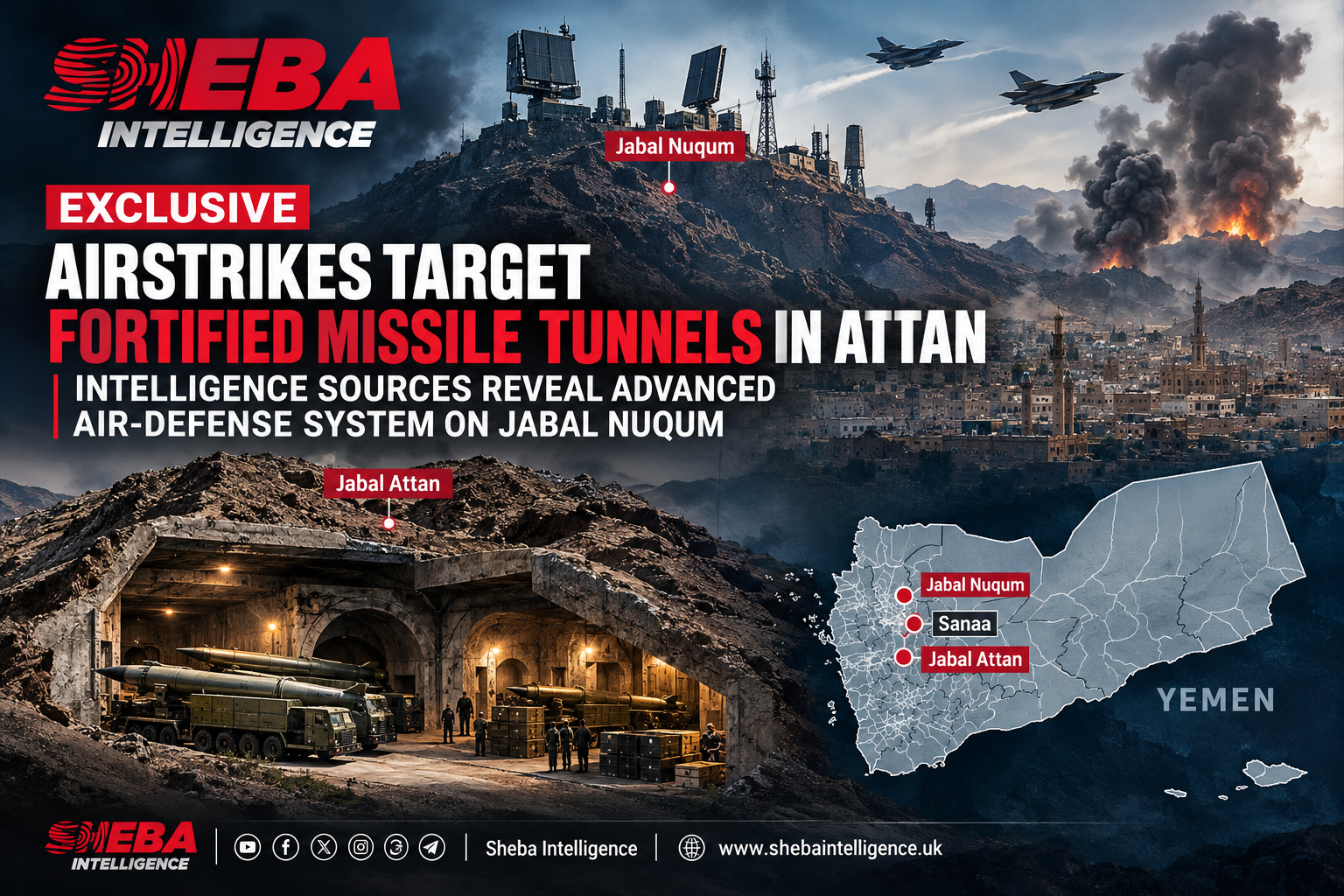
Intelligence sources tell Sheba Intelligence that the strikes hit entrances linked to underground missile facilities inside Jabal Attan, while Jabal Nuqum has recently been reinforced with advanced air-defense capabilities, new missile systems and specialized aircraft-tracking equipment operated under the supervision of IRGC experts. It remains unclear whether the newly deployed air-defense system on Nuqum was targeted in the latest strikes.
Sheba Intelligence | Exclusive
Airstrikes on Saturday targeted entrances linked to a network of fortified missile tunnels and underground facilities inside Jabal Attan in Sanaa, as Yemeni intelligence sources separately revealed to Sheba Intelligence the presence of an advanced air-defense system on Jabal Nuqum, recently reinforced with new missile systems and specialized equipment for detecting and tracking military aircraft under the supervision of experts from Iran’s Islamic Revolutionary Guard Corps (IRGC).
According to the sources, the strikes on Jabal Attan hit sites associated with newly prepared entrances to missile caves, leading into a network of tunnels that the Houthis had recently rehabilitated and partially reopened.
Information obtained by Sheba Intelligence indicates that the tunnel network is connected to fortified underground weapons and missile storage facilities, operations rooms and other military infrastructure.
There is not yet sufficient information to determine the extent of damage inside the underground complex or whether the strikes penetrated into the deeper sections of the tunnel network.
Advanced Air-Defense Capabilities on Jabal Nuqum
In a separate development, intelligence sources told Sheba Intelligence that the Houthis have established advanced air-defense capabilities on Jabal Nuqum, a strategic mountain overlooking Sanaa, and reinforced the site with new missile systems in recent days.
The sources said specialized air-surveillance and receiving equipment designed to detect and track military aircrafthas been activated at the site. The equipment is intended to provide operators with air situational awareness, particularly for detecting and tracking airborne targets operating at medium altitudes.
According to the sources, some of the surveillance equipment incorporates frequency-agility techniques, allowing operating frequencies to be changed in ways intended to reduce vulnerability to electronic jamming and improve the system’s ability to continue detecting and tracking aircraft in a contested electromagnetic environment.
IRGC experts supervised the activation and operation of these capabilities, the sources said, while new missile systems were brought into Jabal Nuqum during the past several days.
Sheba Intelligence has not independently established the exact type, range or operational characteristics of the newly introduced missile systems.
There is currently no confirmed information indicating whether the newly deployed air-defense system and associated surveillance equipment on Jabal Nuqum were targeted in Saturday’s strikes. Although strikes were reported in the Jabal Nuqum area, the information available to Sheba Intelligence does not establish whether the new air-defense assets were among the specific targets or whether they sustained any damage.
From Underground Missile Facilities to Air Defense
The new intelligence adds to a broader picture documented by Sheba Intelligence in recent months of the Houthis developing a distributed military infrastructure across the mountains surrounding Sanaa, combining underground missile facilities, air defenses, military communications, and command-and-control capabilities.
Sheba Intelligence previously reported the deployment of air-defense capabilities on Jabal Nuqum, including surface-to-air missiles and equipment used to monitor military aircraft. It also reported the deployment of the Meraj surface-to-air missile on the mountain.
The latest intelligence indicates that development of the site has continued, with additional missile systems and enhanced surveillance and tracking capabilities introduced under Iranian supervision.
At Jabal Attan, meanwhile, the latest strikes highlight a different component of the military infrastructure: fortified missile caves, tunnels, underground storage facilities and operations rooms designed to protect sensitive assets beneath the mountain.
Sheba Intelligence has also previously reported that the Houthis, with IRGC support, developed a hybrid military communications network combining fiber-optic and wireless systems, with nodes and stations positioned on strategic high ground around Sanaa, including Attan and Aiban.
Taken together, the latest intelligence points to two parallel components of the Houthi military infrastructure around Sanaa: fortified underground missile, storage and operational facilities inside Jabal Attan, and an increasingly sophisticated air-surveillance and air-defense architecture on Jabal Nuqum.
The status of the newly deployed air-defense system on Nuqum after Saturday’s strikes, however, remains unknown.