
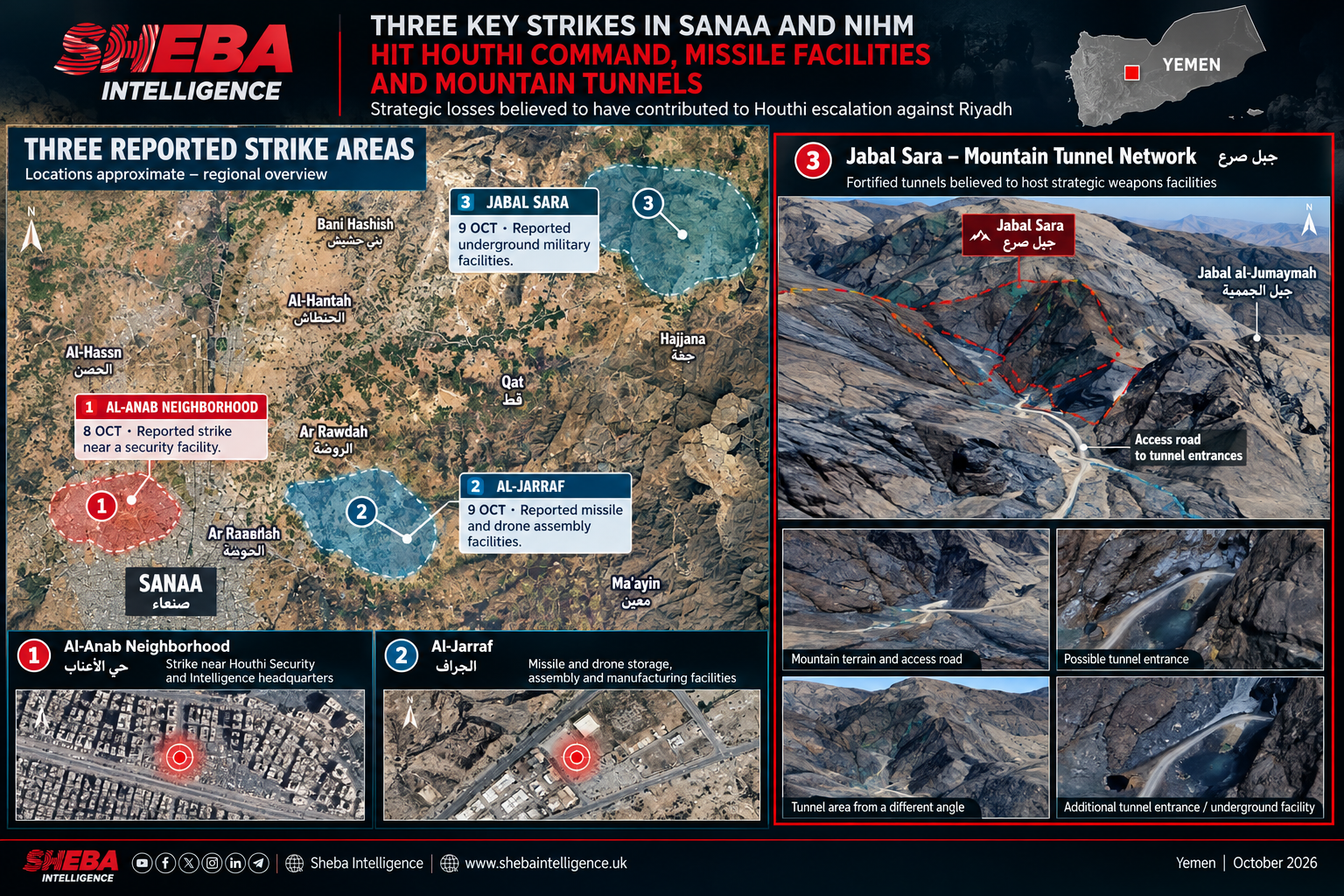
Coalition precision strikes target security leaders, missile facilities and fortified mountain tunnels in Sanaa and Nihm, amid intelligence reports of damage to strategic weapons programs
Precision airstrikes carried out by the Saudi-led coalition in support of Yemeni government forces under Operation “Dawn of Yemen” appear to have been among the factors driving the Houthis to escalate their attacks against civilian facilities in Saudi Arabia, as the group seeks to respond to military and security losses extending beyond the battlefield.
Between October 8 and 10, the conflict witnessed significant developments as coalition aircraft struck sensitive targets in and around the capital, Sanaa. Some of these sites were reportedly linked to strategic military facilities that the Houthis had been preparing to develop their missile and aerial capabilities for future phases of the conflict.
Alongside airstrikes targeting supply lines, weapons depots and field commanders since the launch of Operation “Dawn of Yemen” on October 5, three particularly significant operations targeted sensitive security, military and industrial facilities, potentially inflicting substantial damage on the Houthis’ weapons infrastructure.
The three operations targeted a site near the Houthi Security and Intelligence Service headquarters in Al-Anab neighborhood, facilities associated with missile and drone storage and assembly in the al-Jarraf district of Sanaa, and a network of fortified mountain tunnels in the Jabal Sara area, east of Nihm District.
Information obtained by Sheba Intelligence indicates that some of the targeted facilities were associated with weapons production and assembly, including rocket propellants and missile components. Other intelligence points to possible facilities handling hazardous chemical and biological materials that could be incorporated into specialized weapons programs.
These strikes have gained particular significance amid the escalating Houthi attacks against Saudi Arabia, culminating in the October 10 attack on King Khalid International Airport in Riyadh, which killed 12 people and injured 309 others, according to Saudi authorities.
Al-Anab Neighborhood: Strike Targets Possible Meeting of Security and Military Leaders
On October 8, an airstrike targeted a sensitive site near the headquarters of the Houthi Security and Intelligence Service in Al-Anab neighborhood, Sanaa.
Sources speaking exclusively to Sheba Intelligence said the location was believed to be a secret facility where the Houthis had planned to hold a meeting involving senior military, security and intelligence officials, with Iranian Islamic Revolutionary Guard Corps (IRGC) liaison officers also expected to attend.
The nature of the location and information surrounding the planned meeting underscore the site's potential importance within the group's military and intelligence coordination structure, particularly given the role attributed to Iranian liaison officers in supporting Houthi missile and drone capabilities.
The identities of those present at the time of the strike and the extent of the casualties remain unclear. Whether the strike directly hit the meeting or disrupted its preparations is among the questions requiring further information.
Al-Jarraf: Missile and Drone Assembly Facilities Targeted
On October 9, a sensitive Houthi facility in the al-Jarraf area of northern Sanaa was hit by a precision airstrike, amid reports that the target was linked to missile and unmanned aerial vehicle storage and assembly operations.
Sources told Sheba Intelligence that the site was believed to contain missile and drone storage facilities and assembly workshops, alongside machining and manufacturing facilities producing components used in these weapons systems.
The information suggests that the location formed part of the Houthis’ military-industrial infrastructure, supporting component manufacturing, weapons assembly and maintenance activities that allow the group to replenish some of its losses and sustain missile and drone operations.
Striking such facilities carries implications beyond the destruction of existing weapons stockpiles. Damage to production, assembly and repair capabilities could affect the group's ability to replace lost equipment and maintain prolonged military operations.
The full extent of the damage and the equipment destroyed at the site has yet to be established.
Jabal Sara: Mysterious Strike Reaches Fortified Tunnels Deep in the Mountains
The third strike, carried out on October 9 in the Jabal Sara area near Jabal al-Jumaymah, east of Nihm District, appears to have been the most complex in terms of the target's location and the aftermath of the attack.
Successive explosions were observed rising from the mountainous area, followed by intense fires and thick columns of smoke that reportedly continued for more than 24 hours, according to field accounts.
The targeted facilities are located within highly complex mountainous terrain, surrounded by elevated ridges from multiple directions. Field information indicates that some tunnel entrances face steep mountain formations, making direct aerial access particularly challenging.
The area is largely uninhabited and contains a seasonal flood channel running through the mountains, with no visible agricultural activity or permanent water sources, according to local descriptions.
Information obtained by Sheba Intelligence points to the possible existence of an extensive tunnel network inside Jabal Sara, housing military facilities serving multiple purposes. These may include rocket propellant production laboratories, missile and drone manufacturing and assembly facilities, and storage sites for strategic weapons and military equipment.
The intelligence also raises the possibility that some underground facilities were associated with the production or storage of hazardous chemical and biological materials, potentially linked to specialized weapons programs.
The succession of explosions, rapid spread of flames, dense smoke and prolonged fires raise questions about the materials and equipment stored inside the facilities, particularly the possible presence of highly flammable propellants or industrial substances.
The significance of the strike lies in the uncertainty surrounding how the attack affected facilities believed to be protected inside a tunnel network embedded within difficult mountain terrain.
Several scenarios have emerged, including the possible use of specialized air-delivered munitions capable of penetrating hardened structures, very small aerial systems, or precise intelligence concerning the underground facilities. A special operation has also been raised as a possibility, although available evidence does not establish which, if any, of these methods was used.
If extensive damage to the underground facilities is confirmed, the strike could represent an important development in the vulnerability of the Houthis’ fortified military infrastructure.
Strategic Losses Beyond Battlefield Setbacks
An assessment of the three targets suggests that the recent strikes may have affected different components of the Houthi military structure, ranging from command and intelligence coordination facilities to missile and drone assembly sites and strategic installations concealed inside mountain tunnels.
The potential significance of these targets differs from the losses the group has suffered on the front lines, including the loss of military positions, the deaths of field commanders and the destruction of supply routes.
While some battlefield losses can be offset by redeploying personnel and equipment, damage to manufacturing and assembly facilities, strategic stockpiles and specialized components could have longer-term consequences for the group's ability to produce weapons, replace losses and prepare for prolonged confrontation.
The strikes follow a series of setbacks suffered by the Houthis since the launch of Operation “Dawn of Yemen,” including territorial losses along the Marib, al-Jawf, Taiz and western coastal fronts, particularly around the Bab al-Mandab area, alongside attacks on field commanders, troop movements and reinforcements.
Against this backdrop, the possibility emerges that strikes against sensitive facilities in Sanaa and Nihm may have had a greater impact on the group's strategic calculations than some of its battlefield losses, particularly if weapons capabilities prepared for future phases of the conflict were damaged.
Escalation Against Riyadh: Retaliation for Strategic Losses?
Sheba Intelligence assesses that the recent precision strikes may have been among the factors prompting the Houthis to intensify attacks against Saudi Arabia, as Yemeni government forces continue advancing with coalition support under Operation “Dawn of Yemen.”
The attack on King Khalid International Airport in Riyadh came amid an ongoing escalation targeting civilian aviation facilities in the Kingdom, reaching a more dangerous level with the large number of civilian casualties.
These developments suggest that the Houthis may have sought to shift some of the pressure from the battlefield into Saudi territory, either in retaliation for damage to their military infrastructure or in an attempt to influence Riyadh's continued support for Yemeni government operations.
Targeting a major civilian facility such as King Khalid International Airport also carries political implications beyond any immediate military effect, placing civilian aviation security and passenger movements at the center of the regional escalation.
Although Houthi attacks against Saudi Arabia began before the three strikes, the subsequent intensification of the campaign raises questions about whether the severity of the escalation was linked to losses suffered by the group's military and strategic infrastructure.
A New Phase of the Conflict
Recent developments highlight the expanding scope of military operations under “Dawn of Yemen,” moving beyond strikes against frontline positions, reinforcements and military movements to attacks on security, military and industrial facilities deep inside Houthi-controlled territory.
The coalition previously announced extensive air operations targeting the Houthi ballistic missile network, command-and-control facilities and supply infrastructure, while maintaining air support for Yemeni government forces across multiple fronts.
The nature of the targets struck in Sanaa and Nihm suggests that the confrontation may have entered a phase focused on the infrastructure supporting the group's weapons production, storage and operational command capabilities, rather than solely on troops and equipment deployed along the front lines.
If intelligence concerning the strategic facilities inside the Jabal Sara tunnels is confirmed, the strike may have damaged a sensitive component of the Houthi military infrastructure, with potential consequences for the group's ability to develop and deploy weapons in future confrontations.
The full impact of the three strikes, particularly the extent of damage inside the fortified mountain facilities, will be crucial to assessing their effect on the balance of the conflict and understanding the factors behind the latest Houthi escalation against Saudi Arabia.