
Yemeni Government Approves Draft Law Designating Houthis as Terrorist Organization Amid Military Mobilization and Taiz Health Crisis
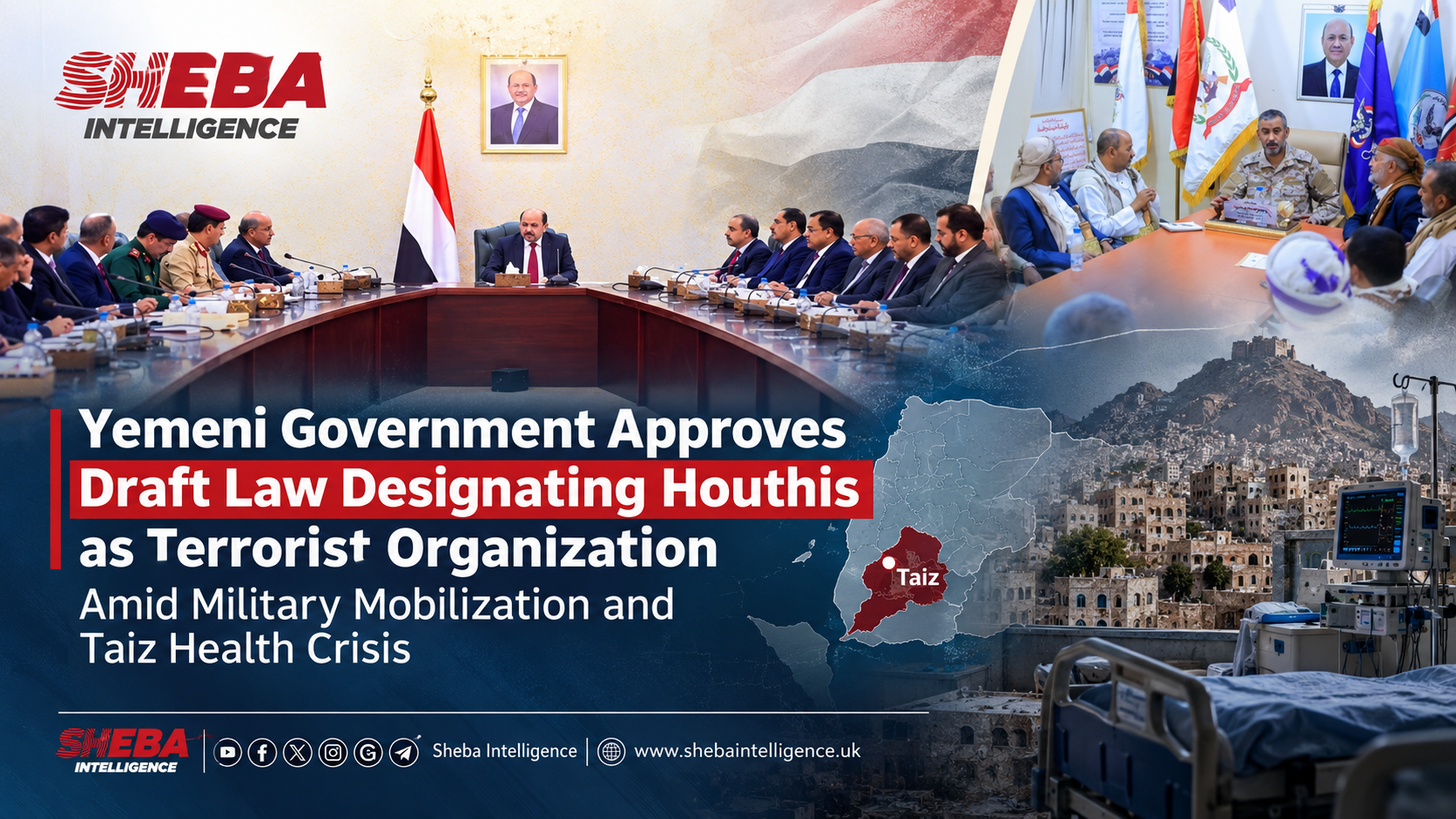
The Yemeni government has approved a draft law designating the Houthi group as a terrorist organization and criminalizing its activities and financing, as military authorities intensify efforts to mobilize popular support for the ongoing “Dawn of Yemen” operation and health officials warn of an imminent humanitarian catastrophe in the besieged city of Taiz.
During a cabinet meeting chaired by Prime Minister Shaya Al-Zindani, the government reviewed military, security, and humanitarian developments, emphasizing that regaining control of Bab al-Mandab represents a strategic turning point that would deprive the Houthis of a key means of exerting pressure on international maritime navigation.
The cabinet also condemned the Houthi attack on King Khalid International Airport in Riyadh, describing it as a war crime and a threat to regional and international security.
During the meeting, the transport minister reported that the bombing of Aden International Airport while a civilian aircraft was approaching for landing constituted a grave violation of international civil aviation protection rules.
Prime Minister Al-Zindani said the strikes carried out under Operation “Dawn of Yemen,” together with the Houthis’ loss of positions around Bab al-Mandab, had disrupted the group and prompted it to shift its attacks toward civilians and civilian infrastructure.
He stressed that Houthi attacks would neither alter the course of the military campaign nor halt its progress.
Al-Zindani said the government was not managing a temporary defensive phase or waiting for developments, but was leading state institutions in a national struggle requiring comprehensive political, military, economic, humanitarian, and media mobilization.
He also called on government institutions to move from a reactive approach to proactive measures aimed at supporting military fronts, maintaining essential services, and protecting civilians.
Military Leadership Moves to Strengthen Popular Mobilization
In a parallel development, Yemen's Chief of General Staff and Commander of Joint Operations, Lieutenant General Saghir bin Aziz, met with leaders of the Popular Resistance to discuss strengthening coordination and mobilizing civilian support for government forces.
Bin Aziz emphasized the importance of unifying national efforts, improving military readiness, and organizing popular support in accordance with the general mobilization declaration and resolutions issued by the National Defense Council.
He called for closer cooperation among the armed forces, security institutions, local authorities, and community leaders to support ongoing operations and reinforce internal cohesion.
Popular Resistance leaders expressed their readiness to continue supporting government forces, coordinating with military commanders and local authorities, and mobilizing community resources to assist military fronts.
Health Ministry Warns of Imminent Humanitarian Catastrophe in Taiz
Meanwhile, Yemen's Ministry of Public Health and Population warned on October 10 that the continuing Houthi siege of Taiz threatens to trigger an imminent health and humanitarian catastrophe as medical facilities approach critical shortages of medicines, intravenous fluids, medical supplies, and fuel.
The ministry said the disruption of essential supply routes could force hospitals to suspend emergency services, surgical operations, intensive care, dialysis treatment, and neonatal care, placing patients, wounded civilians, pregnant women, and newborns at immediate risk.
It warned that fuel shortages could also disable hospital generators, ambulances, and temperature-controlled storage systems for medicines and vaccines, potentially causing preventable deaths.
The ministry held the Houthis responsible for the siege and obstruction of essential supplies, demanding the immediate reopening of access routes and safe passage for patients, ambulances, medical personnel, and humanitarian assistance.
It also urged the United Nations, international humanitarian organizations, and health partners to urgently deliver medicines, oxygen, medical supplies, and fuel to healthcare facilities in Taiz.
The warning comes amid renewed concerns over the humanitarian consequences of military developments around Taiz, where Houthi control of key roads and surrounding mountainous areas has complicated civilian movement and the delivery of essential supplies.
Background: Operation “Dawn of Yemen”
The latest government measures follow the launch of Operation “Dawn of Yemen” on October 4–5, a multi-front military campaign aimed at restoring government authority over territories controlled by the Houthis.
Supported by the Saudi-led coalition, Yemeni government forces have reported advances along the Bab al-Mandab and western coastal fronts, as well as in Marib and Al-Jawf.
The coalition has provided sustained air support while conducting strikes against Houthi military infrastructure, missile systems, command facilities, and supply networks.
The latest developments indicate that the Yemeni government is seeking to expand its confrontation with the Houthis beyond battlefield operations through legal measures, nationwide mobilization, and greater coordination between military and civilian institutions.
At the same time, the deteriorating humanitarian situation in Taiz underscores the mounting challenges facing the government as it attempts to sustain military operations while maintaining essential services and protecting civilians.