
Yemen’s Dawn of Yemen Offensive Surpasses 26,000 Strikes Amid Heavy Houthi Losses and Declining Missile Capabilities
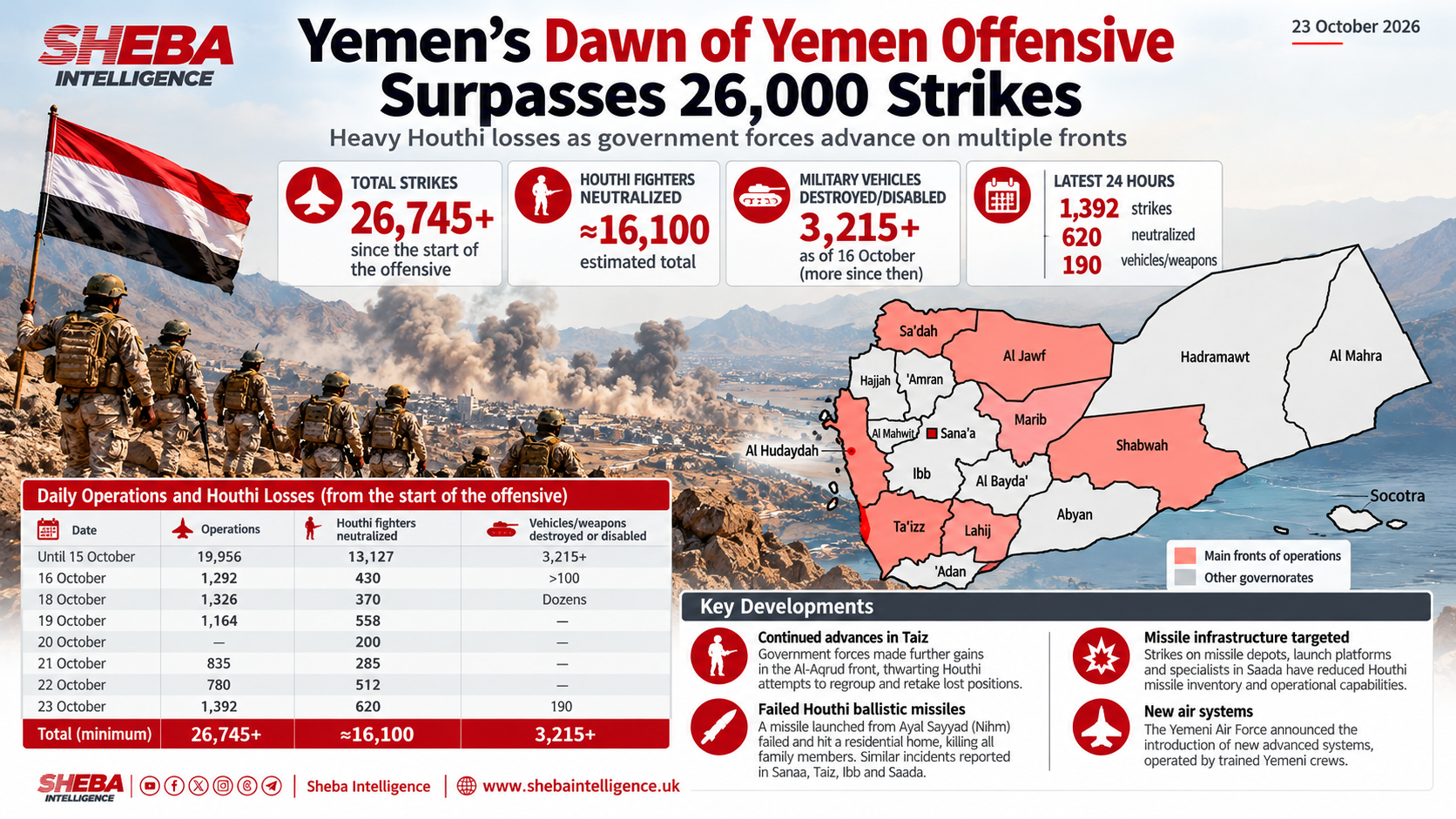
Yemeni military reports 1,392 new strikes and 620 Houthi fighters neutralized, as Sheba Intelligence estimates approximately 16,000 fighters neutralized during the offensive. Government forces advance in Taiz, while new air systems enter service.
Yemen’s armed forces announced on Friday that they had conducted 1,392 additional targeting operations as part of the ongoing Dawn of Yemen offensive, bringing the cumulative tally tracked by Sheba Intelligence to at least 26,745 operations as of October 23, according to available military statements.
Daily and cumulative figures compiled by Sheba Intelligence from Yemeni military reports suggest that approximately 16,000 Houthi fighters have been neutralized during the campaign, including field commanders and specialized personnel. The figure remains preliminary, pending further reconciliation of daily reports and verification that their reporting periods do not overlap.
Colonel Majed al-Nuzaili, spokesperson for the Yemeni Armed Forces, said the latest operations involved airstrikes, concentrated fire missions, and ground assaults targeting Houthi troop concentrations, reinforcements, defensive positions, firing sites, military vehicles, and supply routes.
According to the spokesperson, preliminary battlefield assessments indicate that approximately 620 Houthi fighters, including field commanders, were neutralized over the past 24 hours. Around 190 military vehicles, armored vehicles, transport assets, and heavy and medium weapons were also destroyed or disabled.
Government Forces Advance in Taiz as Military Pressure Continues
The Yemeni military announced further territorial gains along the Al-Aqrud front in Taiz governorate following raids and counterattacks against Houthi positions.
Government forces reportedly thwarted attempts by Houthi units to regroup and recapture positions lost during recent fighting.
Al-Nuzaili said the operations targeted fortifications, trenches, heavy and medium weapons positions, and military reinforcements, disrupting Houthi field command structures and restricting the movement of troops and supplies between operational sectors.
The developments in Taiz coincide with continued military pressure in Al-Jawf, western Marib, Al-Bayda, and the southern and western fronts, as government forces seek to weaken Houthi combat capabilities and prevent the reorganization of their military formations.
Failed Houthi Ballistic Missiles Strike Residential Areas
In a significant development, the military spokesperson reported repeated failures involving Houthi ballistic missiles during or shortly after launch, causing them to deviate from their intended trajectories and fall into populated areas.
Al-Nuzaili said that on Friday afternoon, October 23, a ballistic missile launched by the Houthis from the Ayal Sayyad area of Nihm district failed to maintain its flight trajectory and struck the home of Mohammed Ahmed al-Qashaa while his family was gathered inside.
According to the military statement, everyone inside the house was killed, while a neighboring property sustained damage.
The spokesperson said similar incidents had occurred in Sanaa, Taiz, Ibb, and Saada, warning that malfunctioning ballistic missiles pose a direct threat to civilians and their property.
He also reiterated that the continued use of ballistic missiles to threaten the Bab al-Mandab Strait and international shipping lanes presents broader risks to maritime security and global trade.
Missile Specialists and Launch Platforms Targeted in Saada
The Yemeni military linked the reported deterioration in Houthi missile capabilities to sustained strikes against missile storage facilities and launch platforms in recent weeks.
Al-Nuzaili said Yemeni air operations, conducted alongside coalition strikes against military targets in Saada governorate, had neutralized missile specialists and field commanders responsible for operating and launching ballistic missiles.
According to the spokesperson, these operations have reduced the Houthis’ missile inventory, diminished their available launch systems, and weakened their technical and operational capabilities.
Targeting specialized personnel alongside missile depots and launch platforms suggests an effort to disrupt the operational infrastructure supporting Houthi missile systems rather than merely destroying individual launch assets.
However, establishing a direct causal connection between these strikes and the recently reported missile failures would require additional technical evidence.
New Air Systems Enter Operational Service
Colonel al-Nuzaili also announced that new advanced systems had entered service with the Yemeni Air Force and had achieved successful operational results under the control of trained Yemeni crews.
The military did not disclose the types, technical specifications, or operational roles of the newly introduced systems.
The announcement comes amid intensified air and ground operations and an expansion of military targeting across several fronts.
The introduction of new systems may indicate an effort to strengthen government air capabilities, although their operational significance will depend on the missions they perform and the results demonstrated in subsequent engagements.
Dawn of Yemen: Cumulative Military Operations and Houthi Losses
The latest phase of military operations began in early October, with the Dawn of Yemen offensive formally announced on October 5, 2026, as part of a broad government campaign against Houthi military positions across several governorates.
According to cumulative figures previously published by Sheba Intelligence, the number of targeting operations had reached 19,956 by October 15, rising to 21,248 on October 16, 22,574 on October 18, and 25,353 on October 22.
With the addition of the 1,392 operations announced on Friday, the documented cumulative tally in Sheba Intelligence’s reporting reaches at least 26,745 targeting operations.
These operations include missions conducted by fighter aircraft, drones, artillery, rocket launchers, and ground combat units. The total therefore does not represent airstrikes alone.
Regarding Houthi personnel losses, Sheba Intelligence previously documented a cumulative figure of approximately 13,127 fighters neutralized by October 15, increasing to around 13,557 by October 16.
Adding the available subsequent daily figures produces a preliminary calculated total of approximately 16,100 Houthi fighters neutralized, although additional military statements require chronological reconciliation before a definitive cumulative figure can be established.
The military term neutralized does not necessarily refer exclusively to fatalities. No independently verified breakdown is available distinguishing those killed, wounded, captured, or otherwise removed from combat.
Earlier Sheba Intelligence reports also indicated that more than 3,215 military vehicles and pieces of equipment had been destroyed or disabled by October 16, with further losses reported in subsequent days.
Military and Strategic Implications
The latest military statements indicate that government forces are maintaining a high tempo of targeting operations across multiple fronts, with increasing emphasis on Houthi fortifications, command structures, reinforcements, and ballistic missile capabilities.
Three developments stand out in the current phase of the offensive: continued ground assaults and reported territorial advances, strikes targeting missile-related facilities and specialized personnel, and the introduction of new air systems into operational service.
The campaign against Houthi missile capabilities carries additional strategic significance given the group’s continued threats to international maritime routes and the Bab al-Mandab Strait, alongside the dangers posed to Yemeni civilians by missiles reportedly falling into residential areas after launch failures.
As the offensive continues, assessing the actual impact on Houthi combat effectiveness will require monitoring changes in the frequency of their attacks, their ability to replace personnel and technical losses, and their capacity to maintain supply lines and reorganize military units.