
Yemeni Army Accuses Houthis of Mutilating Eight Soldiers’ Bodies Amid Intensifying Offensive
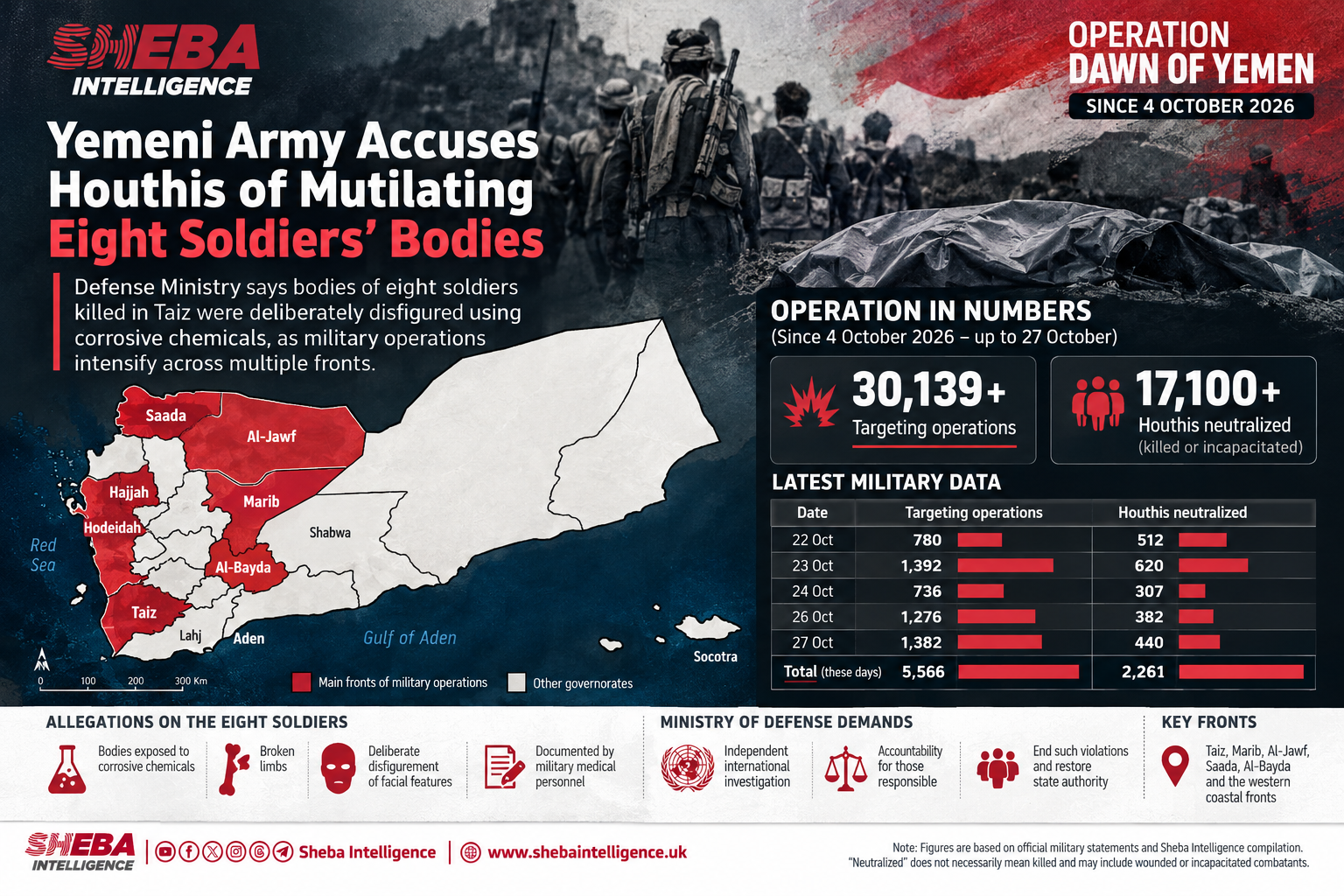
Yemen’s Defense Ministry alleges that the bodies of eight soldiers killed in Taiz were deliberately disfigured using corrosive chemicals, as the army reports more than 30,000 strikes since the launch of Operation Dawn of Yemen.
Yemen’s Ministry of Defense has accused the Houthi group of committing serious violations against the bodies of eight Yemeni soldiers killed on the Taiz front, alleging that their remains were deliberately mutilated before being handed over through the International Committee of the Red Cross (ICRC).
In a statement issued on Tuesday, October 27, military spokesman Colonel Majed Al-Nuzaili said medical personnel at a military hospital had documented extensive damage to the bodies, including burns allegedly caused by corrosive chemicals, broken limbs, and deliberate disfigurement of facial features.
Al-Nuzaili described the alleged acts as a grave violation of Islamic principles, Yemeni tribal customs, and international humanitarian law, which requires parties to armed conflicts to respect the dead and prohibits the mutilation of human remains.
The statement did not specify when the eight soldiers were killed or provide details about the circumstances surrounding the recovery and transfer of their bodies.
Previous Allegations of Abuse
The Defense Ministry said the latest incident was part of what it described as a broader pattern of mistreatment of captured soldiers and the remains of those killed in combat.
The statement cited the case of Brigadier General Hussein Al-Osaimi, commander of the 161st Infantry Brigade, whose body was returned in 2020 allegedly bearing signs of torture and burning after he had been captured while wounded.
It also referred to a 2023 incident in Al-Jawf, alleging that the Houthis returned the bodies of soldiers who had previously been detained alive, with their remains showing signs of mutilation.
These earlier allegations were presented by the military spokesman and have not been independently substantiated in this report.
Al-Nuzaili held the Houthi leadership responsible for the latest alleged violations and called on the United Nations and international human rights organizations to launch an independent investigation and identify those responsible.
He also reaffirmed the army's commitment to continuing military operations until the restoration of state authority across Yemen.
Military Background: More Than 30,000 Strikes Reported
The allegations come amid the continuing Operation Dawn of Yemen, launched on October 4, with government forces conducting offensive operations across Taiz, Marib, Al-Jawf, Saada, Al-Bayda, and the western coastal fronts.
According to cumulative military figures compiled in previous Sheba Intelligence reports, Yemeni government forces had announced at least 30,139 targeting operations by October 27, with an estimated 17,100 or more Houthi fighters and commanders neutralized since the offensive began.
The military reported 1,382 targeting operations on October 27 alone, claiming approximately 440 Houthi personnel neutralized and 146 military vehicles and pieces of equipment destroyed or disabled.
These figures are based on official military statements and preliminary cumulative calculations. They have not been independently verified. The term neutralized does not necessarily indicate fatalities and may include wounded or otherwise incapacitated combatants.
The latest military statements indicate sustained pressure on Houthi command positions, defensive fortifications, weapons storage facilities, and reinforcement routes, particularly in Taiz and the western fronts.
Calls for International Investigation
The Defense Ministry's allegations have renewed attention to the treatment of fallen combatants as fighting intensifies across Yemen.
International humanitarian law requires parties to armed conflicts to respect the dead, prevent the despoliation and mutilation of remains, and facilitate their dignified handling.
If independently established, deliberate mutilation of bodies could constitute serious violations of international humanitarian law and potentially war crimes, depending on the circumstances.
Independent forensic findings, relevant ICRC documentation, and an impartial investigation would be essential to establishing the facts and determining responsibility.
The ICRC's role in facilitating the transfer of remains does not, by itself, constitute confirmation of the allegations made by Yemen's Defense Ministry.