
Since the early 1990s, Yemen has been a safe haven for refugees from East African countries, particularly Ethiopia and Somalia. For these refugees, Yemen is not just a transit bridge to Saudi Arabia, as UN reports suggest, but a country where they can work freely or seek asylum and international aids.
Alarming Statistics
According to the United Nations High Commissioner for Refugees (UNHCR), more than 100,000 Africans risk their lives in rickety boats to reach Yemen. 90% of the migrants are coming from Ethiopia and about 10% from Somalia, despite the war and severe shortages of food and medicine. Both countries are located across the Red Sea, while most of the migrants are unaccompanied children.
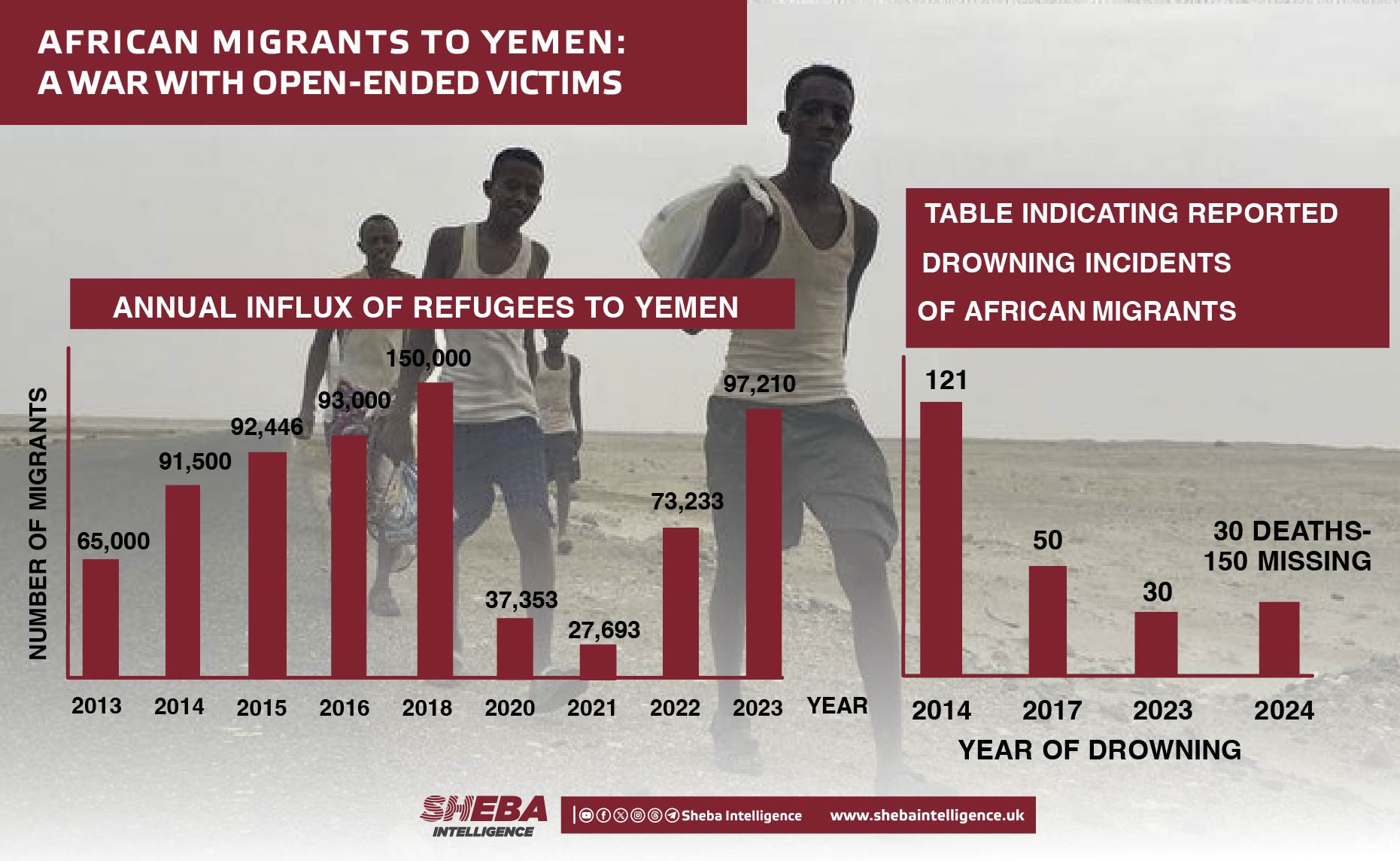
Statistics estimate that there are over half a million African refugees in Yemen, considering the continuous influx of refugees to the Yemeni coasts during the years of conflict. For instance, UNHCR statistics recorded around 65,000 migrants in 2013, but the number increased to 91,500 in 2014 and further to 92,446 in 2015. According to UN statistics, the number doubled by 10% in 2016, reaching over 93,000 migrants, and soared to 150,000 in 2018. However, in 2020, the International Organization for Migration (IOM) recorded only 37,535 migrants, and in 2021, the number was 27,693. In 2022, it rose again to 73,233 migrants, and nearly 100,000 migrants were recorded in 2023, with around 97,210. A recent UN report predicts that Yemen will receive more than 44,000 Somali migrants and asylum seekers in 2024, with many opting for voluntary return.
By 2019, the UNHCR estimated that there were around 282,000 refugees in Yemen, over a quarter of a million. Due to the closure of refugee reception centers, the ongoing conflict, and the extensive open coastlines, the actual number of refugees may now exceed half a million. Additionally, some warring factions have been using refugees in combat zones, further complicating accurate counts.
Drowning Incidents
Migrants must cross the sea and undertake a perilous journey, often transported in dilapidated and very small boats. They face threats not only from unscrupulous smugglers but also from the overcrowded and unseaworthy vessels, making it nearly impossible to safely reach the shore of their destination. Humanitarian organizations have documented numerous drowning incidents near Yemeni coasts. Smugglers often force refugees to disembark far from the Yemeni shore, compelling them to swim to safety.
On June 6, 2014, around sixty-two people perished in a tragedy off the Yemeni coast when a boat carrying Somalis, Ethiopians, and two Yemeni crew members capsized, bringing the total number of drownings in 2014 to 121. On July 10, 2017, about fifty Somali and Ethiopian migrants drowned when smugglers forced them to jump into the sea off the coast of Shabwa Governorate. On November 13, 2023, at least 30 migrants drowned off the coast of Mocha when their boat capsized in international waters in the Red Sea. The Yemeni Coast Guard managed to rescue 26 others. On June 11, 2024, 38 African migrants died and 151 were reported missing when a boat carrying 260 migrants capsized near the Yemeni coast.
On July 25, 2024, a boat carrying 45 refugees and migrants capsized in the Red Sea off the coast of Taiz Governorate, marking the second such incident on Yemeni shores within two months. African migrants use Yemeni coasts as a transit route to the Gulf countries in search of job opportunities.
Voluntary Return
A recent report by the International Organization for Migration (IOM) confirmed that over 5,600 African migrants voluntarily returned from Yemen to their home countries in 2023. The latest IOM report on migrant movements along the eastern migration route indicated that 5,688 migrants voluntarily returned from Yemen to the Horn of Africa between January and October 2023.
The IOM’s latest report on "Migration along the Eastern Corridor" highlighted the return of 1,398 stranded migrants in Yemen through risky boat journeys back to the Horn of Africa during May 2024.
|
Annual influx of refugees to Yemen |
|
|
Year |
Number of migrants |
|
2013 |
65,000 |
|
2014 |
91,500 |
|
2015 |
92,446 |
|
2016 |
93,000 |
|
2018 |
150,000 |
|
2020 |
37,353 |
|
2021 |
27,693 |
|
2022 |
73,233 |
|
2023 |
97,210 |
|
Table indicating reported drowning incidents of African migrants |
|
|
Year of Drowning |
Number |
|
2014 |
121 |
|
2017 |
50 |
|
2023 |
30 |
|
2024 |
30 deaths- 150 missing |