
Yemen’s Gold Route: Documents Point to a High-Value Corridor Through Aden, Al-Rayyan and Dubai
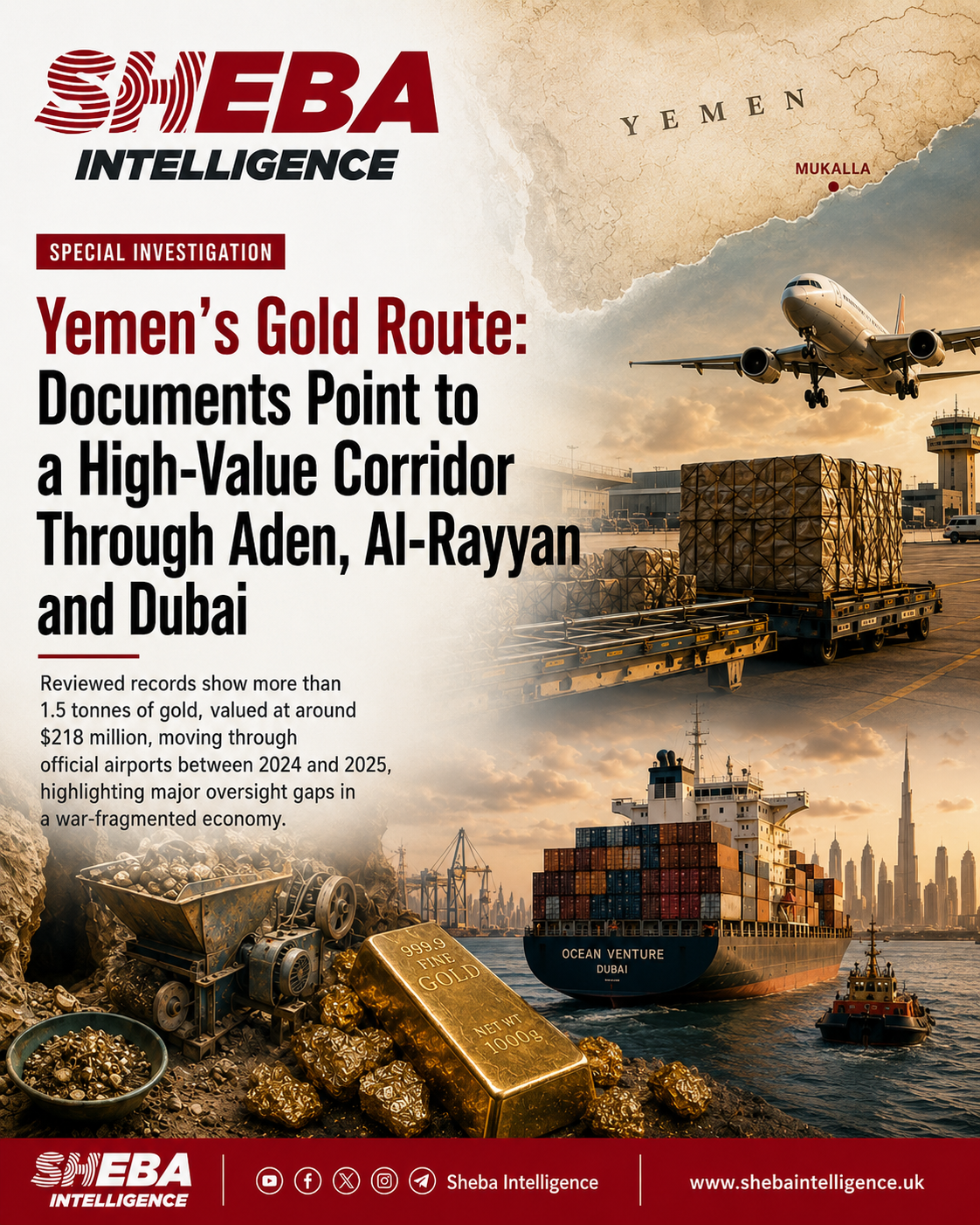
In late May, security authorities in Hadramout, eastern Yemen, announced the dismantling of four illegal gold mining and processing workshops in the city of Mukalla, only one week after a similar workshop had been seized.
The Criminal Investigation Department of Hadramout Coast Police said the raids followed careful surveillance and intelligence tracking, which uncovered what it described as organized networks seeking to exploit and plunder the governorate’s mineral resources. The seized items included equipment and machinery used to crush and process rocks, as well as raw materials and stones containing gold. The detainees and confiscated materials were referred to the relevant authorities for legal procedures.
At first glance, the incident may appear to be a local security case involving unlicensed mining workshops in a coastal city. But its timing, location and the nature of the activity uncovered raise a broader and more sensitive question: what happens to gold extracted or processed outside official channels, and where does it go once it leaves mines, workshops and informal processing sites?
That question becomes more urgent when compared with official documents reviewed by Sheba Intelligence. The records, covering several movements between 2024 and 2025, reveal a repeated pattern of large quantities of gold — and, in some cases, cash — moving through airports located in areas under Yemen’s internationally recognized government.
A Regulatory Gap
The documents do not prove that every gold movement was illegal. Nor do they automatically link the workshops seized in Mukalla to every shipment recorded in the files. But they place the recent security operation within a wider context: illegal mining and processing inside Hadramout, significant gold movements through official airports, repeated foreign destinations, and recurring gaps in documentation whenever gold exits the country.
Between the informal workshop and the official airport, a serious regulatory gap appears to emerge. In a country weakened by war, institutional fragmentation and depleted public finances, gold becomes more than a precious metal. It can become a means of transferring wealth, moving capital out of the country, and recycling value beyond the formal banking, customs and financial systems.
This investigation does not issue a prior judgment on the legality of every shipment. Instead, it places the available facts side by side: illegal workshops seized in Hadramout; documents showing gold movements through official airports; a foreign destination repeatedly appearing in the records; and repeated concealment or incomplete documentation of outbound gold where such records were available.
This investigation traces what the documents reveal about Yemen’s “gold route”: from Hadramout and Aden, through airports, and onward to Dubai during the period in which UAE-backed forces had significant influence over Aden and Mukalla. It asks whether Yemen is witnessing regulated trade subject to oversight — or a broader network exploiting state fragility to move high-value assets out of the country.
Documented Gold Movements
Sheba Intelligence reviewed multiple documents and images and extracted 13 non-duplicated records of outbound gold movements through Aden and Al-Rayyan airports between May 1, 2024, and December 11, 2025. Together, these records show at least 1,372.036 kilograms of gold, equivalent to approximately 1.37 tonnes.
Among the 13 non-duplicated outbound movements used to calculate this total, the number of gold bars was explicitly stated in only two records: 62 bars weighing an estimated 513.753 kilograms. A third record referred to gold bars weighing 201.485 kilograms, but did not specify the number of bars. Based on the approximate average weight of the bars mentioned in the other records — around 8.29 kilograms per bar — this third shipment may have contained at least 24 additional bars. That would bring the estimated number of gold bars in the 13 records to around 86 bars.
| Record | Airport | Quantity | Number of Bars |
|---|---|---|---|
| 11 | Al-Rayyan | 97.803 kg | 43 bars |
| 12 | Al-Rayyan | 415.950 kg | 19 bars |
| 13 | Aden / reference to Al-Rayyan | 201.485 kg | Estimated at around 24 bars |
Based on spot gold prices, the documented quantity of 1,372.036 kilograms is worth approximately $187.85 million. The value may vary depending on global gold prices, purity levels and whether the gold was raw, processed or cast into bars.
| Item | Figure |
|---|---|
| Documented gold quantity | 1,372.036 kg |
| Equivalent in troy ounces | 44,112 oz |
| Estimated value at $4,258.39 per ounce | Around $187.85 million |
However, six additional records were not included in the core total because they require further verification. These records involve quantities whose status, duplication risk or commercial context remains unclear.
| Quantity | Reason for Exclusion |
|---|---|
| 41.928 kg | The operation is unclear |
| 38.177 kg | It is unclear whether it is separate from nearby Aden records |
| 48.182 kg | Appears within a group of records linked to traders |
| 57.158 kg | Requires verification; may be part of a wider commercial file |
| 14.766 kg | Requires verification; appears within the same group |
| 230.000 kg | Listed as 50 gold bars, but lacks sufficient weight details |
The 230-kilogram record alone is equivalent to roughly 7,176.4 troy ounces, with an estimated value of more than $30 million.
| Basis of Calculation | Approximate Value |
|---|---|
| At $4,238.10 per ounce | Around $30.41 million |
If these six additional records are included, the total number of records rises to 19, involving approximately 1,595.246 kilograms of gold — more than one and a half tonnes — with an estimated value of around $218 million. This equals an average of about 89 kilograms per movement.
How Did the Gold Move?
The documents refer to gold in different forms. This is significant because it suggests that the movement was not limited to one method or one channel.
| Form of Gold | Indication in the Documents |
|---|---|
| Raw gold | Some records describe it as “raw gold” |
| Gold bars | Some records mention the number of bars and total weight |
| Gold linked to passengers | Several shipments were attributed to individual passengers or carried with them |
| Gold linked to traders | Many records were associated with traders or businessmen |
| Collective shipments | One record referred to gold belonging to a group of traders |
This variety points to a flexible movement pattern involving passengers, traders and shipments with a commercial character.
Clear Documented Outbound Gold Movements
The following table includes the clearest records linked to gold leaving Yemen or being exported abroad between May 1, 2024, and December 11, 2025. Similar records or those likely to have been duplicated were not counted twice.
| No. | Departure Airport | Quantity | Destination / Direction | Description | Status |
|---|---|---|---|---|---|
| 1 | Aden | 18.855 kg | Dubai | Gold sent to Dubai, linked to a trader and carried on a Yemenia flight | Clear |
| 2 | Aden | 21.143 kg | Dubai | Gold exported to Dubai with a passenger | Clear |
| 3 | Aden | 40.815 kg | Dubai | Gold leaving Aden for Dubai, linked to a trader/passenger | Clear |
| 4 | Aden | 41.930 kg | Dubai | Gold sent to Dubai on a Yemenia flight, linked to a trader | Clear |
| 5 | Aden | 44.172 kg | Dubai | Gold exported to Dubai with a passenger | Clear |
| 6 | Aden | 45.745 kg | Not fully clear | Gold leaving through Aden, linked to a passenger | Medium clarity |
| 7 | Aden | 71.000 kg | Not fully clear | Raw gold exported from Aden | Medium clarity |
| 8 | Aden | 86.195 kg | Dubai | Gold exported to Dubai with a passenger | Clear |
| 9 | Aden | 101.365 kg | Dubai | Gold sent to Dubai, linked to a businessman/trader | Clear |
| 10 | Aden | 185.578 kg | Dubai | Gold exported to Dubai, linked to a trader and passenger | Clear |
| 11 | Al-Rayyan | 97.803 kg | Abroad | 43 gold bars linked to a trader | Clear |
| 12 | Al-Rayyan | 415.950 kg | Abroad | 19 gold bars linked to a trader | Clear |
| 13 | Al-Rayyan / This quantity of gold was originally flown from Aden Airport | 201.485 kg | Dubai | Gold bars sent to Dubai, reportedly belonging to a group of traders | Clear |
Gold Returning to Yemen
The documents reviewed during the same period also show the return of around 132.564 kilograms of gold to Yemen. This appears to be a normal commercial quantity, with an estimated value not exceeding $18 million.
The sharp difference between outbound and inbound quantities is notable. While the return of gold may reflect routine commercial activity, the much larger outbound movement raises questions about oversight, taxation, licensing and the final destination of the exported gold.
Gold Carried by Passengers Raises Questions
Several records state that gold moved “with” or “accompanied by” individual passengers. This is one of the most sensitive aspects of the file.
When tens or even hundreds of kilograms of gold are linked to individual travelers, the question is no longer only whether the gold passed through airport procedures. The deeper question is whether the relevant authorities had sufficient capacity and procedures to verify ownership, source, licensing, customs clearance, tax obligations and final destination.
Gold is a small-volume, high-value asset. In countries suffering from weak banking systems, fragmented institutions and limited financial oversight, it can become a practical alternative to formal financial transfers.
This makes records linked to passengers particularly important. They may indicate a system in which gold movements of a commercial scale were handled — at least on paper — as if they were linked to individual travelers.
Aden and Al-Rayyan Airports as Key Nodes
Aden airport appears in most of the records involving gold carried by passengers or linked to traders heading to Dubai. Al-Rayyan airport, meanwhile, appears in records involving gold bars, raw gold and movements of both gold and cash in different directions.
Al-Rayyan appears especially sensitive because the documents do not show it merely as a point for gold leaving Yemen. They also show it as a point where gold and cash arrived. In this file, the airport appears to be more than a normal transport facility; it appears as a financial and logistical node.
Dubai as the Main Destination
Dubai appears repeatedly in the documents as a destination for gold leaving Yemen. This does not, in itself, prove wrongdoing. Dubai is one of the region’s most important gold markets and a major center for trading, refining, resale and re-export.
But the repeated appearance of the same destination, combined with large quantities and records linked to passengers or traders, suggests that the movement was not random. It appears closer to a recurring air route connected to individuals, traders or commercial actors.
| Airport | Role in the Reviewed Documents | Main Direction |
|---|---|---|
| Aden International Airport | Main departure point for gold linked to passengers or traders | Dubai |
| Al-Rayyan Airport | Appears in movements of gold bars, raw gold, cash and two-way flows | Dubai / abroad |
Economic Drain on Yemen
Gold allows individuals, traders and networks to move wealth across borders without relying fully on banks. In Yemen’s fragmented economy, it can become an effective tool for capital flight.
The documents do not prove that the listed movements were illegal. But they do show that large quantities of gold moved through official airports in a manner that requires examination and scrutiny.
If commercial quantities of gold left Yemen without transparent customs, tax and financial procedures, the state may have lost important revenues at a time of severe economic crisis.
In an economy exhausted by war, this is not a technical issue. It touches public finances, currency stability, customs revenues and the ability of state institutions to regulate high-value trade.
The documents suggest that official airports may have been used as channels for moving high-value assets. This raises questions about customs inspection, airport security, passenger screening, documentation and coordination between security and financial authorities.
The issue becomes even more sensitive because airports are supposed to function as regulated gateways. When large quantities of gold pass through them, the integrity of that oversight becomes a matter of public interest.
Cash Movements
Several documents also refer to the movement of large amounts of cash through airports in hard currency. These records were not included in the gold calculations, but they remain important because they suggest that the same air routes may have been used to move other forms of value — not only gold — during the period covered by the documents.
Although this investigation focuses on gold, the reviewed documents also mention large cash movements across airports. This suggests that the issue may be broader than gold alone.
The same air corridors may have been used to move different forms of value: gold, foreign currency and possibly other high-value assets.
Conclusion
The documents do not point to a single isolated incident or a limited commercial transaction. Instead, they outline the features of a repeated air corridor through which 1,595.246 kilograms of gold moved across 19 records — more than one and a half tonnes, worth approximately $218 million — between May 2024 and December 2025. The movements took place through Aden International Airport and Al-Rayyan Airport in Hadramout, with Dubai appearing repeatedly as the main destination.
The departure of gold worth nearly $218 million from a country suffering from war and institutional division cannot be treated as ordinary commercial movement without clear licensing and disclosure documents. Even if some shipments were legal, their size, frequency, association with passengers, and concentration along the Aden/Al-Rayyan–Dubai route point to a major oversight gap — and possibly an organized channel for moving high-value assets abroad.
The problem is not the movement of gold in itself. It is the method of movement, the size of each shipment, the linking of some shipments to passengers, the repeated destination, and Yemen’s weak regulatory environment. Some recorded shipments reached unusually large levels: one at 185 kilograms, another at 201 kilograms, and a third at more than 415 kilograms.
Movements of this scale would normally require licensing, proof of source, ownership documentation, certificates of origin, inspection, customs clearance, financial disclosure and possibly approval from the central bank or other financial authorities. But according to the information reviewed, several shipments appear to have moved without passing through all these procedures, except for what some security and intelligence officers were able to record and report to official bodies.
A security official who tracked the case and spoke to Sheba Intelligence said that cash bags also moved without their value being known, sometimes recorded only as “a large bag of money.” The official added that corruption often creates opportunities to prevent information from reaching decision-makers, allowing large quantities of gold and cash to leave without proper documentation.
In functioning systems, carrying gold or precious metals through airports is subject to disclosure and oversight, especially when the value exceeds common financial declaration thresholds. In Yemen’s current environment — marked by war, divided institutions, weak oversight and multiple local authorities — gold movements become far more sensitive. They may be used to smuggle wealth, move capital out of the country, launder money, or finance networks operating outside the official system.
The repeated appearance of Dubai as a destination does not prove wrongdoing; Dubai is a major regional gold market. But the recurrence of the same destination, the large quantities involved, the use of two specific airports, and the presence of 19 documented movements make the case look less like separate incidents and more like a pattern — or a route.