
From Trade to Firepower: How the Houthis Became Iran’s Regional Military Operator
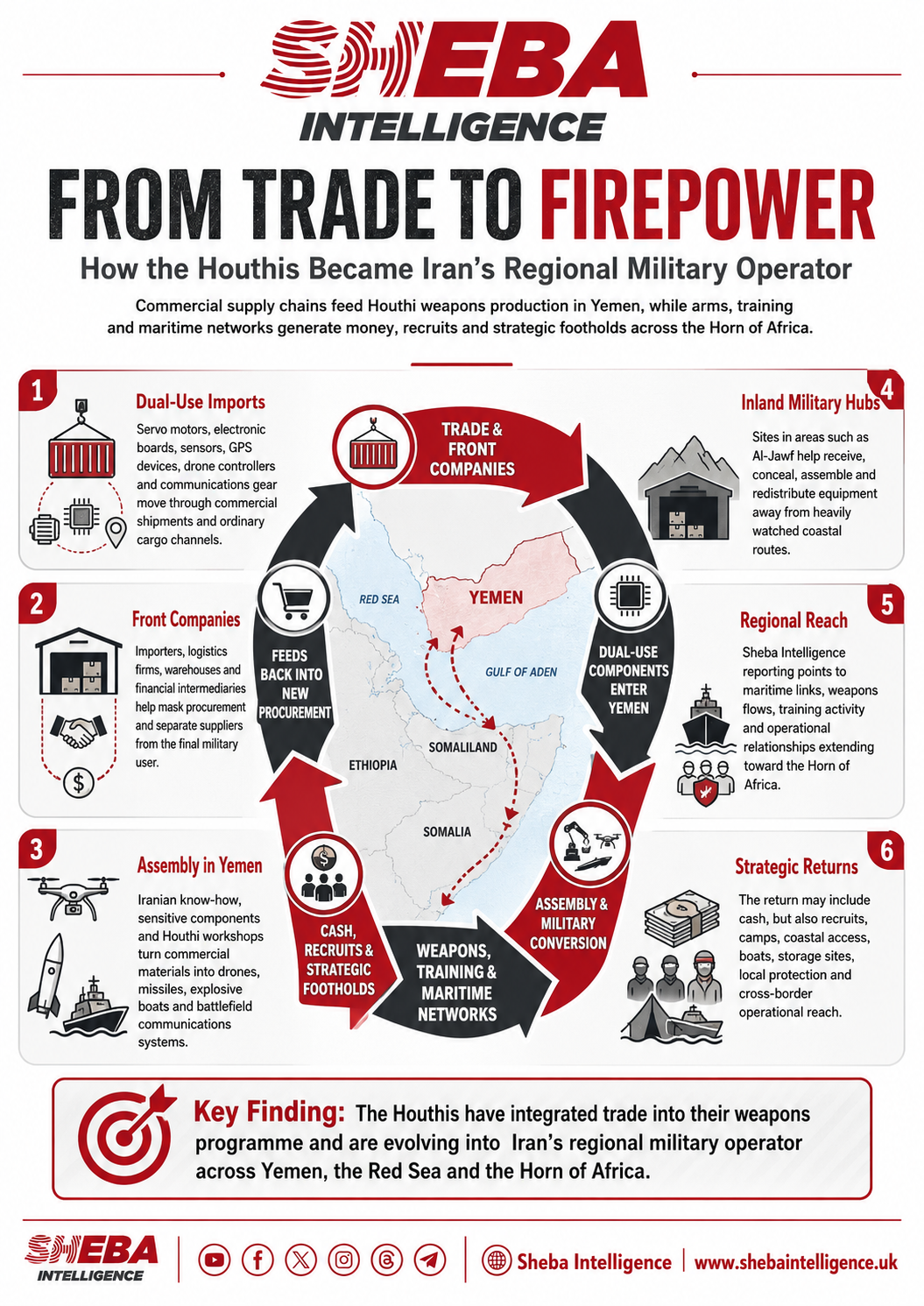
An investigation into a cross-border cycle in which commercial supply chains feed Houthi weapons production in Yemen, while arms, training and maritime networks generate money, recruits and strategic footholds across the Horn of Africa
The Houthis no longer rely solely on clandestine shipments of complete Iranian weapons entering Yemen. Evidence reviewed for this investigation shows that the group has incorporated international trade, commercial companies and civilian supply chains into its military procurement system.
Commercially available engines, electronic boards, sensors, navigation devices, communications equipment and other dual-use components enter Yemen through importers, logistics firms and ordinary cargo shipments. Iranian expertise and sensitive military technology help transform those materials inside Houthi-controlled territory into drones, missiles, explosive boats and battlefield communications systems.
The evidence confirms the first central hypothesis of this investigation: trade has become a structural component of the Houthi military apparatus, not merely a cover for individual smuggling operations.
A second pattern is also emerging. The Houthis are using the weapons, expertise and maritime networks developed inside Yemen to build relationships with armed actors and trafficking networks across the Horn of Africa. The returns may include cash, but they may also take the form of recruits, training camps, coastal access, storage sites, boats, local protection and routes that expand the operational reach of both the Houthis and Iran.
This does not yet prove the existence of a fully developed Iranian network of missile bases in Africa. It does show, however, that the Houthis have evolved from a recipient of Iranian support into a regional military operator capable of converting trade into weapons and weapons into cross-border influence.
Weapons Entering as Commercial Goods
In January 2025, customs authorities in Aden announced the seizure of 180 smart servo motors and 1,760 electronic boards and sensors. According to the customs authority, the motors could be used to move drone wings and release payloads, while the electronic components could control engines, manage power and detect obstacles or gases.
None of these items necessarily constitutes a weapon in its original commercial form. Servo motors, electronic boards and sensors are widely used in robotics, industrial equipment and civilian technology. Their function changes when they are assembled with navigation devices, batteries, propellers and control systems inside an unmanned aircraft.
Days later, customs officials reported another seizure involving fuel-powered engines, wireless drone controllers and a small aircraft concealed inside a mixed commercial container arriving from China.
Other seizures at the ports and border crossings of Aden, Shahn and Sarfait have included drone engines, propellers, communications devices, jamming equipment and electronic parts hidden among clothes, spare parts and general merchandise.
The pattern is consistent. Instead of importing a complete drone or missile that can be easily identified, the system is divided into separate components. Engines arrive in one consignment, controllers in another, while batteries, navigation systems and electronic boards move through different suppliers and routes.
Once the components reach Houthi-controlled areas, they can be reassembled for military use. Trade is therefore not only being used to conceal weapons. It has become the first stage of weapons production.
From Smuggling Routes to Supply Chains
Successive reports by the United Nations Panel of Experts on Yemen have documented maritime and land routes used to supply the Houthis with weapons and military components.
The routes have included dhows and small boats operating in the Arabian Sea, the Gulf of Aden and the Red Sea, as well as overland networks extending through eastern Yemen. The reports have also identified middlemen, procurement networks and financial channels that separate the final beneficiary from the original supplier.
The development of the system can be seen in the growing number of actors involved. A procurement operation may begin at a civilian factory in Asia, pass through a distributor, a freight company, an importer and a customs agent, and end at a warehouse controlled by a military network.
A carrier may not know the final purpose of a shipment. An importer may conduct mainly legitimate business while inserting sensitive components into a limited number of containers. This structure makes the network difficult to dismantle through the interception of individual boats or the sanctioning of a single company.
An international study published in 2026 under the title From Smugglers to Supply Chains reached a similar conclusion: the Houthis have developed a distributed global procurement system that combines commercial markets, international suppliers and local assembly capacity.
The network is resilient because it does not depend on a single route, company or state supplier.
Commercial Companies as Military Infrastructure
International sanctions and investigations show that commercial companies have become operational parts of Houthi procurement.
In January 2026, the US Treasury said Houthi procurement officials relied on a network of front companies, logistics firms and financial intermediaries operating across Yemen, Oman and the United Arab Emirates.
The Treasury identified Wadi Kabir Logistics Services, a Sana’a-based company with a branch in Oman, as part of a network that used warehouses and trucks to coordinate weapons shipments. It said company representatives had attempted to smuggle 52 Kornet anti-tank missiles concealed inside specially modified electricity generators.
The same case involved another commercial entity that allegedly provided warehouse space in Oman’s Al Mazyunah Free Zone, as well as a Sana’a exchange house used to settle payments for missile components, advanced systems and other military materials.
The operation illustrates how the system works. One company purchases or transports the goods, another provides storage, a logistics network moves the cargo and a financial intermediary pays the supplier.
Investigations published by Yemeni researcher Abdulqader Al-Kharraz described a comparable structure. His reporting identified businessmen and companies allegedly involved in registering commercial fronts, negotiating purchases and presenting weapons-related transactions as legitimate trade.
Some of the individual allegations require independent verification through ownership records, shipping documents and financial transfers. The broader mechanism, however, corresponds with the findings of UN experts, international sanctions and official Yemeni seizures.
A company registered for general trade, transport, spare parts or travel can perform military functions without listing any weapons-related activity in its official records.
Iran Supplies the Critical Layer
Commercial markets can provide many components, but the Houthi weapons programme also depends on military designs, specialised knowledge and sensitive technologies.
Technical investigations into intercepted Houthi missiles and drones have found combinations of Iranian-origin materials and internationally manufactured commercial components. This suggests a production model in which Iran does not need to deliver every weapon in complete form.
Iran can provide designs, guidance, specialised parts and technical experts. Commercial networks obtain motors, batteries, cameras, processors and industrial materials from international markets. Houthi workshops then assemble, modify and test the final systems inside Yemen.
Recent reporting by Sheba Intelligence provides examples of this relationship.
Sheba Intelligence revealed that an IRGC-linked technical cell had assessed the relocation of Houthi missile and drone facilities from Yemen’s western coast to mountainous and desert areas, including locations in Al-Jawf. The cell reportedly examined underground facilities, protected storage sites and alternative deployment zones.
This indicates that Iranian involvement is not limited to the supply of hardware. It extends to the protection, relocation and operational management of the capabilities produced from imported components.
Sheba Intelligence also reported movements of missile-related equipment and Houthi forces into areas of Al-Jawf connected to smuggling routes and desert storage locations. The governorate’s geography and links to Saada and Sana’a make it suitable for receiving, concealing and redistributing equipment arriving through eastern Yemen.
The supply chain therefore does not end at a port or border crossing. It continues through warehouses, assembly workshops, testing grounds and deployment sites.
Technology Purchased as a Service
The Houthi procurement system is not limited to physical goods.
Sheba Intelligence reported that the Houthis had sought access to Chinese satellite capabilities through a channel connected to Muscat. The platform could not independently establish whether the Houthis ultimately obtained the services or data.
The attempt is nevertheless important because it shows how military capability can be acquired through a commercial contract rather than a weapons shipment.
Satellite imagery, communications services, targeting data and software can all be sold as civilian or commercial products. When integrated with missile and drone units, they become part of a military targeting system.
The arrival of a Mahan Air flight in Sana’a raised similar questions about the movement of specialists and sensitive equipment. No public evidence establishes that complete weapons were transported on the flight. Air transport, however, is well suited to engineers, electronic systems, specialised components and high-value devices, while larger cargo continues to move by land and sea.
The emerging system combines commercial goods, technical services and human expertise.
The Supply Line Becomes a Weapons Industry
The repeated seizure of complementary components indicates that the Houthis are not simply maintaining imported weapons. They are building the capacity to assemble and adapt systems inside Yemen.
A drone requires engines, propellers, batteries, electronic boards, communications equipment, navigation systems and software. Many of these items can be purchased legally in civilian markets.
When the components are distributed across different shipments, no individual cargo necessarily reveals the final weapon. The military purpose becomes visible only when the shipments, suppliers, warehouses and workshops are examined together.
Iranian expertise completes the process. Designs, technical supervision and sensitive components enable the Houthis to convert civilian and dual-use goods into military systems.
The resulting weapon may then be used in Yemen, against shipping in the Red Sea, or as part of a broader network of military relations beyond the country.
The Route Runs in Both Directions
The evidence of commercial procurement into Yemen is strong. A more difficult question is whether the Houthis are using their weapons and expertise to arm actors in Africa and receive strategic benefits in return.
UN reporting on Yemen and Somalia has documented illegal arms movement between the two shores of the Gulf of Aden and the activities of networks using traditional vessels, small coastal ports and trafficking routes.
Sheba Intelligence has reported, citing security sources in Puntland, that Somali piracy networks obtained weapons and GPS navigation equipment through channels connected to the Houthis or their partners.
The information does not prove that every pirate group is controlled by the Houthis. It does suggest that weapons and technical equipment may be moving from the Yemeni network toward actors on the African coast.
A GPS device can be as operationally important as a rifle. It allows small boats to navigate at distance, reach predetermined maritime coordinates and move between remote landing points.
The return does not have to be a direct financial payment. A Somali network can provide boats, local knowledge, coastal storage, information on vessel movements or assistance in transporting people and equipment.
The Gulf of Aden thus becomes a two-way corridor. Components, expertise and weapons move through the network, while money, services and access move back toward the Houthis.
Arms in Exchange for Strategic Space
The clearest indication that the return may extend beyond money is Sheba Intelligence’s reporting on a Houthi-linked training camp in the Golis Mountains near Odweyne in Somaliland.
According to Sheba Intelligence sources, the site has been used for training connected to Houthi-linked military and logistical activity.
A training camp represents a different form of return. Its value lies not in a direct payment, but in the territory, personnel and infrastructure it provides.
A camp can accommodate instructors, receive recruits, store equipment and connect inland networks to coastal routes. It can also create relationships with local armed actors capable of protecting movements and concealing external involvement.
The available evidence does not establish that the Somaliland site contains missiles, drones or permanent Iranian units. It does show that Houthi-linked activity has moved beyond occasional contact with individual smugglers toward a more durable presence on African territory.
The relationship may operate as an exchange. The Houthis provide weapons, training or technical experience. Local partners provide recruits, land, security and access to maritime routes.
In such a transaction, the camp itself may be more valuable than cash.
Piracy as a Military Service
Sheba Intelligence has also documented the return of piracy in the Gulf of Aden and raised questions about links between Houthi networks and Somali maritime groups.
Piracy operates in the same environment as the smuggling of fuel, weapons, drugs and migrants. The same boat may carry fishermen on one journey, migrants on another and military equipment on a third.
These networks possess boats, navigators and knowledge of remote coves and informal ports. They can observe commercial shipping, move personnel between the two coasts and provide cover for operations that do not openly involve Houthi personnel.
Weapons and navigation equipment strengthen the pirate network. In return, the network can provide maritime access and operational services.
This arrangement allows the Houthis to expand their presence without formally deploying units across the African coast.
From Recipient to Regional Operator
The combined evidence shows a change in the Houthis’ position within Iran’s regional system.
The group began as a recipient of external weapons and expertise. It now operates procurement companies, assembly facilities, maritime networks and relationships with actors outside Yemen.
Iran remains the critical sponsor. It provides sensitive technology, military knowledge and strategic direction. But the Houthis increasingly manage the regional cycle themselves.
They obtain commercial components through global markets, convert them into military capability in Yemen, move weapons and expertise through the Red Sea and Gulf of Aden, and use those assets to gain money, recruits, camps, storage locations and coastal access.
This makes the Houthis more than an Iranian proxy in the narrow sense. They have become an operational intermediary capable of extending Iranian military influence through local companies, smugglers, armed groups and informal economies.
What the Evidence Proves
The first hypothesis of this investigation is confirmed.
The Houthis have integrated trade and civilian supply chains into their weapons programme. Commercial companies, logistics firms, warehouses, financial intermediaries and dual-use products now form part of the group’s military infrastructure.
The evidence also confirms that Iranian support is increasingly combined with local manufacturing. Iran supplies the critical layer of expertise, design and sensitive technology, while commercial markets provide many of the components assembled inside Yemen.
The second hypothesis is supported, but only partially proven.
Weapons, navigation equipment, training relationships and Houthi-linked activity have reached networks and locations in the Horn of Africa. The information supports the conclusion that the Houthis are exchanging military capability for money, services, recruits and strategic access.
Publicly available evidence does not yet establish the value of the arms trade, the full identity of all African recipients, or the existence of an operational Iranian missile-base network on African soil.
What can be established is the presence of the foundations: maritime intermediaries, weapons transfers, technical support, a reported training camp, local recruitment possibilities and access to coastal routes.
Conclusion
The Houthis’ military economy begins with an object that may appear entirely civilian: an engine, an electronic board, a communications device, a shipping contract or satellite data.
Commercial networks move the product. Iranian expertise and Houthi workshops transform it into military capability.
That capability is then used not only on Yemen’s battlefields or against shipping in the Red Sea. It can also be exchanged across the Horn of Africa for cash, recruits, camps, boats, storage sites, protection and access to strategic territory.
The cycle is therefore broader than arms smuggling.
It is a cross-border system in which trade becomes firepower, firepower becomes influence, and influence creates new infrastructure for Iranian power.
The evidence shows that the Houthis have moved beyond the role of an armed group receiving external support. They are becoming Iran’s regional military operator across Yemen, the Red Sea and the Horn of Africa.