
Exclusive: Yemen Shuts All Airports as Iranian Flight Diversion Opens New Front in Airspace Confrontation
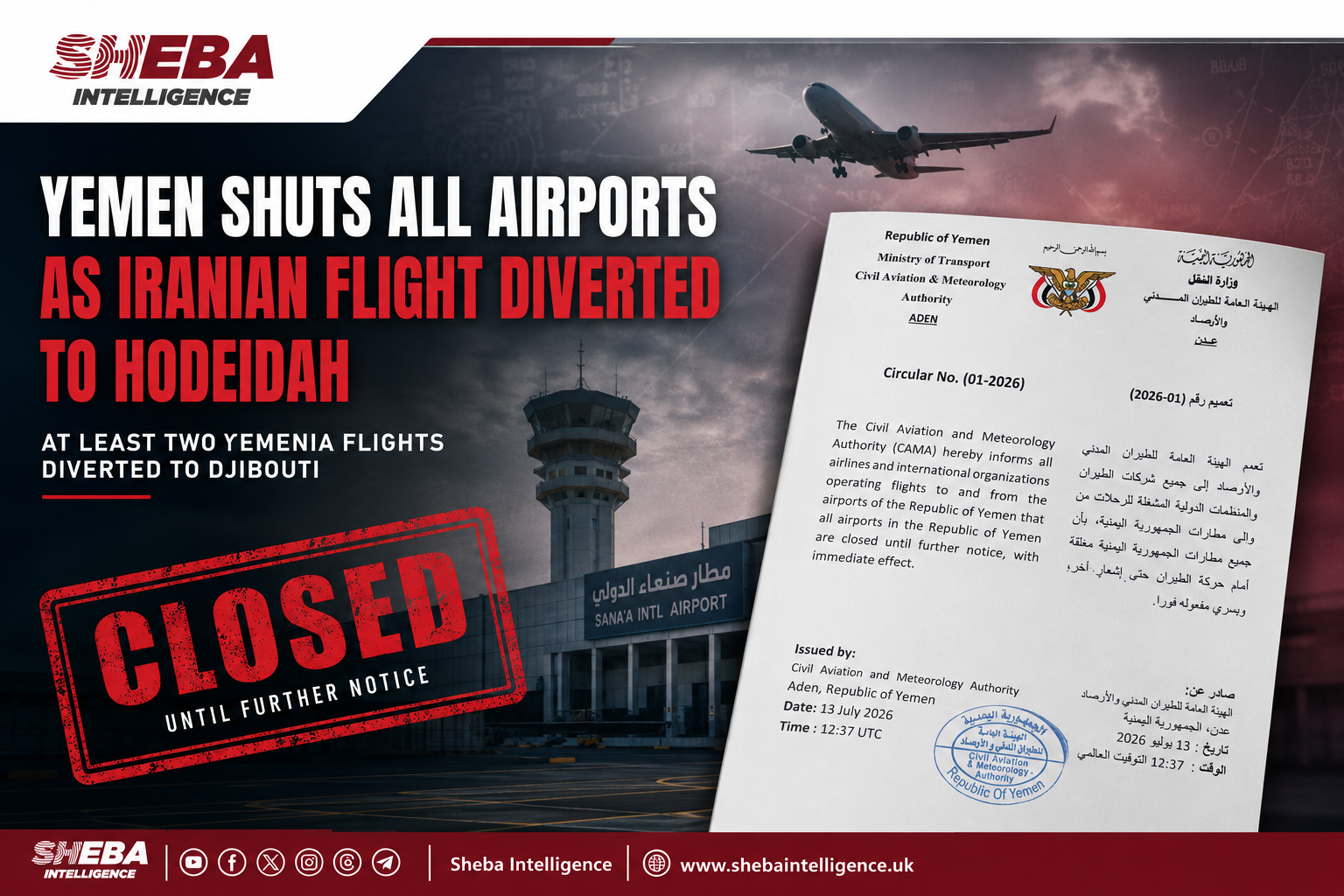
ADEN — Yemen’s internationally recognized Civil Aviation and Meteorology Authority (CAMA) has ordered the immediate closure of all airports across the country, marking a dramatic escalation in the dispute over Iranian flights to Houthi-controlled territory and signaling the emergence of a broader contest over Yemen’s airspace.
The nationwide closure, announced in Circular No. 01-2026 and issued from Aden on 13 July at 12:37 UTC, instructed all airlines and international organizations operating flights to and from Yemen that all airports were closed until further notice with immediate effect. The authority did not specify the reason for the decision or indicate when operations might resume.
Operational information obtained by Sheba Intelligence indicates that at least two Yemenia Airways flights were diverted to Djibouti after they were unable to continue to their intended destinations inside Yemen, underscoring the immediate impact of the closure on civilian aviation.
From a Single Flight to an Airspace Crisis
The airport shutdown follows several days of escalating tensions triggered by Iranian flights to Yemen.
Earlier this month, Yemen’s government warned that Iranian aircraft would not be allowed to enter Yemeni airspace or land at airports outside government control without official authorization, arguing that such flights represented a violation of Yemen’s sovereignty and could facilitate the transfer of personnel or sensitive equipment to the Houthis.
The Houthis responded by threatening retaliation if Iranian flights were prevented from reaching Yemen, raising concerns that the dispute could evolve into direct military confrontation affecting civilian aviation.
That scenario materialized when Sanaa International Airport was struck, preventing an Iranian aircraft from landing there. The aircraft subsequently diverted and landed at Hodeidah Airport, opening what appears to be a new operational route into Houthi-controlled territory.
Hodeidah Emerges as an Alternative Gateway
The diversion to Hodeidah carries broader strategic significance.
In recent days, open-source information indicated that Hodeidah Airport had undergone maintenance and rehabilitation work despite remaining largely inactive for regular commercial operations.
Previous Sheba Intelligence reporting assessed that the airport could be prepared to serve either as an alternative to Sanaa Airport or as a logistical facility supporting Houthi operations. While the successful landing of the Iranian aircraft does not by itself prove that the rehabilitation was conducted specifically for this purpose, it significantly increases the strategic relevance of the airport and reinforces the need to monitor its future role.
Sheba Intelligence had also previously highlighted concerns that earlier Iranian flights could potentially have transported military advisers or sensitive equipment in addition to publicly declared humanitarian or medical missions. No independent evidence has yet confirmed the cargo or personnel aboard the aircraft that landed in Hodeidah.
Civil Aviation Faces Growing Disruption
The closure of all Yemeni airports demonstrates that the crisis has expanded well beyond a dispute over a single Iranian flight.
The suspension is likely to disrupt commercial travel, humanitarian operations, medical evacuations, and international organizations operating inside Yemen. The diversion of Yemenia aircraft to Djibouti also imposes additional operational costs through fuel consumption, passenger accommodation, flight rescheduling, and aircraft repositioning.
Djibouti has historically served as an emergency diversion airport for Yemen-bound flights during periods of instability, but prolonged reliance on it would further complicate already limited air connectivity with Yemen.
A New Phase in Yemen’s Air War
The sequence of events suggests that Yemen is entering a new phase of competition over control of its airspace.
The internationally recognized government appears determined to prevent airports under Houthi control from becoming direct gateways for Iranian influence, while the Houthis are demonstrating their ability to maintain an air bridge by shifting operations from Sanaa to Hodeidah when necessary.
If Iranian flights continue using Hodeidah or other Houthi-controlled airports, the confrontation could extend beyond Sanaa, increasing the likelihood of further strikes against aviation infrastructure and prolonged disruptions to civilian air traffic.
Rather than an isolated aviation incident, the diversion of the Iranian aircraft, the closure of Yemen’s airports, and the rerouting of Yemenia flights to Djibouti collectively indicate that control of Yemen’s airspace has become a central front in the country’s evolving conflict, with implications extending beyond aviation to regional security and freedom of movement.