
International Condemnation Mounts After Houthi Attack on Saudi Vessel, Raising Pressure on Iran and Maritime Security
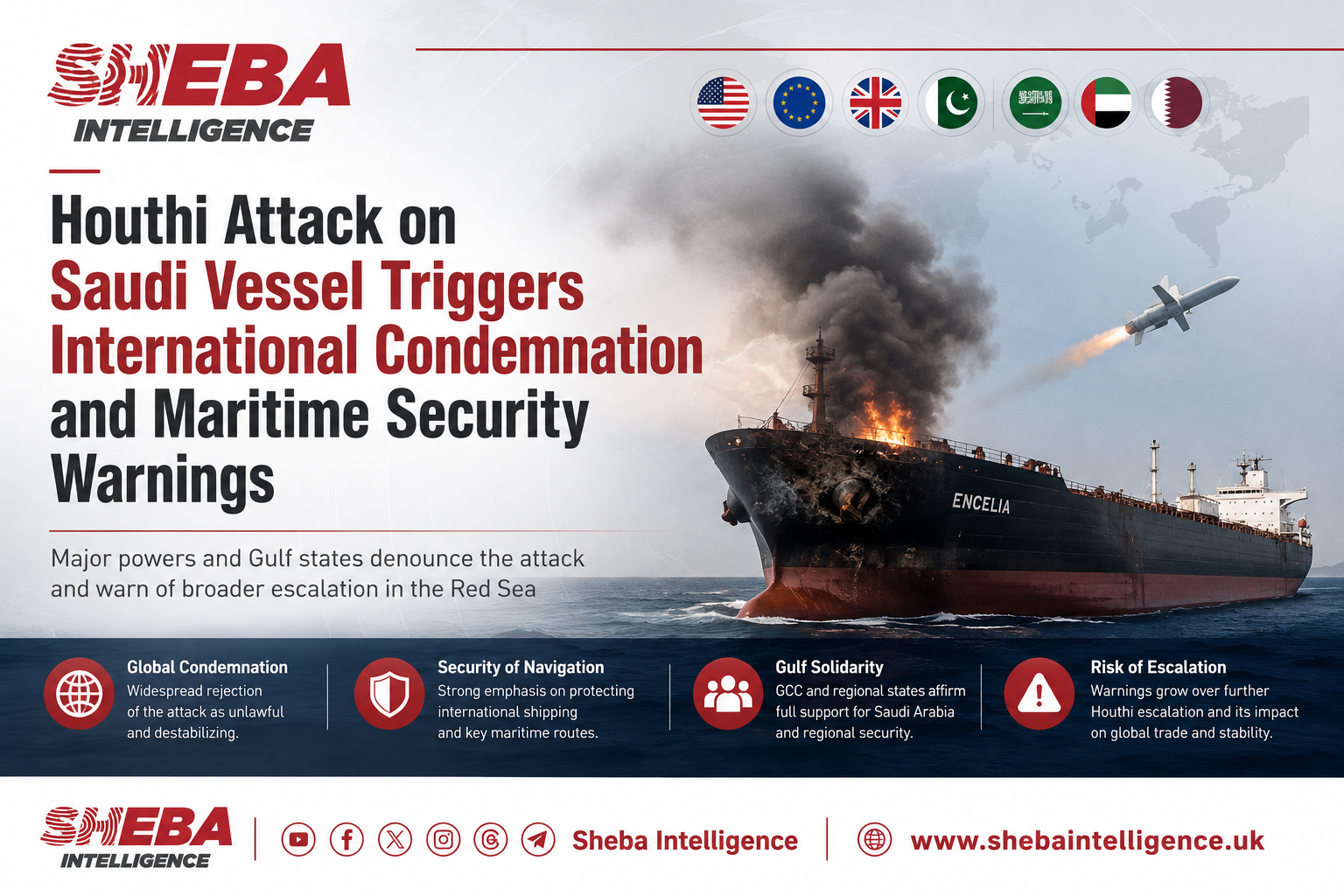
The international response to the Houthi attack on the Saudi-operated vessel ENCELIA marks one of the strongest diplomatic reactions since the group announced its maritime blockade against Saudi Arabia. Rather than treating the incident as an isolated attack on commercial shipping, major powers increasingly framed it as a direct challenge to regional security, international navigation, and the rules governing global maritime trade.
The United States delivered the strongest strategic response by explicitly linking the escalation to Iran and warning of severe consequences, while European governments emphasized international law and maritime security. Gulf states presented the attack as a collective threat to regional security, demonstrating an unusually unified political position behind Saudi Arabia.
Although no coordinated military response has yet been announced, the political messaging suggests that future attacks against Saudi or international shipping could trigger broader international action.
United States: Iran Held Responsible for Houthi Escalation
Washington delivered the most significant international response.
President Donald Trump warned that the United States would hold Iran directly responsible for any future Houthi attacks, declaring that Tehran would face "major consequences" if it continued using the Houthis to threaten regional security and international shipping.
Secretary of State Marco Rubio also accused Iran of encouraging the Houthis to expand their confrontation by targeting Saudi Arabia and commercial maritime traffic. Rubio argued that the group had previously avoided direct involvement in the wider regional conflict but had now become part of Iran's broader escalation strategy.
The American position was significant because it elevated the attack beyond a maritime security incident, placing it within the broader confrontation between Washington and Tehran. Unlike most international statements, the U.S. response introduced the possibility of direct strategic consequences extending beyond Yemen itself.
European Union: Illegal Attack Threatening International Navigation
The European Union condemned the attack as illegal and unacceptable, warning that Houthi threats against Saudi Arabia and commercial shipping further destabilize an already volatile region.
The EU reaffirmed its commitment to protecting freedom of navigation through Operation ASPIDES, stressing that attacks against merchant shipping violate international law and threaten one of the world's most important maritime corridors.
Unlike Washington, Brussels focused primarily on preserving international maritime security rather than linking the incident directly to Iran.
United Kingdom: Threat to Peace and Regional Stability
The United Kingdom strongly condemned the Houthi attack, describing it as reckless and dangerous for international shipping.
London warned that attacks against Saudi vessels undermine regional stability, threaten freedom of navigation, and jeopardize diplomatic efforts to end the conflict in Yemen.
Britain reaffirmed its full support for Saudi Arabia while calling on the Houthis to immediately halt their escalation.
Gulf Cooperation Council: Collective Security Under Threat
The Gulf Cooperation Council issued one of the strongest regional statements.
Secretary-General Jasem Mohamed Albudaiwi described the attack as a flagrant violation of international law and freedom of navigation.
He stressed that Saudi Arabia's security is inseparable from the security of all GCC member states and called upon the international community to adopt firm measures capable of deterring future attacks.
The statement demonstrated that Gulf governments increasingly regard Houthi maritime operations as a collective regional-security challenge rather than a bilateral Saudi-Houthi dispute.
United Arab Emirates
The UAE condemned the attack in the strongest terms, describing it as a serious threat to international shipping and the stability of strategic waterways.
Abu Dhabi called for the implementation of UN Security Council resolutions concerning Yemen and Red Sea navigation while reaffirming its full solidarity with Saudi Arabia.
Qatar
Qatar condemned the attack, describing it as a dangerous violation of international maritime law and a threat to regional energy security and global trade.
Doha reiterated its support for Saudi Arabia and rejected any attempts to disrupt commercial navigation through the Red Sea.
Pakistan
Pakistan strongly condemned the attack and reaffirmed its unwavering support for Saudi Arabia's sovereignty and security.
Islamabad warned that any attack threatening Pakistani commercial vessels or maritime interests would be treated as a direct national security concern, while reaffirming its defence commitments with Saudi Arabia.
France
France condemned the Houthi attacks and reaffirmed its commitment to protecting freedom of navigation and civilian maritime traffic.
Paris also supported continued international efforts to secure commercial shipping throughout the Red Sea.
Jordan and Arab States
Jordan joined Gulf governments in condemning the attack and reaffirmed support for Saudi Arabia's right to defend its sovereignty and maritime interests.
Several Arab governments similarly warned that continued attacks against commercial shipping threaten regional stability and international trade.
Yemeni Government
The internationally recognized Yemeni government condemned the attack, arguing that it demonstrated the Houthis' continued willingness to threaten international shipping and global energy supplies.
Officials said the attack further confirmed the group's role in destabilizing regional security while undermining prospects for peace in Yemen.
The diplomatic reaction to the attack on ENCELIA reveals an emerging international consensus that Houthi maritime operations have evolved into a broader regional and international security challenge.
The United States delivered the strongest strategic message by directly linking the attack to Iran and warning of serious consequences. The European Union and United Kingdom focused on defending international maritime law and protecting commercial navigation, while the GCC and Gulf states presented the attack as a direct threat to collective regional security.
Although international responses remain primarily diplomatic, the combination of American strategic warnings, European maritime commitments, and unified Gulf political support suggests that any further escalation against Saudi or international shipping could generate a significantly stronger international response.