Somalia Security Update: Al-Shabaab Intensifies Multi-Front Offensive as Puntland Battles ISIS
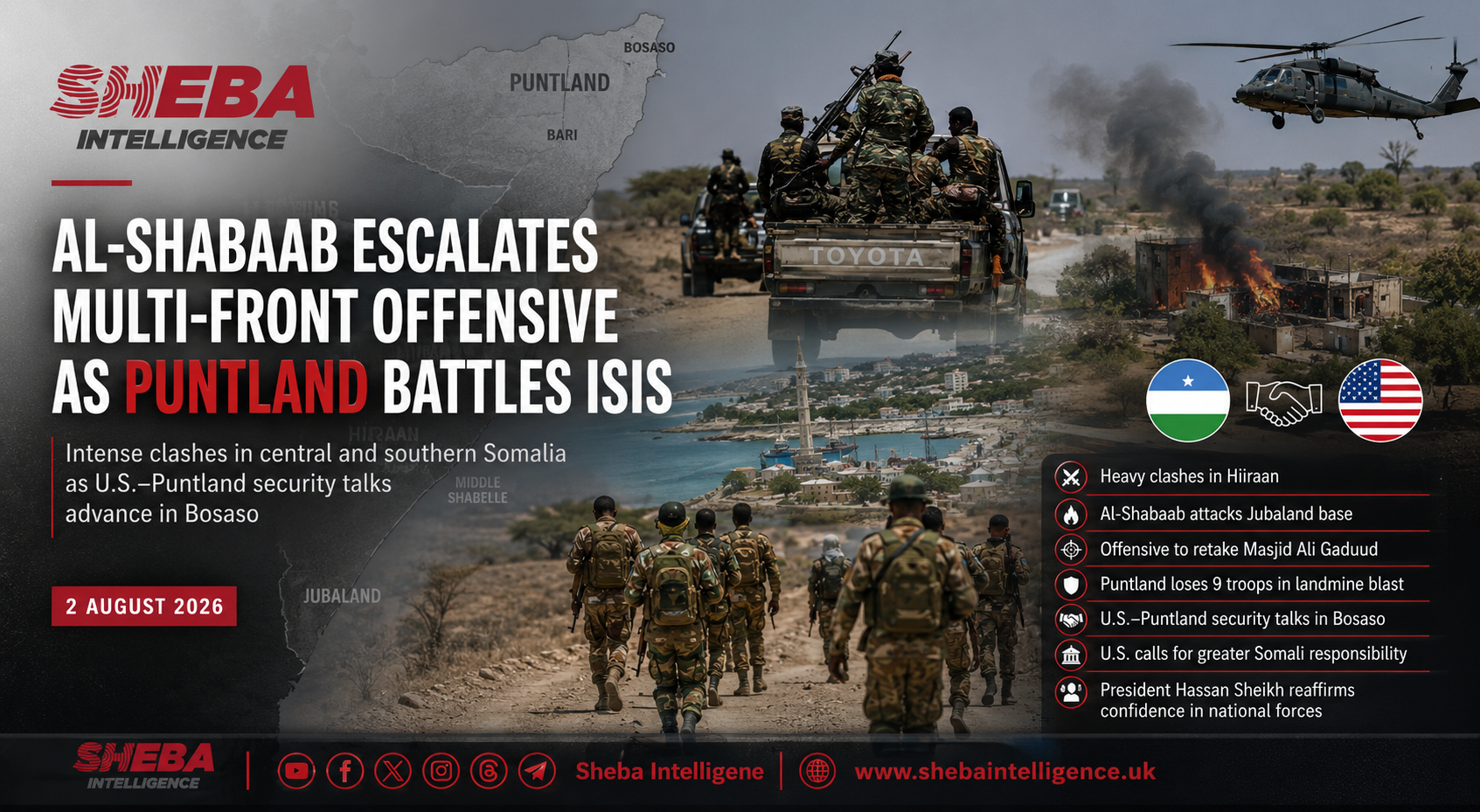
Al-Shabaab launched coordinated attacks across central and southern Somalia on 2 August, underscoring its ability to conduct simultaneous operations despite continued military pressure from Somali government forces and international partners. The developments coincided with renewed U.S.–Puntland security consultations and ongoing counter-ISIS operations in northeastern Somalia.
In Hiiraan, heavy fighting continued for more than 24 hours around Soolay, Tidan, and Hassan Raqay, where Somali National Army (SNA) forces and local Macawiisley fighters clashed with Al-Shabaab militants. The group reportedly achieved limited tactical gains after using improvised explosive devices (IEDs) to break a siege on its fighters. Somali military sources said government forces captured several Al-Shabaab members, while airstrikes targeted militant positions during the fighting. Preliminary reports indicate government casualties, with conflicting claims over the fate of an armored military vehicle reportedly seized during the assault before possibly being destroyed in a later airstrike.
Further south, Al-Shabaab temporarily overran a Jubaland military base near Doolow in Gedo Region, forcing government forces to withdraw before setting the installation on fire and withdrawing. The attack highlighted the group’s continued capability to strike strategic border areas linking Somalia with Kenya and Ethiopia, even if it did not attempt to hold the position.
Government forces also began preparations for an operation to recapture Masjid Ali Gaduud in Middle Shabelle, a strategically important logistics hub under Al-Shabaab control since March 2025. The planned offensive involves the elite Gorgor Commandos, regular army units, and Macawiisley forces advancing from the Wargaadhi axis toward the town.
Meanwhile, Somali forces advanced toward Maxaas in Hiiraan after regaining momentum following intense clashes. Military units reportedly pushed through several defensive positions established by Al-Shabaab while awaiting reinforcements and additional air support, suggesting the government intends to sustain offensive pressure despite recent setbacks.
In northeastern Somalia, Puntland suffered a significant loss when nine security personnel were killed after their military vehicle struck a landmine in the Al-Miskad Mountains of Bari Region, where Puntland has conducted an extended campaign against ISIS for nearly two years. The incident demonstrates that, despite territorial gains claimed by Puntland authorities, ISIS retains the ability to conduct lethal asymmetric attacks inside the mountainous operational zone.
Against this backdrop, Puntland and the United States opened high-level security talks in Bosaso, focusing on expanding counterterrorism cooperation, intelligence sharing, logistics, training, and direct operational coordination against both ISIS and Al-Shabaab. The discussions indicate a possible shift toward deeper bilateral security cooperation beyond previous limited support arrangements and reflect Washington’s continued interest in maintaining a reliable counterterrorism partner in northeastern Somalia.
The diplomatic engagement came as AFRICOM Commander Gen. Dagvin Anderson reaffirmed U.S. support for Somalia while warning that continued political instability and internal divisions could undermine future security cooperation. He stressed that Mogadishu must assume greater responsibility for national security even as Washington remains committed to counterterrorism operations.
Separately, President Hassan Sheikh Mohamud insisted that Somali security forces remain capable of defeating Al-Shabaab despite the gradual reduction of external assistance and the future transition of the African Union mission. His remarks sought to project confidence amid growing debate over Somalia’s ability to sustain security gains as international military support evolves.