Suspected Drone Strike Hits U.S.-Owned LNG Facility at Egypt’s Damietta Port
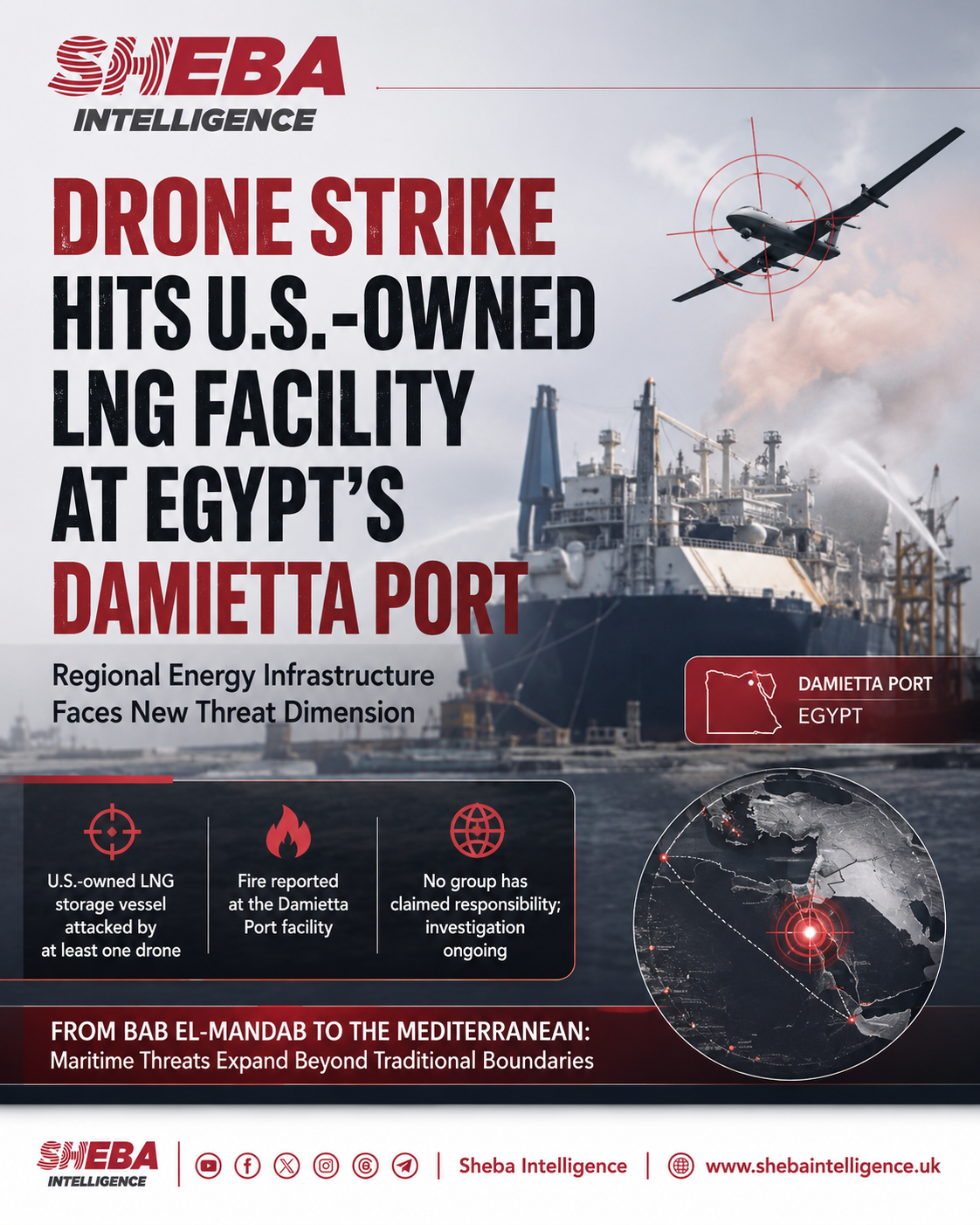
A U.S.-owned floating liquefied natural gas storage facility was struck by at least one unmanned aerial vehicle while berthed at Egypt’s Damietta Port, according to British maritime security firm Ambrey, marking a potentially significant expansion of attacks against regional energy infrastructure.
The drone reportedly struck a floating storage vessel at the Mediterranean port, triggering a fire that spread to a second vessel. The crew was evacuated, and the blaze was later brought under control, Ambrey said.
The full extent of the damage and its potential impact on operations at the port remain unclear. No casualties have been reported, and no group has claimed responsibility for the attack.
Egyptian authorities have not yet released detailed information about the drone’s type, flight path, launch location, or the identity of the party behind the operation. The incident should therefore remain classified as an unattributed attack pending an official investigation or a credible claim of responsibility.
A New Geographic Dimension to Regional Energy Threats
If confirmed as a deliberate military strike, the Damietta incident would represent a notable geographic expansion of the threat to energy and maritime infrastructure.
Recent attacks and security disruptions have largely centred on the Red Sea, Bab el-Mandab, the Strait of Hormuz, Saudi oil infrastructure and commercial vessels operating along strategic maritime corridors. The Damietta attack, however, extends the risk environment to a major energy facility on Egypt’s Mediterranean coast.
The incident also indicates that floating energy infrastructure inside ports may be vulnerable alongside merchant vessels operating at sea. Such platforms are economically sensitive targets because they support the storage, import and handling of liquefied natural gas and form an important part of national energy supply chains.
Although there is currently no evidence directly linking the Damietta attack to the Houthis, Iran-backed Iraqi groups or any other regional actor, its timing raises questions about whether energy installations and U.S.-linked commercial assets are becoming part of a broader regional targeting pattern.
Background: A Selective Passage Regime Emerges in Bab el-Mandab
The Damietta attack comes as maritime security conditions around the Red Sea and Bab el-Mandab are undergoing a broader transformation.
In its latest report, Sheba Intelligence found that commercial shipping traffic through Bab el-Mandab had begun to recover, but that the rebound was occurring alongside the emergence of what appears to be a selective passage regime administered by the Houthis.
Rather than imposing a complete and indiscriminate blockade, the group is increasingly differentiating between vessels according to their nationality, ownership structures, commercial affiliations and perceived links to hostile states.
According to information published by Sheba Intelligence, the Houthis have developed a centralised mechanism to monitor vessels, classify them and communicate warnings to shipowners, operators and charterers. Some ships may be permitted to transit after obtaining prior approval or assurances from the group.
Internal discussions have also considered securing financial contributions or other forms of support from certain vessels in return for facilitating their passage, particularly ships whose ownership structures or commercial affiliations remain unclear. These proposals have not yet been formally adopted, but their consideration points to an effort to convert military influence over the maritime corridor into political and economic leverage.
The emerging model resembles Iran’s long-standing approach in the Strait of Hormuz, where control over a strategic maritime chokepoint is used to pressure rivals, shape shipping behaviour and influence global energy flows.
From Controlling Sea Lanes to Threatening Energy Nodes
The Damietta incident adds a new dimension to this evolving security environment.
The selective passage regime documented by Sheba Intelligence is primarily designed to influence which vessels can move through Bab el-Mandab and under what conditions. The attack in Damietta, by contrast, suggests that the threat may no longer be limited to vessels in transit but could potentially extend to ports, storage platforms and energy facilities connected to the same maritime supply chains.
This does not establish an operational link between the Houthi maritime campaign and the Damietta attack. No publicly available evidence currently supports such a conclusion.
However, the two developments illustrate a wider shift in which vessels, ports, pipelines, floating storage facilities and energy terminals are increasingly becoming interconnected components of regional confrontation.
The maritime pressure emerging in Bab el-Mandab is therefore no longer solely about disrupting navigation. It increasingly reflects attempts to shape commercial decisions, control access to strategic waterways and impose political or economic costs on selected states and companies.
Initial Assessment
The Damietta drone strike should be viewed as a potentially important development, but any attribution remains premature.
Technical evidence will be needed to determine the drone’s origin, range and guidance system, as well as whether it was launched from land, sea or a nearby commercial platform. Investigators will also need to establish whether the U.S. ownership of the floating storage facility was the primary reason for its selection or whether the attack was intended more broadly to disrupt Egypt’s gas infrastructure.
If the attack proves connected to the wider regional confrontation, it would indicate that the threat to energy trade is expanding beyond traditional maritime chokepoints toward the infrastructure that receives, stores and processes energy cargoes.
For now, the most significant conclusion is that the regional maritime threat environment is becoming increasingly interconnected: Bab el-Mandab is witnessing attempts to establish selective control over shipping, while the Damietta incident demonstrates the vulnerability of energy assets located far beyond the southern Red Sea.