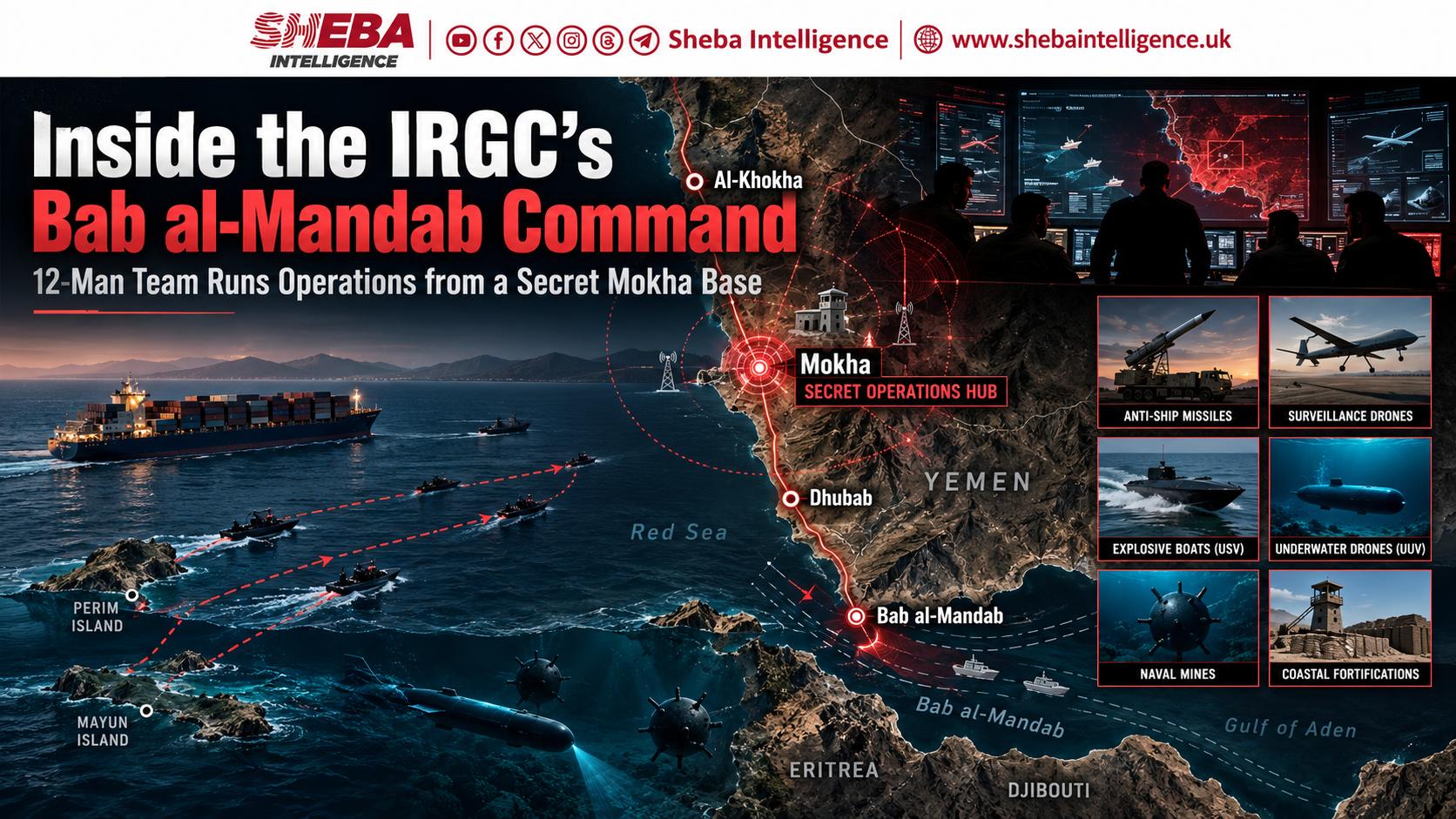
Inside the IRGC’s Bab al-Mandab Command: 12-Man Team Runs Operations from Secret Mokha Base
Documents and intelligence obtained by Sheba Intelligence point to a layered Iranian command structure behind the western-coast breakthrough, with Houthi intelligence officers managing penetration networks built over several years.
Sheba Intelligence | Exclusive
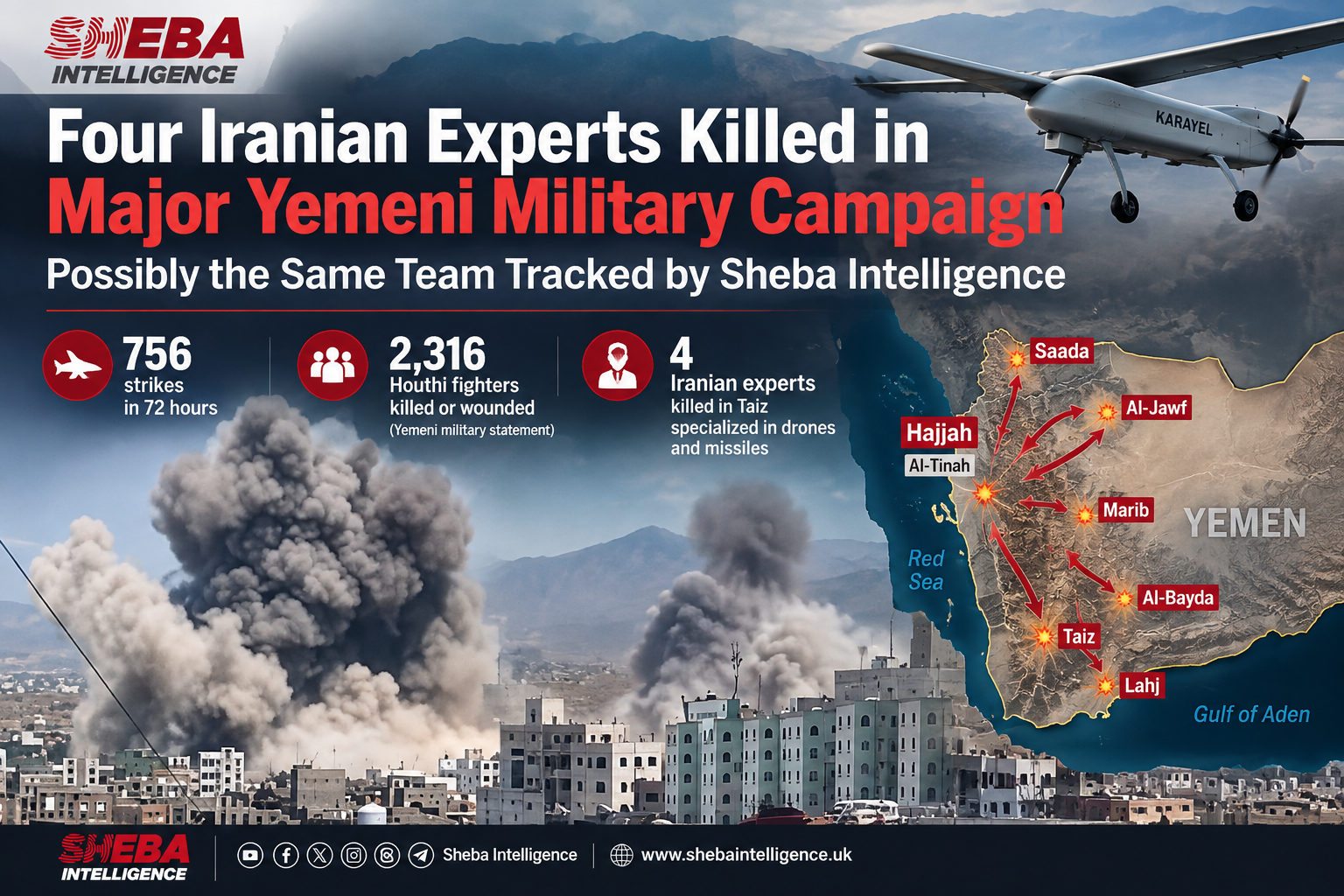
Iran’s Islamic Revolutionary Guard Corps has assigned a specialized team to oversee operations around Bab al-Mandab and Yemen’s western coast, intelligence sources told Sheba Intelligence, giving the unit broader authority after what the sources described as its successful role in managing the operation that preceded the Houthi breakthrough along the coast.
According to the sources, the team consists of 12 IRGC experts and now operates from a secret command-and-control headquarters in Mokha.
The sources said the team handles strategic decisions through a joint operations channel linked directly to its leadership in Iran, while coordination with the Houthi command structure in Sanaa is largely confined to operational planning and battlefield implementation.
The arrangement points to two distinct command levels: an Iranian-led strategic layer responsible for major decisions concerning Bab al-Mandab, and an operational layer coordinating implementation with Houthi commanders and units inside Yemen.
Ten Houthi Intelligence Officers in the Coordination Network
Sheba Intelligence has obtained part of the operational structure used during the campaign that led to the Houthi advance toward Bab al-Mandab, including the identities of Houthi commanders tasked with coordinating with the IRGC team.
A review of the material found that most of the figures involved were not conventional battlefield commanders. They were primarily officers affiliated with the Houthis’ intelligence and security apparatus.
Sheba Intelligence obtained the names of ten Houthi intelligence officials assigned to coordinate with the Iranian team. They belong to bodies including the Preventive Security service, Military Intelligence and the intelligence apparatus, according to the information reviewed by the platform.
The same officers have, according to the sources, spent years managing recruitment, penetration and intelligence networks across the western coast, including efforts to develop contacts among local communities and inside military formations opposing the Houthis.
Based on the composition of the coordination network and the years of penetration activity preceding the military advance, Sheba Intelligence assesses that the fall of Bab al-Mandab carried the characteristics of an IRGC-directed intelligence operation as much as a conventional military offensive.
The battlefield breakthrough, in this assessment, was the final stage of a longer process involving recruitment, infiltration, intelligence collection and the exploitation of vulnerabilities inside forces deployed along the coast.
Earlier reporting by Sheba Intelligence had already documented Houthi attempts to recruit insiders inside government-aligned military formations and obtain advance information on troop movements and operational plans.
Building a Permanent Military and Surveillance Architecture
The sources said the IRGC has moved from managing the offensive to consolidating the territory captured along the coast.
Current work reportedly includes digging trenches, developing fortified positions and establishing military facilities in the hills and coastal terrain extending from Al-Khokha through Mokha and Dhubab to Bab al-Mandab.
The 12-member team is also overseeing the deployment or expansion of radar systems, multiple communications networks and maritime surveillance equipment, according to the intelligence.
These systems are intended to strengthen situational awareness across the strait, support command-and-control functions and improve the ability to monitor naval and commercial movements in the Red Sea and Bab al-Mandab.
The new information is consistent with earlier Sheba Intelligence reporting on the deployment of a hybrid fiber-wireless communications network linked to the IRGC that entered operational use during the Mokha–Bab al-Mandab offensive.
The broader infrastructure reportedly includes positions for missiles, drones, explosive-laden boats, small military craft, autonomous underwater systems and naval mines.
Sheba Intelligence previously reported similar preparations along the western coast, including explosive unmanned surface vessels and small unmanned underwater craft intended for maritime operations around Bab al-Mandab.
The IRGC team is also overseeing radar and surveillance capabilities designed to provide a wider maritime picture. Another Sheba Intelligence investigation reported agreements intended to provide the Houthis with satellite imagery and maritime surveillance data covering Bab al-Mandab, the Red Sea and surrounding waters.
Concerns Over New Weapons Shipments
The consolidation effort has also raised concerns over possible new weapons deliveries to the coast.
Sources said there are fears that larger vessels could attempt to deliver weapons or military equipment directly into Mokha, taking advantage of the altered security environment following the Houthi takeover.
A second scenario under consideration involves shipments being landed first on islands or offshore locations, then transferred toward the Yemeni coast aboard smaller vessels.
Sheba Intelligence has not independently confirmed that such deliveries have already taken place under the new arrangement. The concern is based on the expansion of Houthi and IRGC-controlled maritime infrastructure, the use of islands and small vessels, and previous weapons-smuggling patterns documented in and around Bab al-Mandab.
Earlier reporting by Sheba Intelligence documented repeated interceptions of Iranian-origin weapons and components moving through maritime routes, including equipment associated with drones and explosive boats.
Fishermen and Civilians in the Recruitment Network
The sources said the IRGC’s activities are not limited to infrastructure and weapons deployments.
The team is reportedly overseeing efforts to recruit and train fishermen and civilians along the coast who are considered suitable for intelligence, surveillance, logistical or maritime roles.
Military personnel capable of providing access or information from inside forces opposing the Houthis are also being targeted for recruitment, according to the sources, before undergoing ideological and military training.
This gives additional context to an unusual order reported by Sheba Intelligence on September 24, when fishermen along parts of Yemen’s Red Sea coast were instructed to remain ashore for two to three days without a public explanation.
That report examined several possible explanations, including military training, weapons transfers, coastal deployments and preparations for an operation. The new intelligence raises another possibility: that restrictions on fishing activity could also be connected to recruitment, screening, redeployment or the reorganization of coastal surveillance networks.
There is not yet sufficient evidence to establish that the fishing restrictions were imposed specifically for recruitment purposes.
From a Simulation of Closing Bab al-Mandab to Control on the Ground
The current developments follow a series of indicators documented by Sheba Intelligence months before the western-coast breakthrough.
On July 1, Sheba Intelligence reported that the Houthis were preparing a naval maneuver on Yemen’s western coast designed to simulate the closure of Bab al-Mandab. Preparations included drone-launch platforms, missile deployments and naval personnel concentrated along the Red Sea coast.
On July 19, intelligence sources told Sheba Intelligence that a high-level meeting in Sanaa had identified three priority theaters for a possible wider escalation: Marib–Al-Jawf, Taiz–Bab al-Mandab and the Saudi border.
In August, Sheba Intelligence reported that senior IRGC commander Abdul Reza Shahlai had met senior Houthi military leaders to discuss what intelligence sources described as a Tehran-backed plan for a new phase of the war centered on Marib and the western coast toward Bab al-Mandab.
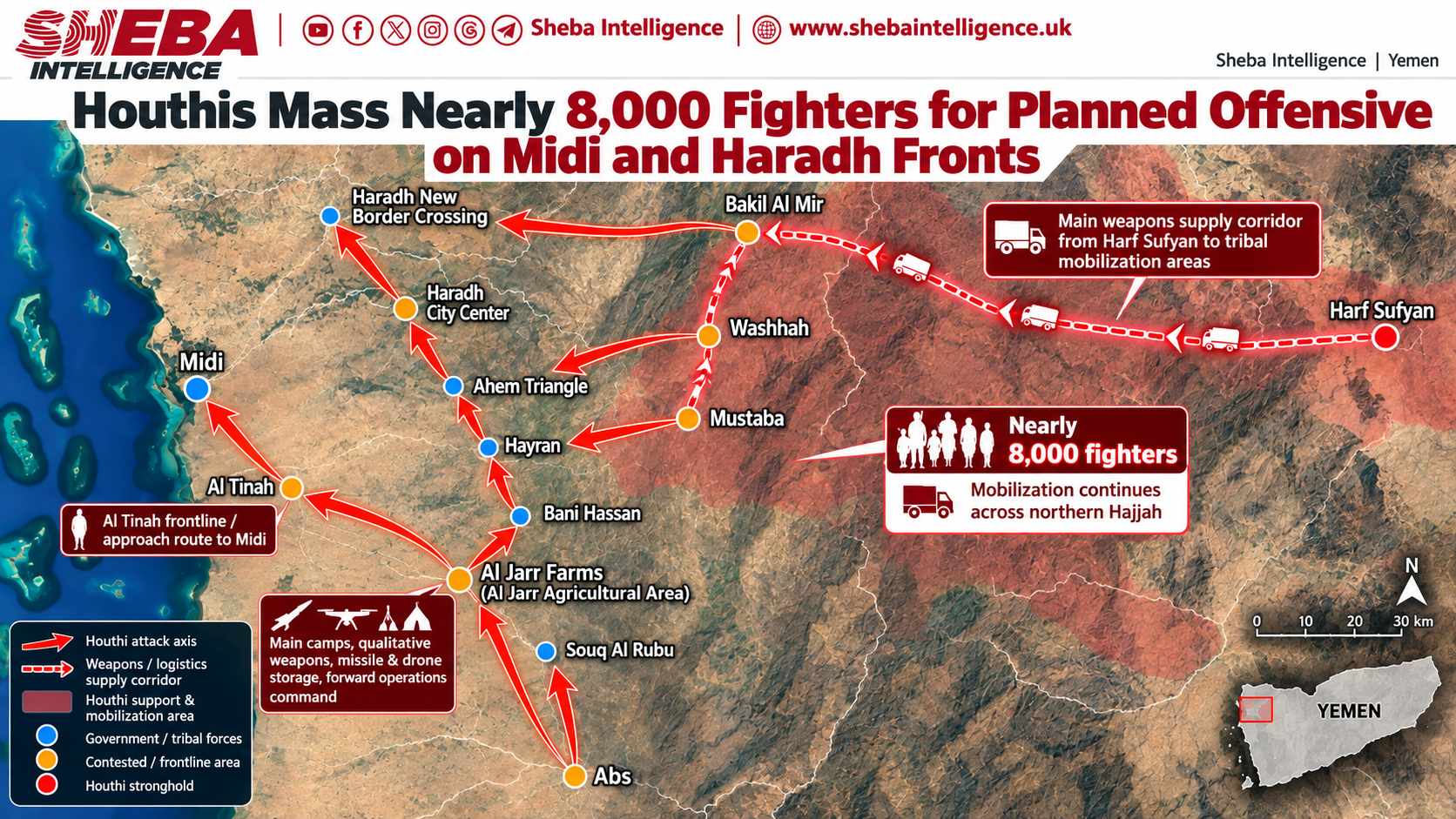
On September 8, Sheba Intelligence reported information about an IRGC-backed plan for a large Houthi offensive along the western coast intended to push toward Bab al-Mandab and stabilize deteriorating Houthi positions in Taiz and coastal areas.
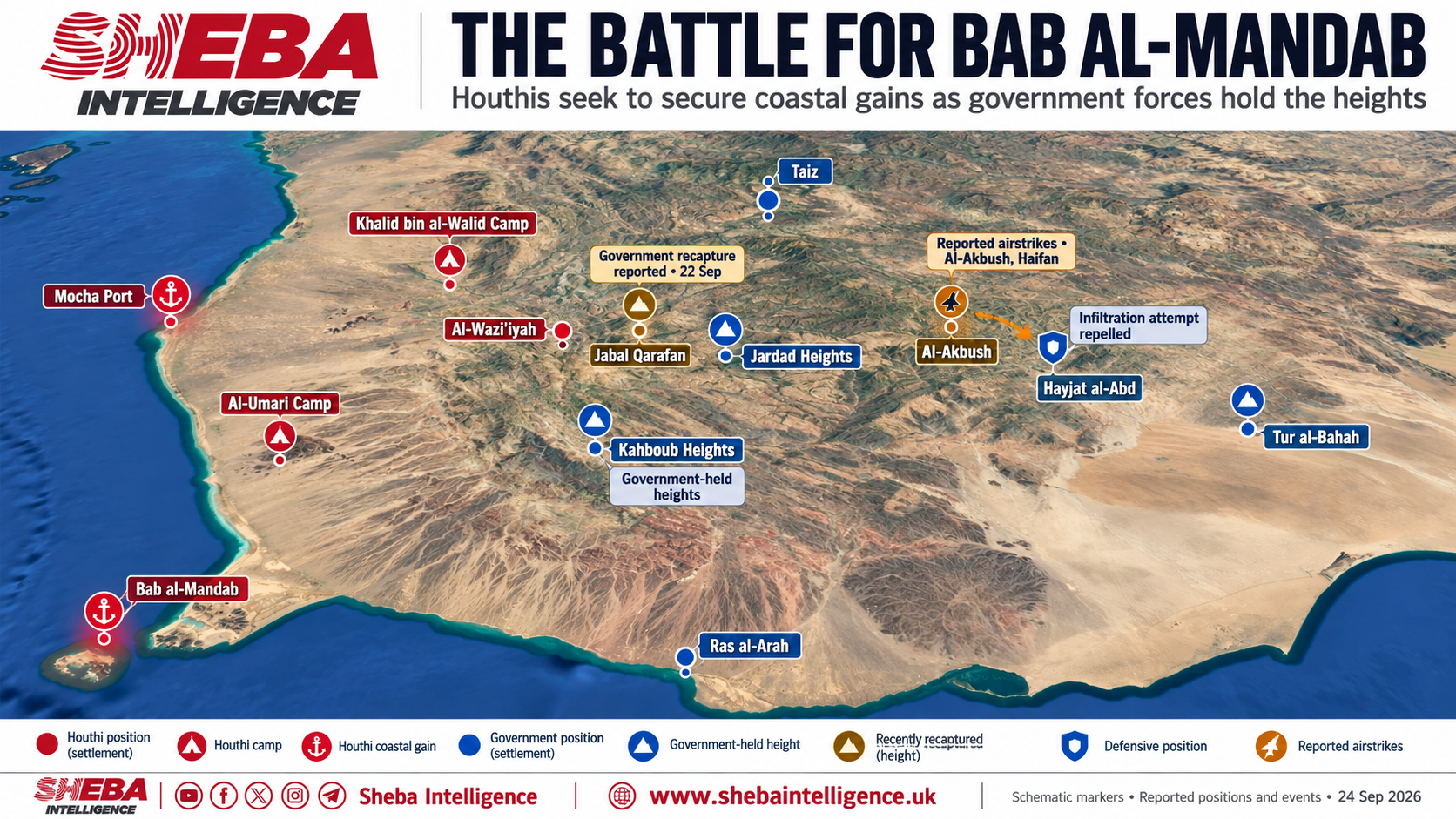
The following day, government forces were reported to be withdrawing from Hays and Al-Khokha toward Mokha as the Houthi offensive expanded.
On September 10, Sheba Intelligence reported that Houthi forces had taken Mokha, shifting the battle directly toward the approaches to Bab al-Mandab.
On September 11, the platform reported that the Houthis had taken Dhubab and Mayun Island, while intelligence sources described an IRGC-supervised plan to continue toward the Al-Arah coast.
Three days later, Sheba Intelligence reported that Shahlai was overseeing military and security arrangements from Al-Khokha, including efforts to consolidate Houthi control, penetrate opposing forces and strengthen the newly captured coastal belt.
An Intelligence-Led Coastal Command
Taken together, the new intelligence suggests that the IRGC is attempting to move beyond temporary battlefield control toward a permanent intelligence, command, surveillance and weapons architecture around Bab al-Mandab.
The 12-member team, according to the sources, now sits at the center of that structure: linked upward to decision-makers in Iran, horizontally to Houthi operational commanders in Sanaa and downward to intelligence, military, maritime and recruitment networks operating across the western coast.
The pattern documented by Sheba Intelligence over the past three months is significant.
What began in July as preparations for a naval maneuver simulating the closure of Bab al-Mandab was followed by identification of the strait as one of three priority fronts, meetings involving senior IRGC figures, a coordinated western-coast offensive, the fall of Mokha and subsequent expansion toward Dhubab and Mayun.
The same theater is now witnessing the installation of radars and communications networks, deployment of maritime weapons, construction of fortified positions, expansion of surveillance systems and the recruitment of local human networks.
For Sheba Intelligence, the emerging picture is therefore not simply of a Houthi force holding newly captured coastline.
It is of an IRGC-directed operational and intelligence hub being built around Bab al-Mandab, designed to transform territorial gains into a durable capability to monitor, defend and potentially threaten one of the world’s most strategically important maritime chokepoints.