Yemen: Bin Fadgham Orders Tribal Advance Toward Frontlines, Raising Risk of Wider Escalation in Al-Jawf
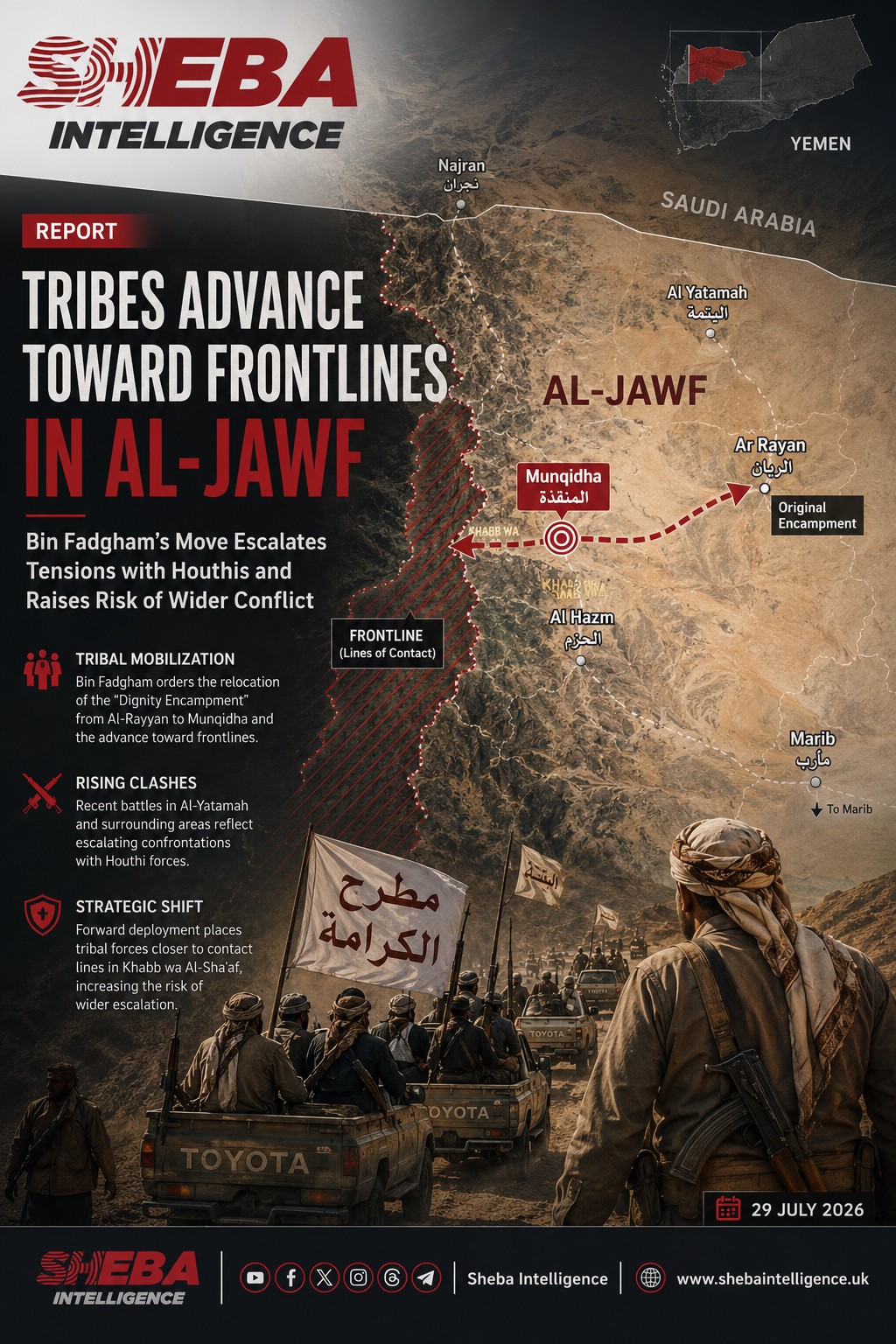
Tensions in Yemen’s northern Al-Jawf governorate have entered a more volatile phase after tribal leader Hamad bin Rashid bin Fadgham announced the relocation of the “Matarih Al-Karama” (Dignity Encampment) from Al-Rayyan to the Munqidha area in Khabb wa Al-Sha’af district, accompanied by the deployment of tribal fighters toward positions near Houthi frontlines.
The move marks a significant shift from weeks of tribal mobilization and political pressure to a forward deployment with clear military implications. While no official government offensive has been announced, the relocation places large tribal formations much closer to active areas of confrontation, increasing the possibility of direct clashes with Houthi forces.
The mobilization follows weeks of growing tribal support for Bin Fadgham’s call for Nakaf, which drew delegations from Al-Jawf, Marib, Hadramawt, Al-Mahrah, and other governorates after disputes between local tribes and the Houthis escalated. Earlier statements by Bin Fadgham had indicated that the tribal gathering would eventually transition into its next operational phase once sufficient reinforcements had arrived.
Escalation Built on Recent Tribal Clashes
The latest deployment comes against the backdrop of a series of armed confrontations in Khabb wa Al-Sha’af, where tribal fighters and Houthi forces have exchanged fire over the past several days.
Recent incidents around Al-Yatamah and nearby areas resulted in casualties on both sides, reflecting an increasingly confrontational environment. Additional localized clashes were also reported around Houthi checkpoints and tribal-controlled areas, underscoring that tensions have expanded beyond the original dispute surrounding Bin Fadgham into a broader confrontation between local tribes and the Houthi authorities.
The pattern suggests that the crisis is no longer confined to a single tribal grievance but is evolving into wider tribal resistance fueled by longstanding disputes over security measures, movement restrictions, arrests, and Houthi governance in northern Al-Jawf.
From Tribal Encampment to Potential Frontline
Relocating the tribal encampment to Munqidha represents a strategically significant development due to its proximity to existing lines of contact in Khabb wa Al-Sha’af. The district serves as an important gateway between government-held territory and Houthi-controlled areas while also connecting to Al-Yatamah, Al-Rayyan, and the Saudi border.
Although the deployment does not necessarily indicate the immediate launch of coordinated military operations, it substantially improves the tribes’ ability to maneuver, reinforce forward positions, or support any future government military activity should broader fighting erupt.
The development is also likely to prompt the Houthis to reinforce northern Al-Jawf, strengthen checkpoints and defensive positions, or intensify mediation efforts aimed at preventing the tribal mobilization from evolving into a wider armed uprising.
A Critical Test for Tribal Mobilization
The next phase will largely depend on whether the tribal coalition can maintain cohesion while transitioning from symbolic mobilization to sustained military action.
The original encampment was established primarily as a platform for tribal solidarity and political demands. Advancing toward frontline positions introduces new operational requirements, including command and control, logistics, sustained supply, and potential coordination with government forces.
Nevertheless, the participation of tribes that have recently engaged in direct clashes with the Houthis could significantly strengthen the movement’s military credibility and broaden its objectives beyond supporting Bin Fadgham personally toward challenging Houthi authority across northern Al-Jawf.
Assessment
Bin Fadgham’s decision to move tribal forces closer to frontline positions represents the most consequential development since the establishment of the Al-Rayyan encampments. It signals a transition from static tribal mobilization to forward deployment capable of influencing the military balance in northern Al-Jawf.
Whether this development evolves into a sustained tribal front or remains a series of localized confrontations will depend largely on three factors: the cohesion of the tribal alliance, the response of Houthi forces, and the extent of coordination between tribal fighters and Yemen’s internationally recognized government forces.
Should direct engagements increase in the coming days, Khabb wa Al-Sha’af could emerge as one of the most significant new flashpoints in northern Yemen, with implications extending beyond Al-Jawf to the broader conflict dynamics.