Yemeni Forces Foil Houthi Attack on Haradh Crossing After Sheba Intelligence Revealed Buildup
Drone-guided artillery struck the attacking force before operations expanded to Houthi staging areas in northern Hajjah.
Yemeni government forces, in coordination with the Saudi-led Joint Forces, have foiled a Houthi attack on the new Haradh border crossing in northern Hajjah, one day after Sheba Intelligence revealed a major Houthi buildup for planned operations on the Haradh and Midi fronts.
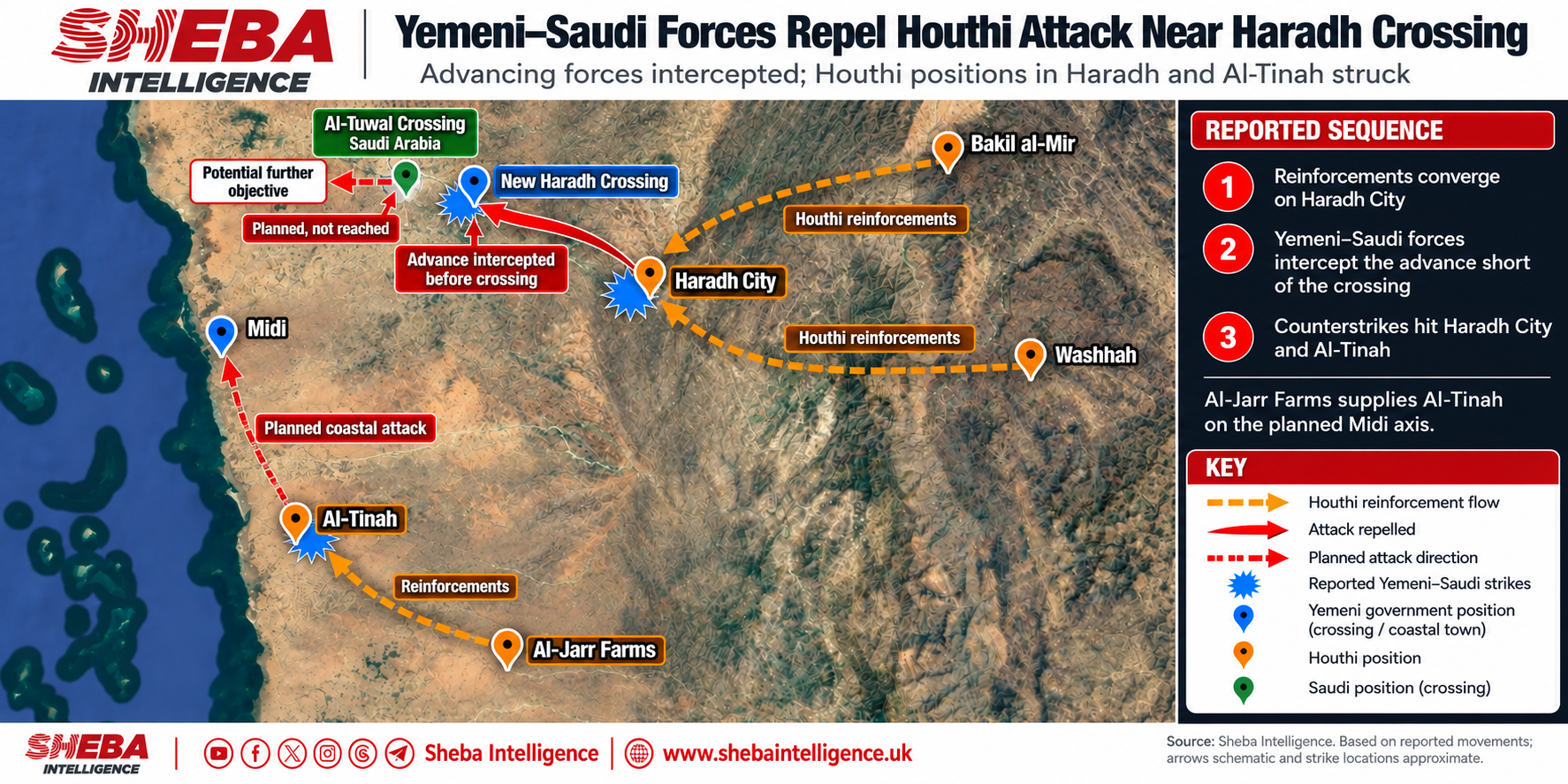
Military sources told Sheba Intelligence that Houthi forces advanced from Haradh city and tribal areas east of Haradh toward Yemeni army positions around the crossing, but were hit before they could break through government defenses.
The defending forces used self-propelled artillery supported by drones, which tracked Houthi movements, provided target coordinates and helped direct artillery fire against the advancing units, according to the sources.
Dozens of Houthi fighters were killed during the failed assault, the sources said. Government and Saudi-led forces then expanded the operation, striking Houthi troop concentrations and staging areas supporting the attack.
Haradh Crossing Was the Immediate Objective
According to information obtained by Sheba Intelligence, the Houthis sought to seize the new Haradh crossing and dislodge Yemeni forces positioned there.
Control of the crossing would have placed Houthi forces directly opposite the Saudi border sector around Al-Tuwal, providing them with a forward position from which they could attempt subsequent cross-border infiltrations into Saudi territory.
The sources said the Houthis were seeking a limited breakthrough into Saudi territory — even if only temporary — that could be portrayed as a battlefield success and used to boost the morale of fighters facing difficult battles on other fronts, particularly Taiz and Marib.
Attack Came One Day After Sheba Intelligence Warning
The assault came one day after Sheba Intelligence reported that the Houthis had massed nearly 8,000 fighters and a large arsenal of weapons in northern Hajjah for a planned offensive against government forces on the Midi and Haradh fronts.
The September 26 report identified two potential axes of attack.
The first runs along the Red Sea coast toward Midi, supported by a Houthi staging and logistics hub at Al-Jarr Farmsand forward positions around Al-Tinah.
The second runs toward Haradh, Ahem Triangle, Hayran and Bani Hassan, drawing manpower and supplies from areas east and southeast of Haradh.
Sheba Intelligence reported that the Houthis could reinforce the Haradh front with fighters from tribal areas including Bakil al-Mir, Mustaba and Washhah. These areas are connected to Houthi-held territory farther east through a supply corridor extending toward Harf Sufyan in Amran, which is used to move fighters, weapons and military supplies into northern Hajjah.
From Repelling the Attack to Striking Staging Areas
After stopping the assault on the Haradh crossing, Yemeni and Saudi-led forces shifted from containing the advance to targeting Houthi concentrations and staging areas behind the front, according to the military sources.
The operations were later reflected in a broader Yemeni military statement announcing a large wave of strikes against Houthi forces across multiple fronts. The statement specifically listed Haradh and Al-Tuwal among the sectors targeted, alongside the coast, Kitaf and Al-Buqa, Alab axis, Al-Jawf, Marib, Lahj, Taiz and Al-Bayda.
The military said the wider campaign targeted troop reinforcements, command-and-control facilities, weapons stores and other military capabilities.
The inclusion of both Haradh and Al-Tuwal is significant given the direction of the failed Houthi operation described by Sheba Intelligence's sources: first seize the Haradh crossing, then establish a forward position facing the Saudi border from which infiltration attempts could be launched.
Al-Tinah Comes Under Focus
The Houthis separately claimed that a Karayel drone was targeted over Al-Tinah in Hajjah during the escalation.
If the claim about the drone's presence over Al-Tinah is accurate, it would be consistent with information obtained by Sheba Intelligence that drones were being used to monitor Houthi movements and provide coordinates for strikes against concentrations and staging positions.
Al-Tinah had already been identified in Sheba Intelligence's September 26 report as a key Houthi forward position on the coastal axis. The report said the Houthis had dug trenches and established fortified positions for tanks and other military vehicles there.
Behind it, Al-Jarr Farms was identified as a deeper operational hub hosting a forward command center, military camps and storage facilities for missiles and drones.
The sequence of events in northern Hajjah therefore moved rapidly from the buildup identified by Sheba Intelligence, to an attempted Houthi assault on the Haradh crossing, and then to counterstrikes against the attacking force and its staging areas.
The developments also show that the Haradh sector has emerged as more than a local Yemeni front. Its proximity to Al-Tuwal gives control of forward positions around Haradh direct significance for the security of the Yemen-Saudi border.