Yemeni Government Opens New Al-Bayda Front as Air-Backed Counteroffensive Expands
Government forces advance in Al-Jawf and western Taiz as Houthi missile activity and two undeclared flights to Sana’a raise questions over the group’s response to mounting battlefield pressure
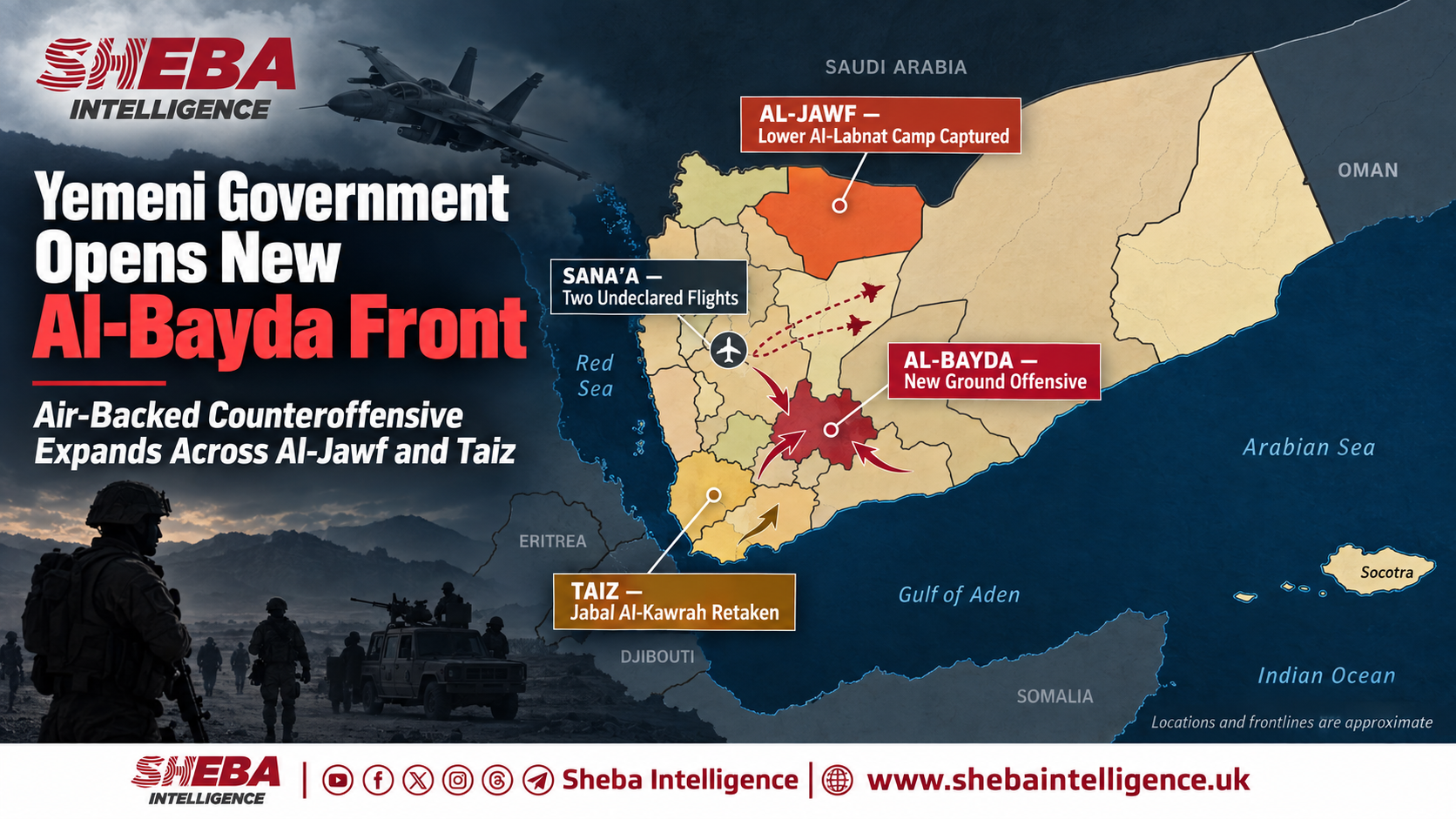
Yemeni government forces have opened a new front in Al-Bayda Governorate while continuing operations in Al-Jawf and retaking positions in western Taiz, marking a further expansion of an air-backed counteroffensive against the Houthis.
The simultaneous operations indicate that government forces are moving beyond containing recent Houthi attacks and are now applying pressure across several connected theatres.
Field sources said the Giants Brigades advanced into western Al-Bayda from the direction of Al-Hadd district in Yafa, taking control of the Um Fulayhan and Al-Majreesh areas in Al-Zahir district, along with surrounding high ground.
The forces subsequently began clearing parts of Al-Nasifah as they prepared to advance towards Dhi Na’im.
Journalist Aref Al-Omari said government forces were approximately eight kilometres from Al-Ribat, an area connected to a Houthi supply route along the Sana’a–Al-Bayda road. Sheba Intelligence could not independently verify the distance or the extent of the advance.
If consolidated, however, the operation could increase pressure on Houthi deployments in Al-Zahir, Dhi Na’im, Mukayras and areas surrounding Al-Bayda city.
Government forces said the ground operation was accompanied by 13 air strikes against Houthi positions, vehicles and troop concentrations in Al-Sharyah, Dhi Na’im, Al-Bayda city and Al-Sawadiyah. One of the targets was reportedly a missile launch platform.
The activation of Al-Bayda expands the fighting beyond the three principal escalation theatres previously identified by Sheba Intelligence: the Taiz–Bab al-Mandab corridor, the Marib–Al-Jawf axis and areas near the Saudi border.
Al-Bayda’s central location gives developments there implications beyond the governorate itself. It borders or connects operationally with Sana’a, Marib, Shabwa, Abyan, Lahj and Al-Dhalea, making it an important junction in the Houthis’ movement and supply network.
Lower Al-Labnat Camp Captured
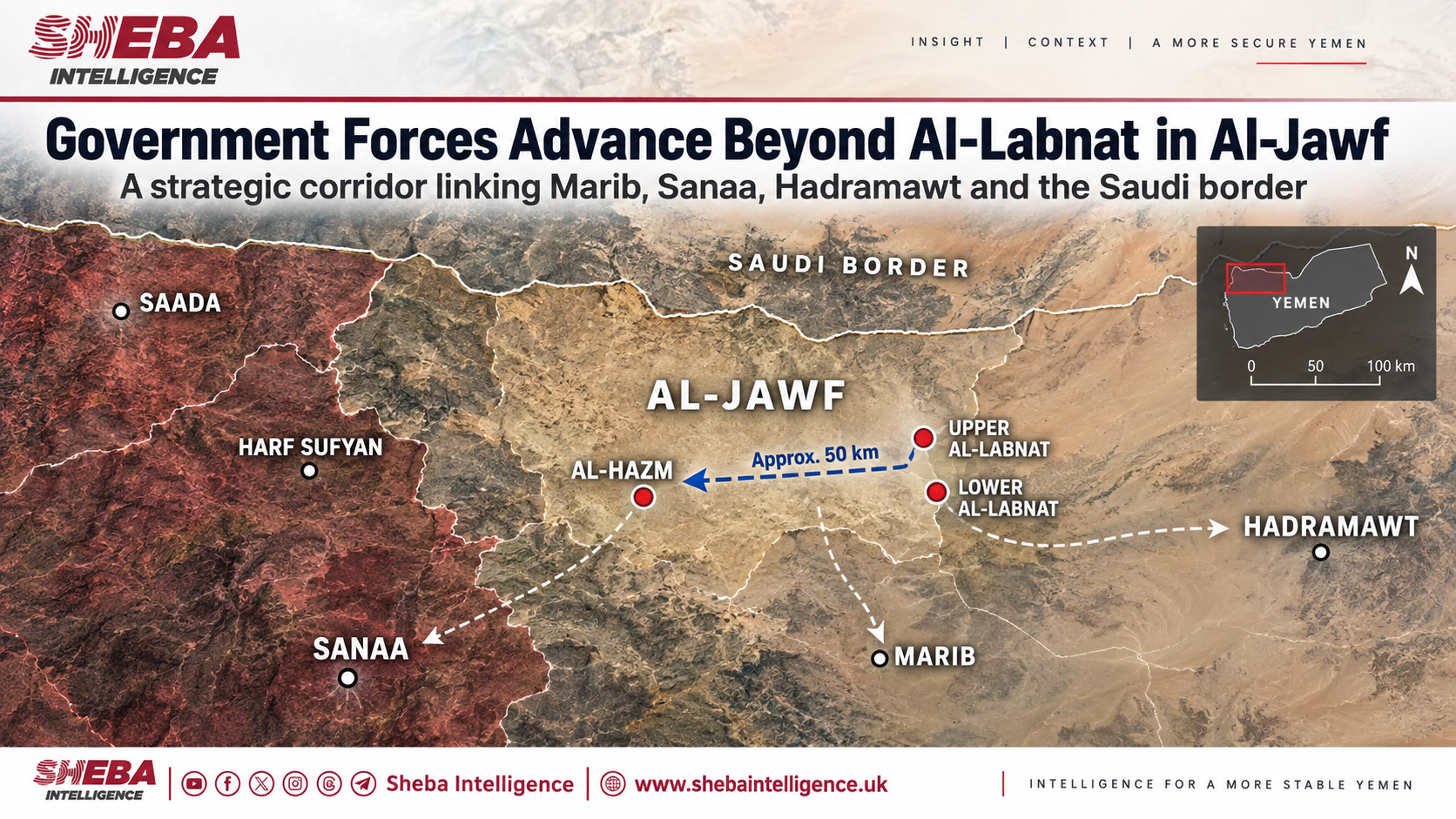
In Al-Jawf, forces from the Sixth Military Region, backed by Emergency Forces units, the Nation’s Shield Forces and tribal fighters, continued their offensive east of Al-Hazm, the provincial capital.
Field sources said government forces had taken full control of the Lower Al-Labnat military camp after air strikes destroyed or disabled much of its military infrastructure.
The forces subsequently expanded their presence around the camp while keeping Houthi positions in Upper Al-Labnat under fire. Those positions form part of the group’s main eastern defensive line protecting Al-Hazm.
The latest information does not indicate that all Houthi positions across the wider Al-Labnat area have fallen. Fighting is continuing around elevated positions and approaches leading towards the provincial capital.
Sources said some abandoned sites contained mines, unexploded missiles and other ordnance. The danger has slowed the deployment of troops inside the former Houthi positions, with government forces securing their surroundings while engineering teams conduct clearance operations.
The Houthis had used Lower Al-Labnat as a recruitment, training and weapons-storage centre, as well as a forward base for operations towards Al-Rayyan and Marib.
Before the government operation began, Sheba Intelligence reported that the Houthis were moving rocket launchers, drones and reinforcements into Al-Jawf in preparation for a possible offensive towards Al-Rayyan.
Air strikes subsequently targeted the Al-Labnat and Al-Khanjar camps, as well as Houthi gatherings and reinforcements east of Al-Hazm. The strikes were followed by the current ground offensive, reversing the direction of pressure on the front.
Instead of using Al-Jawf to open a new offensive towards Marib, the Houthis are now defending positions around Al-Hazm and attempting to reinforce their eastern defensive belt.
Al-Jawf is strategically important because it connects Marib, Saada, Harf Sufyan, Hadramawt and the Saudi border. Its extensive desert also provides routes for moving weapons and personnel away from major roads and populated areas.
Repeated information obtained by Sheba Intelligence points to a joint operations room and concealed facilities used to assemble and store missiles, drones and related components in the governorate.
The information has also indicated the presence of Islamic Revolutionary Guard Corps missile specialists at an operations room in Al-Jawf. Sheba Intelligence has not independently verified the experts’ identities or the room’s precise location.
Government Forces Retake Jabal Al-Kawrah
In western Taiz, government forces recaptured the Al-Kawrah pass and Jabal Al-Kawrah in the Al-Kadaha front of Maqbanah district following heavy fighting with Houthi units.
The high ground overlooks parts of Al-Kadaha and the road connecting Taiz with the coastal city of Mokha. Its recapture is therefore important for securing the route and preventing the Houthis from establishing positions that could again threaten Taiz’s access to the western coast.
Warplanes also targeted Houthi reinforcements moving towards the Al-Barh and Jabal Han fronts.
The Taiz Military Axis spokesperson said the strikes destroyed more than 21 patrol vehicles and military trucks carrying fighters and weapons. The National Resistance Forces separately reported that three Houthi vehicles were destroyed in Al-Kadaha. The reported losses could not be independently verified.
The developments support an earlier Sheba Intelligence assessment that the expanded air campaign had halted much of the momentum behind the Houthi offensive in western Taiz.
Houthi forces had reached Al-Sharajah junction and temporarily threatened the Taiz–Mokha road as part of an apparent effort to separate the city from the western coast and move closer to routes leading towards Bab al-Mandab.
The recapture of Al-Sharajah and Jabal Al-Kawrah, combined with strikes on reinforcements moving towards Al-Barh and Jabal Han, has made it increasingly dangerous for the Houthis to concentrate fighters and vehicles near the front lines.
The developments are consistent with Sheba Intelligence’s earlier reporting on the government counteroffensive, which indicated that air support and newly deployed ground reinforcements were beginning to reverse some of the Houthis’ initial gains.
Houthi Missile Activity Detected
Meanwhile, informed sources said the Houthis had begun launching missiles from several locations, including sites around Sana’a.
It remained unclear whether the missiles were directed towards the battlefronts in Taiz, Marib and Al-Jawf or towards areas near the Saudi border. No confirmed information was immediately available regarding their targets or impact.
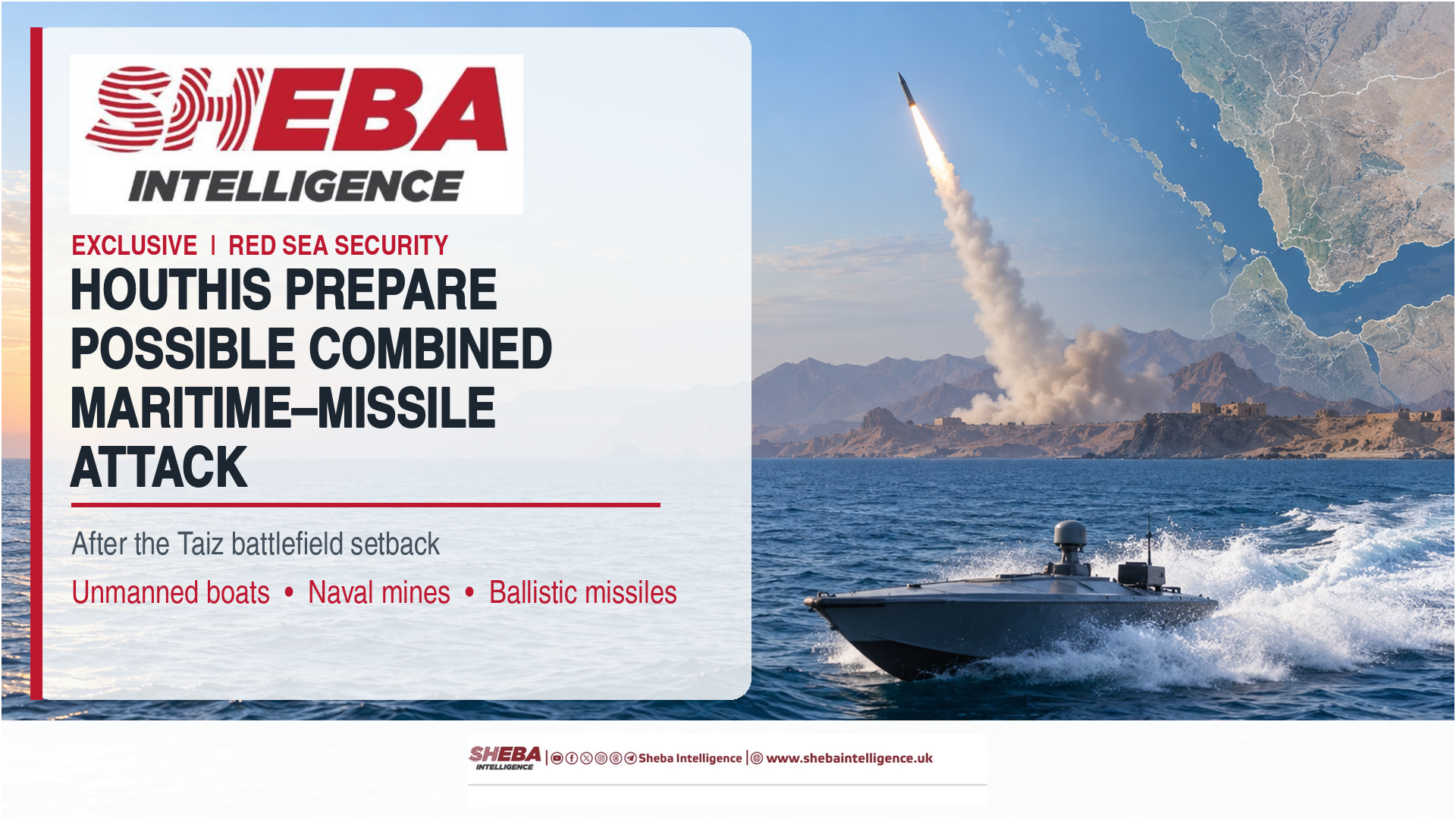
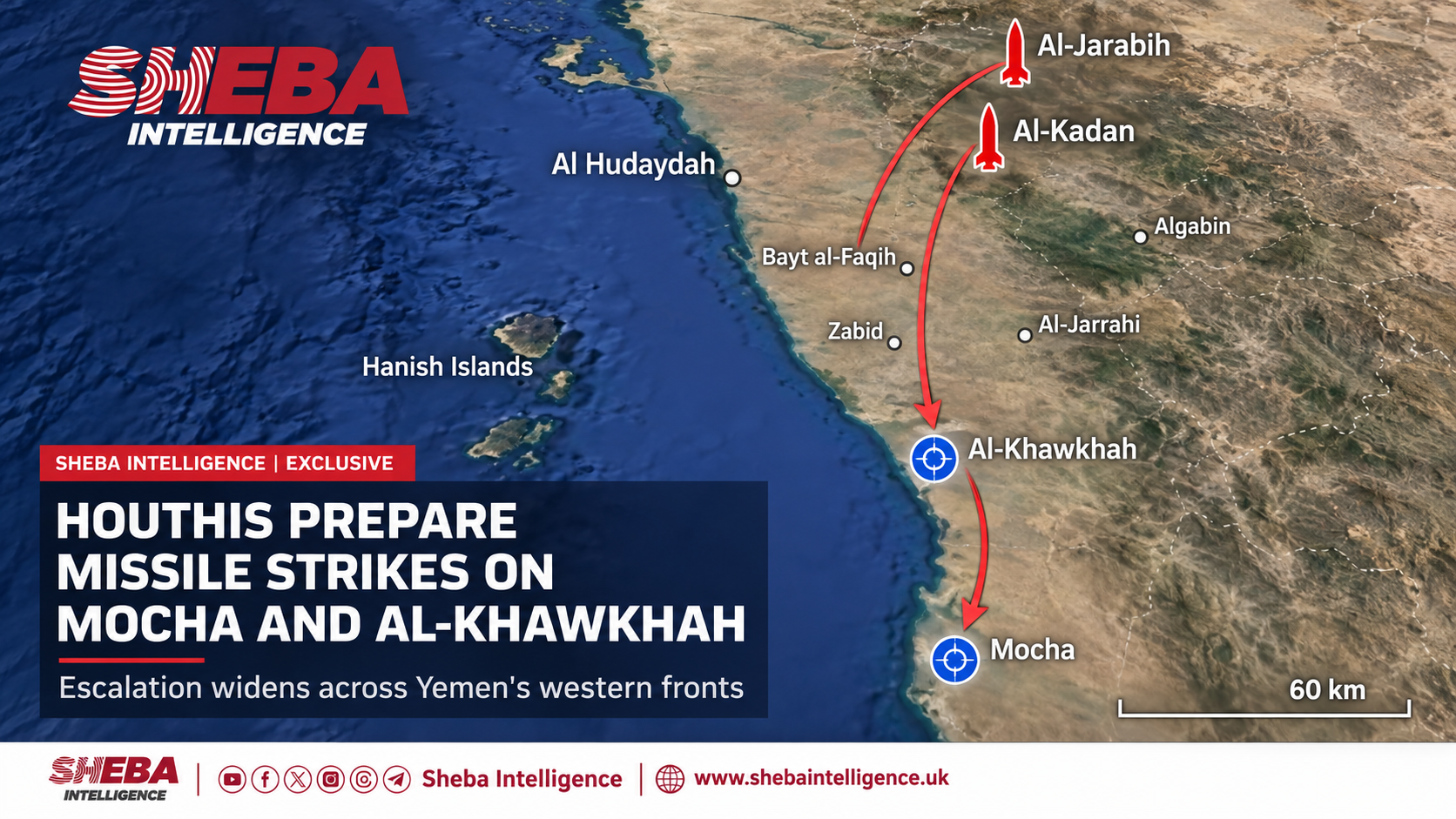
The activity follows intelligence obtained by Sheba Intelligence on Houthi preparations for possible ballistic missile strikes against Mokha and Al-Khokha.
It also supports an assessment that the group may increasingly rely on missiles, drones, artillery fire and limited infiltration operations as air strikes make large ground formations easier to detect and target.
Undeclared Flights Raise Evacuation Questions
As the air campaign intensified, Dr Abdulqader Al-Kharraz and his monitoring team reported the arrival of two aircraft at Sana’a International Airport on September 7.
One of the aircraft was operating for Médecins Sans Frontières. According to Al-Kharraz, neither flight appeared in the United Nations’ published humanitarian aviation schedule for Yemen.
Their arrival following air strikes on Houthi camps, command positions and reinforcements has prompted concerns that the aircraft may have been used to evacuate wounded Houthi commanders or foreign military specialists.
However, no independent evidence has emerged identifying the passengers or confirming that either aircraft conducted a medical evacuation. The UN and Médecins Sans Frontières had not publicly clarified the purpose of the flights or why they were absent from the published schedule.
The incident follows an earlier discrepancy documented by Al-Kharraz on September 2, when three aircraft reached Sana’a although the UN schedule listed only one flight.
Sheba Intelligence previously reported that all humanitarian and medical flights operating within the internationally coordinated framework for Sana’a should be publicly disclosed, including independently chartered or emergency flights that do not formally operate as UN Humanitarian Air Service missions.
The latest battlefield developments reinforce Sheba Intelligence’s assessment that sustained air operations have shifted pressure onto Houthi camps, supply lines and rear positions, allowing government forces to move from defence to coordinated counteroffensives.
The shift is not yet decisive. Its continuation will depend on the government’s ability to secure newly captured territory, clear mines, maintain air-ground coordination and prevent the Houthis from compensating for territorial setbacks through missile and drone attacks.