
The New Red Sea Threat: Piracy Returns as Houthi Pressure Spreads Across the Shipping Corridor
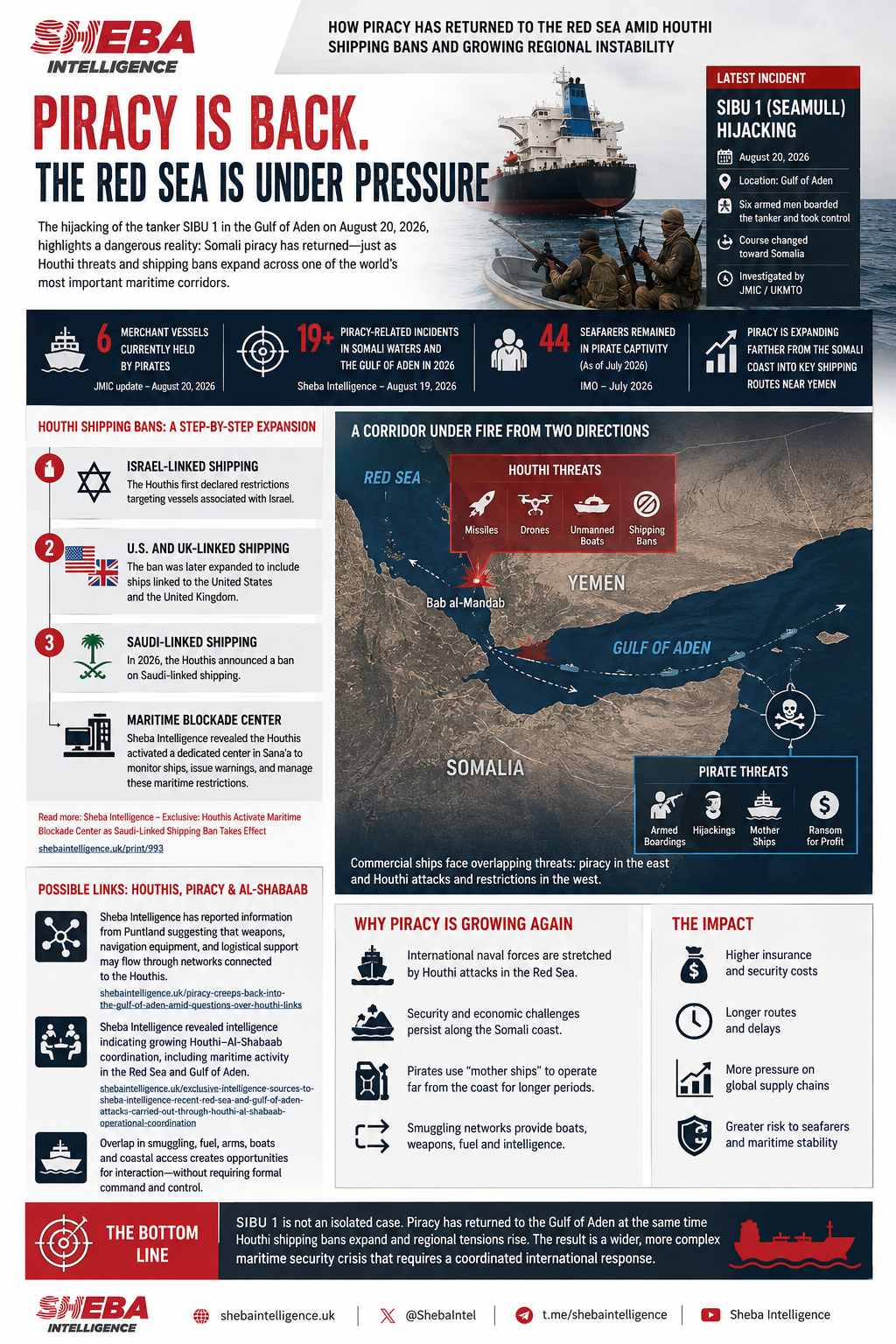
From the SIBU 1 hijacking to Houthi restrictions on Israeli-, US-, UK- and Saudi-linked shipping, Sheba Intelligence traces how overlapping threats are reshaping maritime security from the Somali coast to Bab al-Mandab.
The hijacking of the tanker SIBU 1 on August 20 has added another threat to a shipping corridor already under pressure from Houthi attacks, maritime restrictions and regional military escalation.
The vessel was sailing west through the Gulf of Aden when armed men boarded and took control of it. The Joint Maritime Information Center (JMIC) identified the ship as MT SEAMULL (SIBU 1) and confirmed that it was hijacked in the Internationally Recommended Transit Corridor off Somalia. The case remained under investigation in JMIC’s August 20 update.
Only three days earlier, the Cameroon-flagged LUTUF had also been hijacked off Somalia. The two incidents came after months of renewed pirate activity and reinforced a warning repeatedly raised by Sheba Intelligence: piracy was returning to the Gulf of Aden at the same time that naval attention was increasingly focused on the Houthi threat farther west.
Sheba Intelligence had already documented at least 19 piracy-related incidents in Somali waters and the Gulf of Aden during 2026, including five hijackings of commercial vessels since April. The figures showed that the problem was no longer confined to isolated attacks close to Puntland, but was spreading across waters used by ships moving between the Arabian Sea, the Gulf of Aden and Bab al-Mandab.
The Return Began Before August
Piracy did not suddenly return with SIBU 1. The first clear signs appeared after late 2023, when Somali groups resumed successful hijackings after years in which large-scale piracy had been largely contained. Attacks and boarding attempts continued through 2024 and 2025, before becoming more frequent in 2026.
By July, the International Maritime Organization was publicly warning of the renewed threat. Sheba Intelligence reported that the IMO had called for urgent international action after 44 seafarers remained in pirate captivity, giving official weight to warnings Sheba had issued earlier about the return of piracy around Somalia and the Gulf of Aden.
What changed in 2026 was not only the number of attacks. It was their reach.
Pirates were again operating well beyond coastal waters, using hijacked vessels and larger craft to support attacks farther offshore. This increased their ability to reach routes approaching Yemen and the main commercial lane through the Gulf of Aden.
That was the concern behind an earlier Sheba Intelligence investigation, “Piracy Creeps Back into the Gulf of Aden Amid Questions Over Houthi Links,” which warned that an old maritime threat was returning while international naval forces were heavily occupied with Houthi attacks in the Red Sea and Bab al-Mandab.
A Shipping Route Under Pressure From Both Directions
The renewed pirate threat is unfolding along the same route already disrupted by the Houthis.
A vessel travelling from the Indian Ocean toward the Suez Canal now passes first through waters where Somali piracy has again become a serious risk. Farther west, it approaches Bab al-Mandab and the southern Red Sea, where the Houthis have used missiles, drones, unmanned boats and shipping restrictions as instruments of pressure.
These are different actors with different motives. Somali pirates are primarily seeking ransom and financial gain. The Houthis are pursuing political and military objectives. But for commercial shipping, the effect is increasingly similar.
Both force shipowners to increase security, change operating procedures, pay higher insurance premiums and reconsider routes. Both also require naval forces to cover a larger maritime area.
The overlap matters because the Gulf of Aden and Bab al-Mandab cannot be treated as separate security theatres. Together they form a single corridor connecting the Indian Ocean with the Red Sea.
From Israel to the United States, Britain and Saudi Arabia
The Houthi maritime campaign has also expanded in stages.
The group first presented its shipping restrictions as part of the war against Israel-linked vessels. The targeting framework was later widened to include ships associated with the United States and the United Kingdom.
In 2026, the Houthis extended that policy again by announcing restrictions against Saudi-linked shipping.
Sheba Intelligence subsequently revealed that the group had expanded the operation of a dedicated maritime blockade centre responsible for monitoring vessel movements and administering the Saudi-linked shipping ban. The centre was reported to maintain targeting lists, issue warnings and handle requests linked to passage through Houthi-threatened waters.
This progression is important. The Houthis are no longer relying only on individual attacks. They have repeatedly tried to define which vessels may or may not pass safely through waters near Yemen, broadening the list according to the regional confrontation: first Israel, then Washington and London, and later Riyadh.
Sheba Intelligence reporting also linked this policy to the expansion of Houthi maritime infrastructure. On Kamaran Island, intelligence sources described facilities connected to Red Sea operations at a time when the group had announced its Saudi shipping ban.
Why Piracy Fits the Same Strategic Environment?
There is no public evidence that Iran or the Houthis direct Somali piracy. That distinction is important.
Yet the return of piracy creates consequences that overlap closely with the pressure Tehran and the Houthis are already trying to impose on maritime trade.
Pirate attacks expand the dangerous area eastward from Bab al-Mandab into the Gulf of Aden. They force naval forces to split attention between counter-piracy patrols and protection against Houthi missiles and drones. They also increase the commercial cost of using the corridor.
For Iran, which has used its regional partners to place pressure on strategic waterways, those effects are useful even if the pirates themselves remain motivated by ransom rather than ideology.
Sheba Intelligence has previously examined this broader pattern in its report “From Trade to Firepower: How the Houthis Became Iran’s Regional Military Operator.” The report noted that piracy operates in the same maritime environment as fuel, weapons, drug and migrant smuggling, where boats and logistical networks can serve different purposes from one voyage to another.
The point is not that piracy is an Iranian operation. It is that a growing piracy problem makes the Gulf of Aden and Red Sea harder and more expensive to secure — an outcome that sits comfortably with Iran’s broader strategy of keeping pressure on regional trade and its adversaries.
The Houthi-Pirate Question
Sheba Intelligence began raising questions about possible Houthi links to Somali maritime networks before the latest wave of hijackings.
Its earlier piracy investigation cited information from the Somali side pointing to possible connections involving weapons, navigation equipment and logistical networks. The reporting did not establish that the Houthis controlled pirate groups, and no international maritime body has publicly produced evidence showing Houthi command over Somali piracy. The concern is more practical than organisational.
The Gulf of Aden has long supported networks involved in smuggling weapons, fuel, people and other goods between Yemen and the Horn of Africa. Pirates do not have to become Houthi members for those networks to overlap.
Weapons can be purchased. Boats can be hired. Information on vessel movements can be sold. Fuel and supplies can move through the same ports and coastal communities.
Those kinds of connections are much harder to detect than a formal alliance.
Al-Shabaab Changes the Equation
The question became more serious after Sheba Intelligence obtained information about growing Houthi cooperation with Al-Shabaab.
On August 6, Sheba Intelligence reported that intelligence sources linked several recent maritime attacks in the Red Sea and Gulf of Aden to operational coordination between the Houthis and Al-Shabaab. According to the report, cooperation had moved beyond general contacts and into maritime activity. .
That reporting does not prove that Somali pirates are part of the same structure.
It does, however, make the environment more difficult to dismiss as a collection of unrelated incidents.
Pirates, smugglers, Al-Shabaab operatives and Houthi-linked networks all operate around a relatively narrow maritime space separating Yemen from Somalia. Their goals may differ, but their requirements are often similar: boats, fuel, weapons, coastal access, intelligence and money.
Even limited transactions between these networks could strengthen their ability to operate at sea.
The Security Gap
There is another reason piracy has been able to return.
The security system that helped suppress Somali piracy after 2011 was built around sustained naval patrols, armed guards aboard merchant ships, tighter operating procedures and pressure on pirate bases ashore. That system has been under strain.
Since the Red Sea crisis intensified, naval missions have had to devote more resources to Houthi missile and drone attacks and the protection of merchant traffic near Bab al-Mandab. At the same time, political and security problems persist along parts of Somalia’s coastline. Pirate groups have taken advantage.
The use of mother ships is particularly important. By using captured fishing vessels or other larger craft to transport armed teams, fuel and attack skiffs, pirates can remain at sea longer and operate hundreds of miles from their original bases. Distance from Somalia is therefore no longer a reliable measure of safety.
SIBU 1 Is Part of a Wider Pattern
The SIBU 1 hijacking matters because of what came before it.
It followed LUTUF by three days. It came after repeated hijackings earlier in the year. And it occurred after months of warnings that Somali piracy was spreading into the Gulf of Aden while the Red Sea conflict was drawing naval attention westward.
At the same time, the Houthis were expanding military preparations close to Bab al-Mandab.
Sheba Intelligence reported in August that Houthi forces were reinforcing areas toward Mokha and Yemen’s western coast, including preparations that could increase pressure near the strait.
Earlier reporting also described Houthi deployments and preparations linked to the Saudi border and Bab al-Mandab, reinforcing the view that the group sees maritime pressure as part of a wider regional confrontation.
A Different Crisis From the Piracy Wave of 2010
The current level of piracy is still below the peak seen between 2009 and 2011.
But the environment is more dangerous.
During the earlier piracy crisis, piracy itself was the dominant maritime threat off Somalia. Today, merchant ships face piracy in the Gulf of Aden while navigating a wider region affected by missiles, drones, maritime blockades, smuggling networks and armed groups operating on both shores.
That difference changes the calculation.
A pirate group does not need to coordinate with the Houthis to benefit from the disruption they create. The Houthis do not need to control pirate groups to benefit from naval forces being drawn farther east.
And Iran does not need to direct every actor for multiple sources of pressure to produce the same strategic result: a wider zone of insecurity around one of the world’s most important shipping corridors.
The evidence does not yet support calling this a single network.
But it does support treating the Gulf of Aden, Bab al-Mandab and the southern Red Sea as one connected security theatre.
The seizure of SIBU 1 is the latest warning. For years, the main question was whether Somali piracy could return. In 2026, that question has largely been answered.
The harder question now is whether the returning pirate economy will remain a ransom business on the margins of the Red Sea conflict — or become increasingly entangled with the armed and smuggling networks already competing for influence across the waters between Yemen and Somalia.