Yemen Welcomes European Parliament’s Call to Designate Houthis as a Terrorist Organization
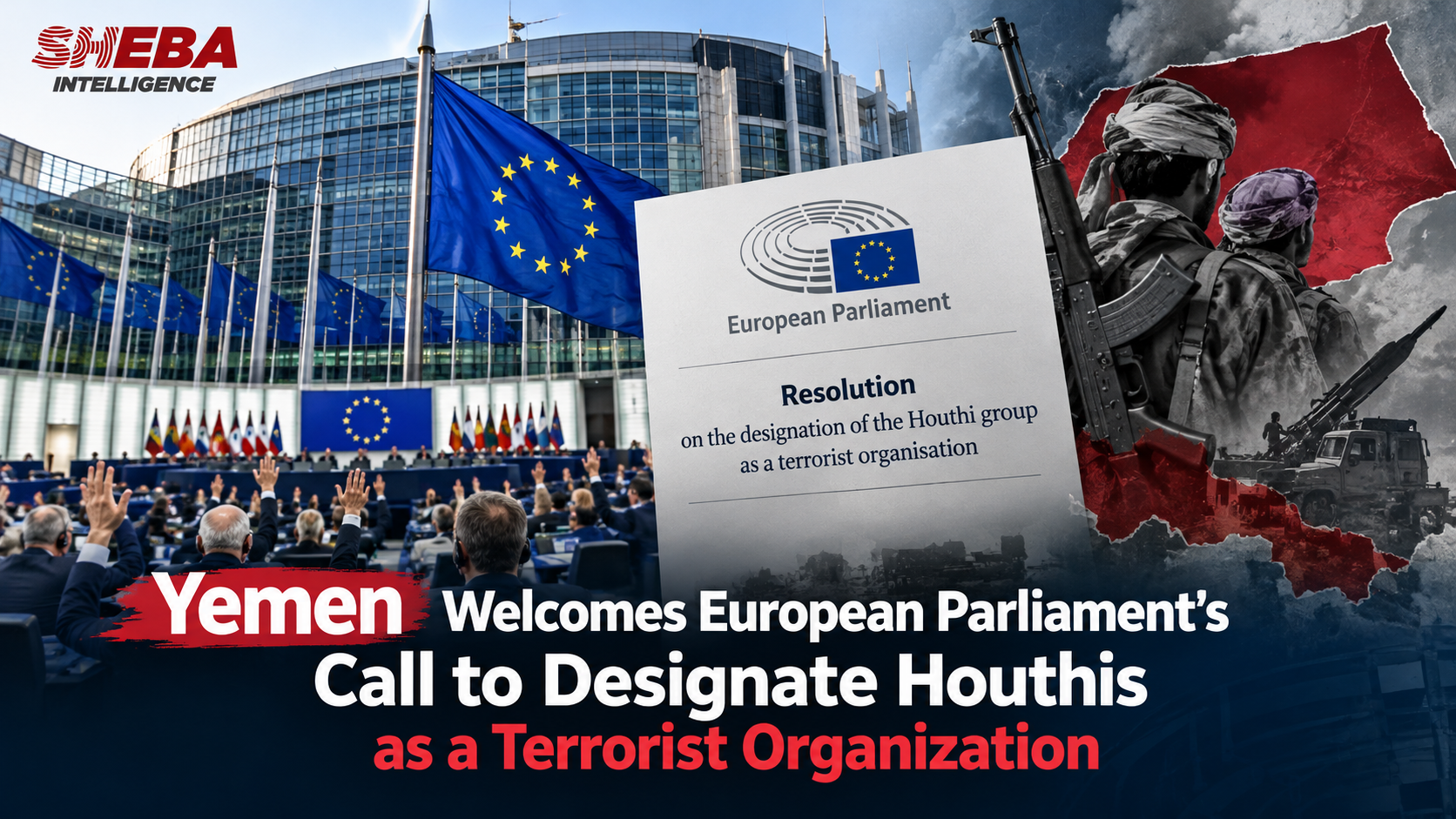
European lawmakers demand asset freezes, action against Houthi financing networks, and stronger maritime security cooperation amid attacks on Saudi Arabia and international shipping.
The Yemeni government has welcomed the European Parliament’s resolution calling for the designation of the Houthi movement, including its political and military wings, as a terrorist organization under European Union law.
Yemen’s Ministry of Foreign Affairs described the move as an important step toward protecting civilians, regional security, and international navigation, while the Yemeni Parliament urged European governments to follow through with concrete measures to disrupt the group’s financial networks and weapons supplies.
In a statement, the Foreign Ministry said the resolution reflected growing European recognition of the threats posed by the Houthis to Yemen, regional stability, and international security.
The ministry also welcomed the European Parliament’s renewed support for Yemen’s internationally recognized government, sovereignty, unity, and territorial integrity.
It expressed hope that the Council of the European Union would respond to the parliamentary resolution by adopting practical measures to halt weapons transfers to the Houthis and dismantle their financing networks.
European Parliament Calls for Comprehensive Designation and Asset Freezes
On Thursday, October 22, the European Parliament adopted a resolution urging the Council of the European Union to designate the Houthis as a terrorist organization, encompassing the movement’s political and military wings, senior leadership, and security and military structures.
The resolution called for freezing financial assets and economic resources linked to the group and entities facilitating its activities, alongside measures to dismantle its financing channels.
European lawmakers condemned Houthi missile and drone attacks against Saudi Arabia, including strikes targeting civilian infrastructure and energy facilities, as well as attacks on commercial vessels in the Red Sea and the Bab al-Mandab Strait.
The Parliament also condemned Iran’s role in supplying the Houthis with weapons, missile and drone technology, training, and financial assistance.
It raised concerns over the group’s coordination with Hezbollah and other Iran-backed armed organizations, linking these relationships to broader regional security threats.
The resolution further called for stronger European maritime and aerial capabilities to protect international shipping and closer security cooperation with Gulf countries.
Yemeni Parliament Urges Europe to Translate Resolution into Action
Yemeni Parliament Speaker Sultan al-Barakani welcomed the European position in a letter addressed to European Parliament President Roberta Metsola.
Al-Barakani said the resolution demonstrated growing European awareness of the dangers posed by the Houthis to Yemen and regional and international security.
He emphasized that Houthi attacks had extended beyond Yemen’s borders, targeting civilian facilities in Saudi Arabia and threatening international maritime trade through the Red Sea and Bab al-Mandab Strait.
According to Al-Barakani, such activities have also affected European economic interests by disrupting shipping routes and increasing risks to global commerce.
He called on European governments to complete the designation process and implement measures aimed at cutting off the group’s financing and weapons supplies.
The Yemeni Parliament Speaker also highlighted violations against civilians inside Yemen, including the prolonged siege of Taiz.
Kaja Kallas: Houthis Employ Terrorist Tactics and Receive Iranian Support
Ahead of the parliamentary vote, EU High Representative for Foreign Affairs and Security Policy Kaja Kallas addressed the European Parliament on October 20, describing Houthi attacks on civilian infrastructure in Saudi Arabia and Yemen as terrorist tactics intended to spread fear among civilian populations.
Kallas referred to attacks targeting King Khalid International Airport in Riyadh, the presidential palace in Aden, and residential areas.
She said the Houthis did not operate independently, pointing to Iranian financial support, military equipment, and training.
The EU foreign policy chief emphasized that adding the Houthis to the European terrorist list would require agreement among all 27 EU member states.
Kallas also reaffirmed European solidarity with Saudi Arabia and Yemen’s internationally recognized government.
She stressed the importance of strengthening the EU’s Operation Aspides to safeguard commercial shipping in the Red Sea, while maintaining humanitarian assistance and diplomatic efforts to support a political settlement in Yemen.
European Lawmakers Call for Tougher Sanctions
During parliamentary discussions, several European lawmakers called for stronger measures against the Houthis, arguing that condemnations alone were insufficient to address the group’s military activities and regional threats.
European Parliament member Hana Jalloul advocated broader sanctions and the inclusion of the Houthis on the EU terrorist list, alongside increased political and financial support for victims of the group’s attacks.
Fellow lawmaker Antonio López-Istúriz White also called for a clear European decision on the designation, arguing that the credibility of the European response was at stake.
The discussions reflected growing pressure within the European Parliament for a more coordinated response combining financial restrictions, maritime security measures, and diplomatic engagement.
European Commentary Highlights Enforcement Challenges
European media coverage has emphasized that the significance of the parliamentary resolution will depend on whether EU member states translate the political recommendation into enforceable legal and financial measures.
Commentary published by EU Today highlighted the importance of targeting financing networks, protecting commercial vessels, and ensuring that restrictions do not obstruct humanitarian assistance to Yemen’s civilian population.
The report noted that the challenge extends beyond adopting a terrorist designation to enforcing financial restrictions and maintaining sufficient maritime capabilities to protect international trade.
Meanwhile, Euronews reported that the resolution had received broad support in the European Parliament through a show-of-hands vote.
However, it emphasized that the resolution is not legally binding and that a formal terrorist designation requires unanimous approval by EU member states.
Such a designation would trigger restrictive measures under the EU’s counterterrorism framework, including asset freezes and prohibitions on making funds or economic resources available to listed entities.
Next Step: Council of the European Union
Following the European Parliament’s vote and the Yemeni government’s response, attention is turning to the Council of the European Union, which holds the authority to approve the proposed terrorist designation.
The parliamentary initiative comes amid escalating military confrontations in Yemen, Houthi attacks against Saudi Arabia, and continued concerns over maritime security in the Red Sea and Bab al-Mandab Strait.
While Yemen’s government and European lawmakers have called for stronger financial and security measures against the Houthis, EU officials have also emphasized the need to maintain humanitarian assistance and diplomatic efforts toward a political settlement.
The proposed designation remains subject to unanimous agreement among the EU’s 27 member states, and no final date has been announced for a decision.
For now, the European Parliament’s resolution marks a formal political call for stronger action, while the legal and financial consequences will depend on subsequent decisions by the Council of the European Union.