Yemen’s Dawn of Yemen Operation: Over 10,465 Strikes as Security Forces Dismantle Houthi Cells
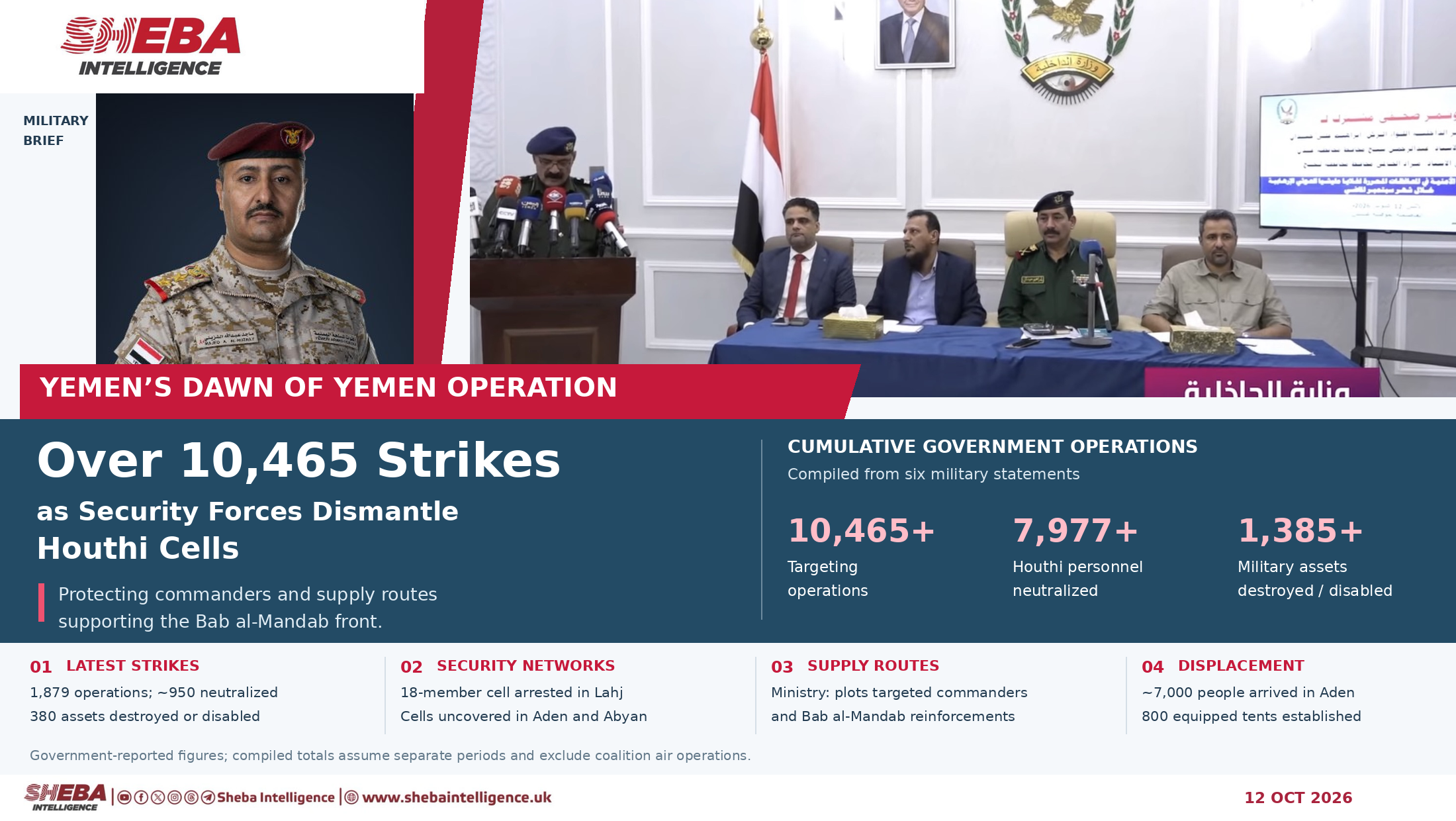
Government forces report nearly 8,000 Houthi fighters neutralized since the offensive began, while security authorities uncover plots targeting military commanders and supply routes to Bab al-Mandab.
Yemeni government forces announced 1,879 new precision strikes against Houthi military positions under the ongoing Dawn of Yemen offensive, reporting approximately 950 fighters neutralized and 380 military vehicles and pieces of equipment destroyed or disabled.
The latest operations coincided with the Interior Ministry's disclosure of several Houthi-linked cells dismantled in Aden, Lahj and Abyan. Authorities said the networks had planned attacks against military and security commanders, troop reinforcements and supply routes supporting the southern and western fronts.
Airstrikes Target Houthi Reinforcements in Taiz
According to the Yemeni Armed Forces, the latest strikes involved combat aircraft, drones, artillery, rocket launchers and sniper units. Targets included defensive fortifications, command-and-control facilities, artillery positions, weapons depots, surveillance posts and military logistics networks.
In Taiz, airstrikes targeted Houthi reinforcement convoys moving toward active frontlines, disrupting troop concentrations and attempts to reorganize defensive positions.
The military reported approximately 950 Houthi personnel neutralized and 380 vehicles and other military assets destroyed or disabled. Engineering units also continued clearing mines and explosive devices from recaptured areas.
Cumulative Military Operations Exceed 10,465 Strikes
Based on six available military statements issued since the launch of Dawn of Yemen on October 4–5, government forces have reported more than 10,465 targeting operations, with over 7,977 Houthi personnel neutralized.
The available figures also indicate that more than 1,385 military vehicles and pieces of equipment have been destroyed or disabled.
These are aggregated figures from the available statements, assuming they cover separate reporting periods, rather than an officially confirmed cumulative total. They exclude coalition air operations reported separately.
The offensive has involved multiple fronts, including Taiz, Marib, Al-Jawf and areas overlooking the Bab al-Mandab Strait, with coalition air support accompanying government ground operations.
Interior Ministry Uncovers Houthi Networks Targeting Bab al-Mandab Supply Lines
In a press conference in Aden, Interior Minister Maj. Gen. Ibrahim Haidan announced the dismantling of several Houthi-linked cells during September, describing internal security as an essential component of the ongoing military offensive.
Among the networks uncovered was an 18-member cell arrested in Lahj on September 26. According to the ministry, the network operated under the supervision of Amjad Khaled Farhan and Ahmed Juraib, whom the Houthis had appointed governor of Lahj.
Investigations indicated that members received specialized training in Saada, Dhamar and Al-Hawban in Taiz, with some courses lasting up to five months. The ministry alleged that Iranian Revolutionary Guard and Lebanese Hezbollah specialists supervised elements of the training.
The network was divided into two operational groups. One monitored military and security commanders and tracked reinforcements heading toward the Bab al-Mandab and Al-Subayha fronts. The second was assigned to plant explosives and attack military convoys, commanders and logistical supply routes.
Authorities also reported dismantling a women's surveillance and recruitment cell in Lahj on September 22, arresting a two-member cell in Lawdar, Abyan, on September 1, and uncovering an explosives-related plot in Aden's Dar Saad district.
Telecommunications Used for Intelligence Gathering
Haidan accused the Houthis of exploiting their control over telecommunications and internet infrastructure to monitor military movements, collect intelligence and support attacks in government-controlled areas.
The ministry said the dismantled networks were intended to disrupt military operations behind the frontlines, particularly by targeting reinforcements and logistical routes connecting Aden and Lahj to the western coastal battlefields.
The allegations point to a parallel security challenge accompanying the ground offensive: protecting military communications, commanders and supply networks from infiltration and sabotage.
Nearly 7,000 Displaced People Arrive in Aden
Aden Governor Abdulrahman Sheikh said escalating fighting in Taiz and Hodeidah had displaced approximately 7,000 people to Aden over a two-week period.
Local authorities established 800 equipped tents in coordination with officials in neighboring Lahj and relevant government agencies, while introducing additional security measures to manage arrivals.
The developments highlight the dual pressures surrounding Dawn of Yemen: expanding military operations against Houthi positions and securing government-held territory against suspected clandestine networks, alongside growing humanitarian needs caused by the fighting.