
Yemen’s Presidential Council Calls for General Mobilization, Sets Sanaa as Final Objective
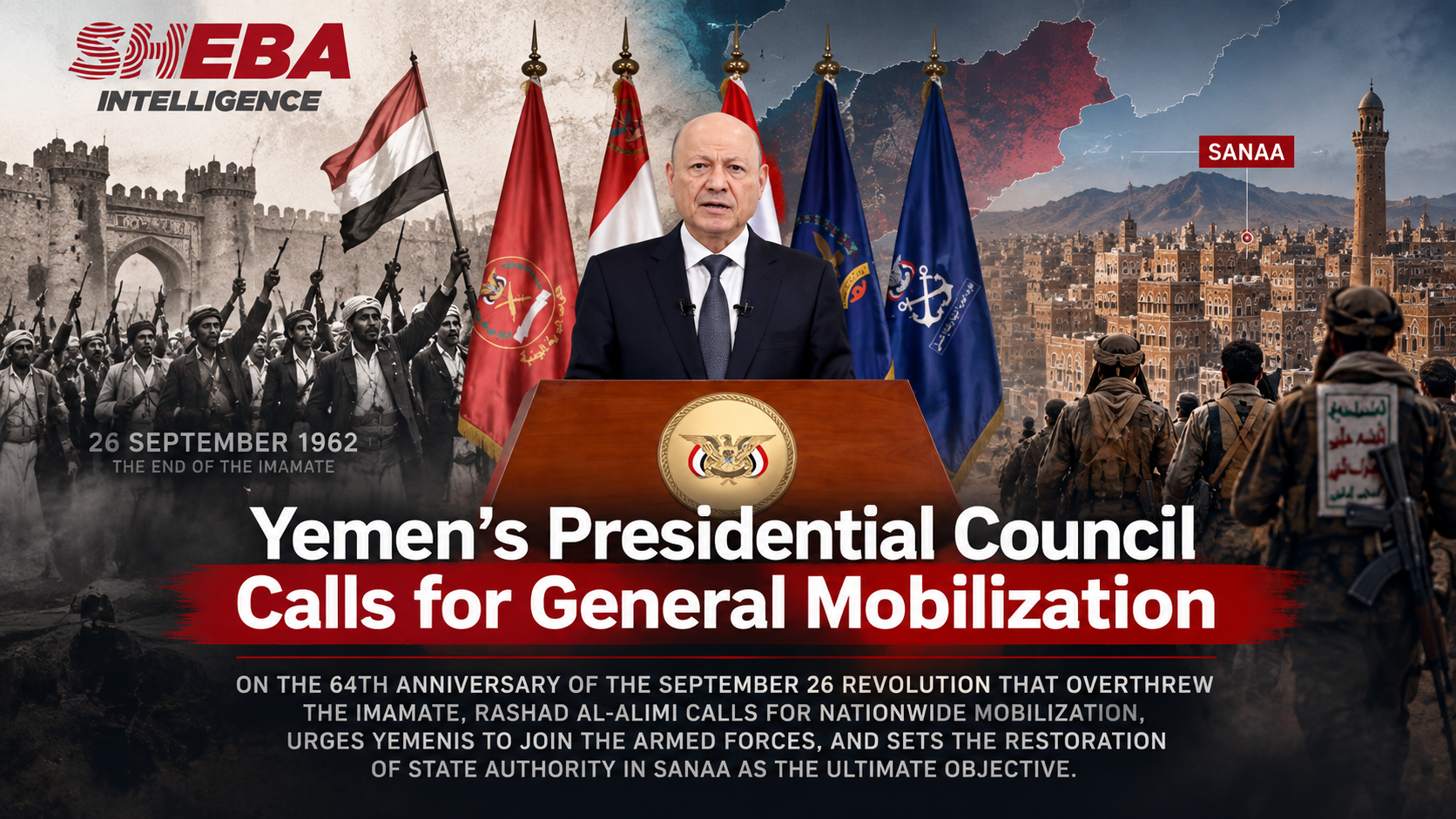
On the 64th anniversary of the September 26 Revolution that overthrew the Imamate, Rashad al-Alimi calls for nationwide mobilization, urges Yemenis to join the armed forces, and sets the restoration of state authority in Sanaa as the ultimate objective.
Yemen’s Presidential Leadership Council Chairman Rashad al-Alimi has called for general mobilization and a national call-up, urging Yemenis to rally behind the armed forces and formally join their ranks, in one of the clearest signals yet that the internationally recognized government is shifting toward a broader wartime footing against the Houthis.
The declaration carries particular significance because it came on the eve of the 64th anniversary of Yemen’s September 26 Revolution, which overthrew the Imamate in northern Yemen in 1962 and established the republican system.
Al-Alimi explicitly framed the current conflict through that historical lens, portraying the confrontation with the Houthis as a renewed struggle between the republican order and a political project rooted in the Imamate-era concept of hereditary and divinely sanctioned rule.
“The goal is clear,” Al-Alimi said: restoring state institutions and extending government sovereignty across the entire country, “all the way to Sanaa.”
From Political Mobilization to Wartime Call-Up
The language of the speech went significantly beyond previous appeals for political unity.
Citing his constitutional responsibilities and decisions of the National Defense Council, Al-Alimi called on Yemenis to join the armed forces and security services through official channels and contribute to what he described as the defense of the republic and its national institutions.
The use of the terms “general mobilization” and “national call-up”, combined with an explicit appeal for citizens to enlist in the armed forces, places the speech firmly in a wartime context.
While Al-Alimi did not formally use the phrase “declaration of war,” the combination of nationwide mobilization, military recruitment, a defined territorial objective and an amnesty offer to fighters willing to abandon the opposing side represents a significant escalation in the government's political and military posture.
September 26: Republic Versus Imamate
The timing was central to Al-Alimi’s message.
The September 26 Revolution of 1962 ended the Imamate in northern Yemen and established the Yemen Arab Republic. Al-Alimi described that revolution as a break between two eras: one in which a ruling group claimed an exclusive right to govern and another based on citizenship, republican government and popular sovereignty.
He then directly connected that history to the present conflict.
Al-Alimi accused the Houthis of reviving a political doctrine based on “divine right” and hereditary privilege, arguing that the group’s rise represented an attempt to reverse the republican transformation that began in September 1962.
He described the current confrontation not simply as a battle for territory, but as a “battle of existence, identity and future.”
The symbolism is therefore difficult to separate from the military message: 64 years after the revolution that overthrew the Imamate, Yemen’s republican leadership used the anniversary to call for nationwide mobilization against a movement it portrays as seeking to restore the political principles of that system.
Amnesty Before a Wider Confrontation
Alongside the mobilization order, Al-Alimi announced what amounts to an exit offer for those currently fighting or working with the Houthis.
He said anyone who leaves the group, stops fighting in its ranks or ceases working on its behalf from the eve of September 26 would be covered by a comprehensive amnesty to be issued under constitutional and legal procedures.
The government also pledged to settle the status of military and security personnel who return, while preserving legally acquired employment rights.
The simultaneous announcement of mobilization on one side and amnesty on the other gives the speech the characteristics of a political and military ultimatum: expanding the government's manpower base while offering members of the opposing camp an opportunity to defect before the confrontation potentially widens.
Sanaa Named as the Objective
Perhaps the most consequential part of the speech was Al-Alimi’s unusually explicit definition of the end goal.
He said temporary advances, retreats or changes in front lines would not alter the government's objective: restoring state institutions and sovereignty across Yemen, culminating in Sanaa.
The statement comes amid intensified fighting across several fronts, including Taiz, Marib, Al-Jawf, Hodeidah, Lahj, Al-Bayda, Shabwa and Al-Dhale, while the western coast and the approaches to Bab al-Mandab have emerged as a central theater of the latest escalation.
Al-Alimi also appealed to Saudi Arabia, coalition members and other international partners to support the government and its armed forces, linking the restoration of state authority to the security of Yemen, the Red Sea and the wider region.
Taken together, the speech marks a notable departure from the language that dominated years of stalled peace efforts.
It does not constitute a formal declaration of war in the conventional legal sense. Politically and militarily, however, the call for general mobilization, national enlistment, defections from Houthi ranks and the explicit designation of Sanaa as the ultimate objective signals that Yemen’s presidential leadership is preparing the public for a potentially broader phase of the war.