Iran Plans Military Offensive to Retake and Close Bab al-Mandab Amid Fears of US Strikes
Intelligence sources reveal to Sheba Intelligence a three-pronged military plan involving simultaneous operations, as Houthi missile attacks intensify in Aden and concerns grow over the potential use of naval mines to disrupt international shipping.
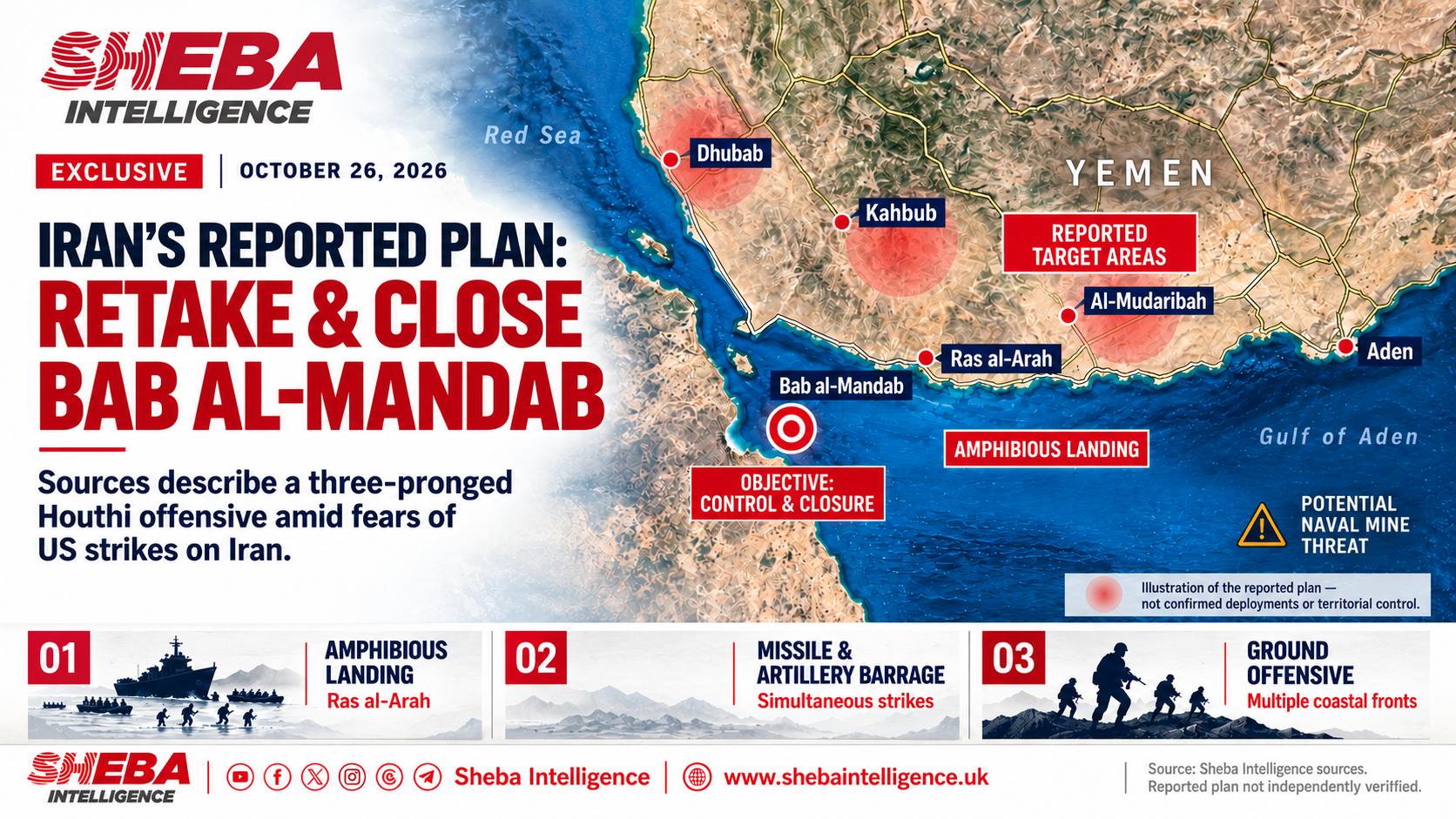
Intelligence sources have revealed to Sheba Intelligence that Iran's Islamic Revolutionary Guard Corps (IRGC) has developed a military plan to retake control of the strategic Bab al-Mandab Strait and surrounding coastal areas through the Houthis, amid growing Iranian concerns over a potential US military operation against Tehran.
According to the sources, Iranian officials are racing against time to implement the plan, pressuring their military advisers in Yemen and Houthi commanders to accelerate preparations.
The objective is to regain control of the strait and close it to maritime traffic, potentially disrupting the movement of military support through the Red Sea while increasing the economic and military costs of any US operation against Iran. Tehran reportedly views control of the strategic waterway as a means of pressuring Washington to halt or abandon such an operation.
Three Simultaneous Military Operations
Sheba Intelligence has obtained details of three main components of the military plan that the IRGC reportedly intends to carry out through Houthi forces around Bab al-Mandab and Yemen's western coastline.
First Operation: Surprise Amphibious Landing
The first operation involves a nighttime amphibious landing targeting the Ras al-Arah area in Lahj governorate, rather than Mayyun Island or the strait itself.
According to the sources, the operation aims to seize positions in Al-Mudaribah district and disrupt Yemeni government forces deployed in the area.
The sources said substantial infantry reinforcements and coast guard vessels have been prepared for the planned assault.
Second Operation: Intensive Missile and Artillery Barrage
The second operation involves launching intensive missile and artillery strikes simultaneously with the amphibious landing.
The bombardment is reportedly intended to disrupt government defensive positions and complicate their response to multiple attacks.
Third Operation: Large-Scale Ground Offensive
The third component consists of a major ground offensive across several fronts, involving successive waves of Houthi fighters and attempts to penetrate and outflank government defensive lines.
According to the intelligence sources, the operation seeks to exploit potential defensive breakdowns, achieve territorial advances, and encircle Yemeni army units stationed in Ras al-Arah, Al-Mudaribah and Kahbub in Lahj governorate, as well as Dhubab and other coastal areas overlooking the Red Sea in Taiz governorate.
Naval Mines Among Potential Options for Closing the Strait
Reports that the Houthis have prepared substantial quantities of naval mines raise the possibility that these weapons could be used as part of efforts to close Bab al-Mandab and disrupt commercial shipping, even without establishing complete military control over the strait.
If linked to the newly revealed plan, such preparations could indicate that closing Bab al-Mandab is being considered as a practical military option rather than merely a political threat.
The threat of naval mines alone could significantly increase maritime security risks and insurance premiums, potentially prompting shipping companies to avoid the strait and thereby advancing the economic pressure objectives attributed to Iran's strategy.
However, a direct connection between the reported mine preparations and the newly disclosed military plan has not been independently established.
Missile Escalation in Aden Coincides With Bab al-Mandab Preparations
The disclosure comes amid intensified Houthi missile attacks targeting military and security facilities and critical infrastructure in Yemen's interim capital, Aden, including the city's airport, the port of Al-Tawahi and coast guard facilities.
In the latest incident, two missiles launched by the Houthis landed near camps for internally displaced persons in the Salah al-Din area west of Aden, according to the corrected official account, raising concerns over the safety of civilians and displaced families.
The repeated missile attacks on Aden and its surrounding areas, coinciding with intelligence reports of preparations for an offensive around Bab al-Mandab, raise questions about whether the escalation could be part of a broader effort to disrupt government forces ahead of the planned operation.
Such attacks could potentially divert military resources, disrupt command structures and complicate the deployment of reinforcements toward Yemen's western coastal fronts.
Nevertheless, a direct operational connection between the missile strikes and the alleged IRGC plan has not been independently confirmed.
Bab al-Mandab as an Iranian Pressure Lever Against Washington
The newly obtained intelligence carries significant strategic implications given Bab al-Mandab's position as a vital maritime chokepoint connecting the Red Sea to the Gulf of Aden and serving as a major route for international trade moving through the Suez Canal.
According to the sources, Iran's objectives extend beyond securing territorial gains in Yemen to transforming Bab al-Mandab into a strategic pressure lever against the United States.
Closing the strait or disrupting maritime traffic could interfere with international trade, drive up shipping and insurance costs, and broaden the economic and security consequences of any potential military confrontation involving Iran.
The sources indicate that the reported plan combines an attempt to regain military control over territory overlooking the strait with the threat of disrupting international navigation, as part of a broader Iranian effort to increase the potential costs of a confrontation with Washington.
Sheba Intelligence has not independently verified the planned operation's timetable or the extent to which the reported Houthi military preparations have been completed.